How I Used Ospho to Stop Rust on a Working Tug

One of my first real seafaring jobs involved a quick, hands-on rehabilitation of a small tug used to push propane barges from a Mississippi River port down to a terminal in Corpus Christi, Texas. As a deckhand on that welded-steel workboat, I learned to manage long tows and lock passages, but I also learned that routine maintenance and corrosion control are part of the job. Keeping the boat presentable was an ongoing task—especially when rust showed up.
When rust began to appear on rails, stanchions or bases, our crew adopted a straightforward, fast process: grind away loose scale, apply a rust-converting product called Ospho, then follow with primer and paint where needed. It was far from a luxury refit, but it worked. Within months the tug looked markedly better; people on other vessels even radioed to compliment how tidy the boat appeared.
What Ospho Is and Why It Works
Ospho is a liquid rust converter that contains phosphoric acid. In simple terms, when you apply it to iron oxide (rust), it reacts to form iron phosphate—a hard, inert, dark material that helps inhibit further corrosion. The product is clear and watery, easy to apply with a brush or spray, and it typically dries to a stable surface you can paint over the next day. It’s not a miracle cure for structural issues, but it’s an efficient way to stabilize rust and avoid endless scraping and wire-brushing.
How I Use Ospho on Board
My technique is deliberately low-tech and practical. I use a disposable 2-inch brush and repeatedly wet it with Ospho, carefully dabbing the rusted area on stanchion bases, ladder supports, and rails. If adjacent surfaces are covered with modern two- or three-part marine paint, I tape them off first to prevent any accidental splashes. Although Ospho is relatively mild compared with stronger acids, protecting a good paint finish avoids unnecessary cosmetic damage.
On many boats you’ll see rust streaks on otherwise stainless hardware. Often this happens because builders used lower-grade fasteners—304 stainless screws or even plain steel—on fittings that are 316 stainless. The dissimilar metals or inferior screws will corrode and leave unsightly stains on stanchions and bases. Applying Ospho to those streaks converts the rust so the staining won’t continue to worsen, then you can decide whether to touch up paint or accept the darker iron-phosphate finish.
Practical Tips and Expectations
- Prep the area by removing loose scale and degreasing if necessary; good contact with the rusted surface improves results.
- Protect adjacent painted or gelcoat surfaces with tape and masking to avoid contamination.
- Allow the treated area to dry thoroughly—typically overnight—before painting or reassembly.
- Be realistic: the converted surface often looks dark or slightly blackened up close. It stabilizes the metal and improves appearance, but it won’t restore a pristine, mirror-polished finish.
For routine maintenance on commercial or recreational boats, Ospho saves time and effort. It’s particularly useful for spot treatments where a full replacement of hardware isn’t practical right away. In my experience it’s an effective, time-saving product that keeps working boats serviceable and presentable without demanding hours of elbow grease.
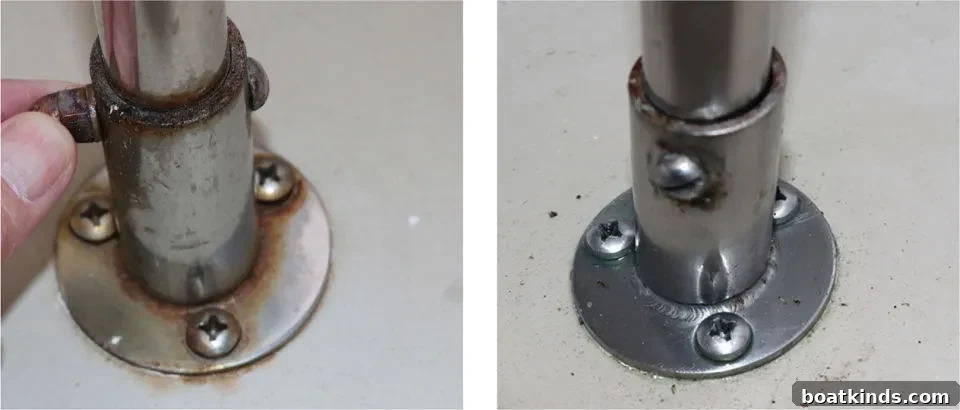
The finish isn’t show-boat perfect, but for a working tug or a busy cruising boat I’d rather have something that’s durable and quick to apply. Ospho gives a reliable stopgap against progressive rust and lets you prioritize repairs when time and budget allow.
This advice previously ran in Power & Motoryacht magazine.