
Essential Knots and Seamanship Habits Every Boater Should Master
I learned to tie knots the hard way as a young crewmember on a two-person delivery. The captain asked for a rolling hitch and I responded with rolling eyes. He drilled me until I could perform bowlines behind my back and wrap clove hitches on everything in sight. For a week I repeated tensioning and easing lashings with rolling hitches until the motions became automatic. By the end of the trip I could reach around the back of a piling and throw a bowline as easily as tying my shoes. That repetition is the secret: knot tying must become second nature.
This is not a step-by-step knot-tying guide but a case for using the right knot and maintaining consistent habits aboard. Experienced mariners know that proper knots and tidy line handling create an unspoken language on deck. When everyone rigs and secures lines the same way, teamwork improves and stressful moments are easier to manage. In a dark or tense situation, discovering a well-tied, easily released knot can make all the difference.
Why the Right Knot Matters
Choosing the appropriate knot is about safety, efficiency, and predictability. The correct knot holds under load yet releases reliably when needed. A well-tied knot can be identified by touch even without sight, and in a challenging docking or sail-handling situation, being able to respond instantly to a call for a bowline or rolling hitch builds trust and respect among crew.
You don’t need to learn every knot in existence. A compact repertoire will cover most onboard needs: hitches (half hitch, clove hitch, rolling hitch) for fastening lines to objects; the square knot and sheet bend for joining two ends; a figure-eight or stopper knot to keep a line from running out; and the bowline for a dependable, non-jamming loop. Mastering these essentials gives you the tools for nearly any situation and keeps procedures consistent across the team.
Coiling, Cleats, and Organized Line Handling
Lines and knots are part of an organized system. Coiling three-strand line clockwise and looping braided line in figure-eights trains each rope to feed out smoothly without kinks or tangles. Neat coils look good, but more importantly they function well and reduce delays when you need line quickly.
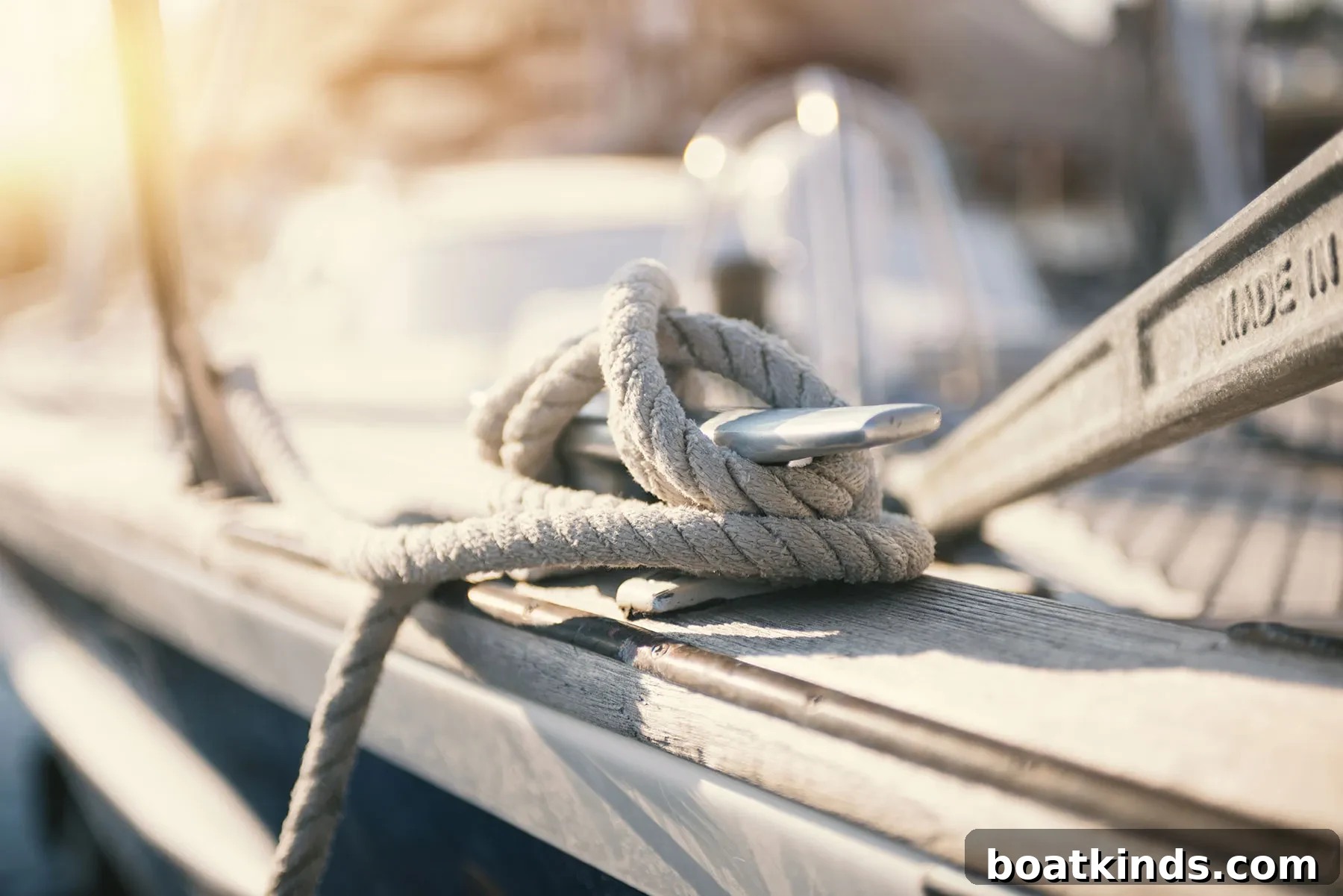
Cleat technique is equally important. Lead a line once around the base of the far horn to transfer the load to the cleat’s mounting point, then make figure-eights from horn to horn. Finish with a twist to form a locking underhand hitch for a secure hold. On sailboats, use the locking hitch on halyard cleats but omit it on sheet cleats, where an extra figure-eight or two allows a rapid release when the sail must be eased suddenly.
Practical Tips for Learning Knots
Knot-tying is a hand-to-eye coordination skill. Develop the habit of dedicating one hand to hold the standing part of the line while the other hand shapes the working end. For right-handed people, hold the standing end with the left hand and manipulate the working end with the right. This approach keeps the mental picture of the knot stable while building the physical pattern. With practice, the knot becomes fixed in your mind’s eye and your hands will find the right path automatically.
The Ashley Book of Knots remains a classic reference, but modern resources make learning more interactive. Online videos, including slow-motion tutorials on YouTube and animated demonstrations at animatedknots.com, are excellent supplements for visual learners.
Advanced Uses and Onboard Tricks
Knots and lines are applied not only by sailors but by riggers, cargo handlers, and climbers; they all exploit friction, vectors of force, and mechanical advantage. In racing or heavy-weather sailing, improvised stopper methods can spare a sail shape or winch. For example, a short length of rough Dacron used as a stopper, woven back and forth up a loaded sheet and finished with a rolling hitch, can transfer load long enough to adjust a fairlead without changing sail trim.
Onboard, slippery hitches are practical when conditions are cold and wet. If you use a draw loop on the last turn of a clove or rolling hitch, the line releases with a gentle tug. That quick-release feature is ideal for fender lines and looped sail ties, and your shipmates will appreciate how much easier routine tasks become.
Conclusion: Habit, Pride, and Crew Safety
Good seamanship is largely habit. Properly coiled lines behave, cleats loaded correctly are less likely to fail, and the right knot will hold under strain yet be simple to undo. Invest time in practice early on so knot skills become automatic. Do it for your own confidence, for the safety and efficiency of the boat, and out of respect for your shipmates. When everyone observes consistent knotting and line-handling standards, the crew operates more smoothly and there’s a lot less cursing on deck.
This article was originally published in the February 2021 issue.