
Boat-A-Cade, Apalachicola — April 1955: How Trailerable Boats Changed American Boating
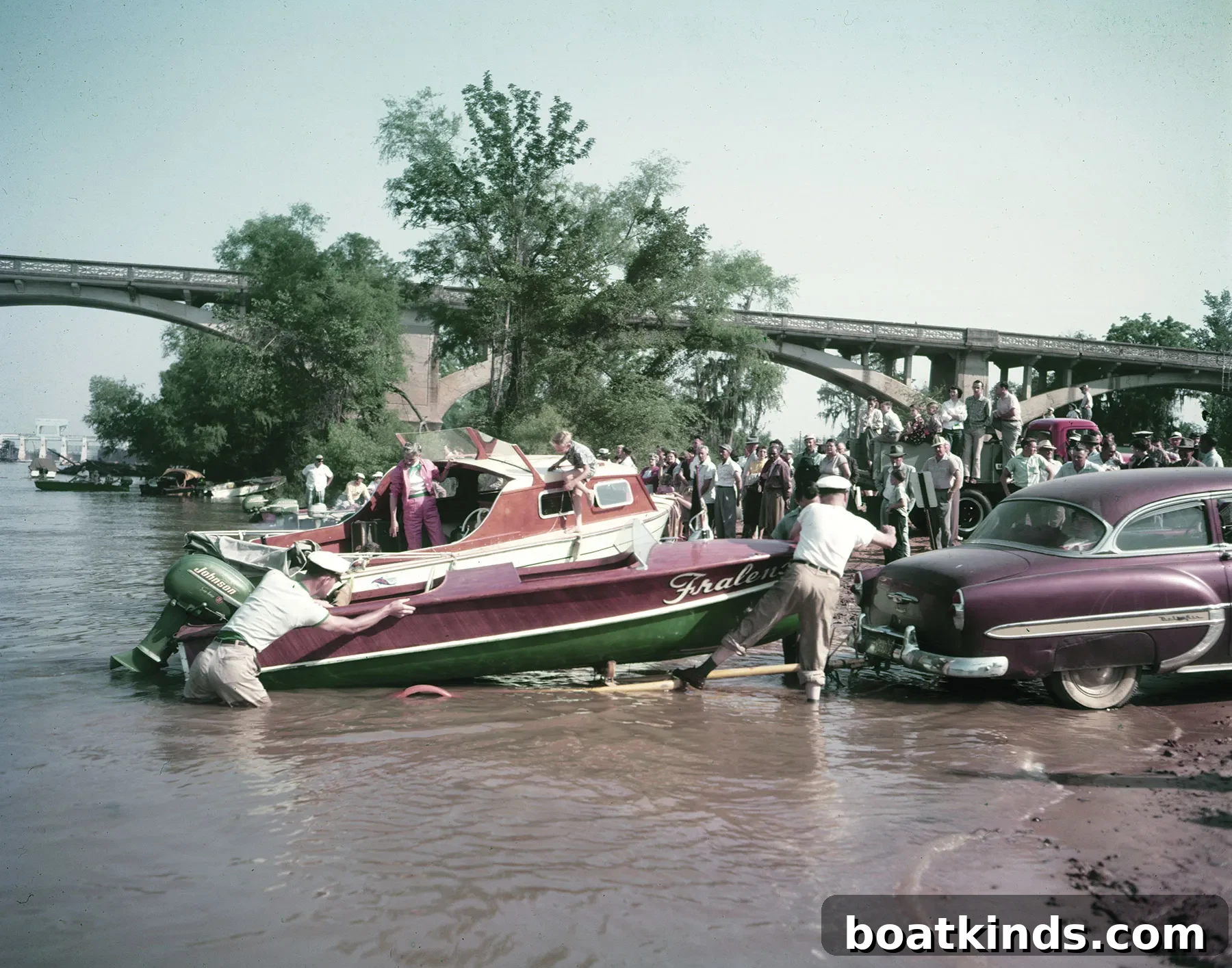
In April 1955 the community around Apalachicola, Florida, marked the start of a new boating season with a Boat-A-Cade, a spirited procession of boats traveling together along the Chattahoochee River. The photograph captures a moment of everyday effort and local pageantry: a small wooden runabout with a 25-hp Johnson Seahorse outboard is being maneuvered onto a trailer while a crowd looks on. A Chevrolet Bel Air is backed into the makeshift launch area, its rear wheels close to the water as two men work to secure the boat. One man ends up with wet pants at the stern, the other has rolled up his trousers to stay dry at the car’s rear — a candid slice of midcentury boating life.
The scene illustrates a broader shift in American recreation during the 1950s: the arrival of the trailerable boat as a common, practical way for families to transport watercraft. After World War II, boating enjoyed a surge in popularity as Americans embraced outdoor leisure and had increased access to automobiles. As demand for small boats grew, so did the market for boat trailers. Trailer sales rose dramatically — from roughly 1,000 units in 1939 to more than 90,000 by 1954 — enabling boat owners to explore waterways beyond their local lakes and rivers. The basic appeal was simple: wherever a car could go, a boat could follow.
Design Innovations and Industry Growth
Trailer manufacturers responded quickly with innovations that made launching and loading easier and safer. Towable options incorporated features such as rollers to guide hulls into position, tilting tongues to reduce the angle at launch ramps, and winches to pull boats securely onto cradles. These user-friendly advances made the trailer a practical solution for weekend boaters and families who wanted the freedom to trailer craft to different destinations.
One notable example is the Tee-Nee Trailer Co., which transitioned from producing military trailers to building trailers for the recreational market. Tee-Nee’s business expanded rapidly — from about 5,000 trailers in the late 1940s to 168,000 by 1959 — and the company became known for its bright yellow finish and its Tip-N-Turn tilting system that simplified launching. By the mid-1950s Tee-Nee’s catalog offered multiple models, with capacities stretching from 400 to 3,400 pounds. Other manufacturers such as Holsclaw and Arnholt, both based in Indiana, also supplied a growing fleet of trailers to meet diverse needs. As small boats grew larger and cabin cruisers became more common, trailer makers developed models capable of handling boats up to about 28 feet long.
The Cultural Impact of Trailering
Trailerable boats reshaped how Americans thought about boating. The combination of a car and trailer extended recreational boundaries and allowed families to plan multi-destination outings. Trailering supported the rise of boating clubs, regattas, and community events like the Boat-A-Cade, where boats could convene at different launch points and enjoy a shared day on the water. Publications of the time recognized the trend’s significance; a March 1954 piece in Sports Afield captured the sentiment succinctly: “There is nothing more responsible for the boom in watercraft than the modern lightweight boat trailer.”
The photograph from Apalachicola is emblematic of that era — a practical, slightly chaotic moment that tells a larger story about innovation, leisure, and mobility. It shows how modest engineering improvements and the increasing availability of automobiles combined to make boating more accessible. Whether towing a small runabout for a day on the river or hauling a larger cruiser for an extended trip, motorists found new freedom in the ability to bring boats to new waters.
This article was originally published in the May 2021 issue.