Restoring a 1986 Grand Banks 32: Deck, Plumbing and Electronics on Snow Goose
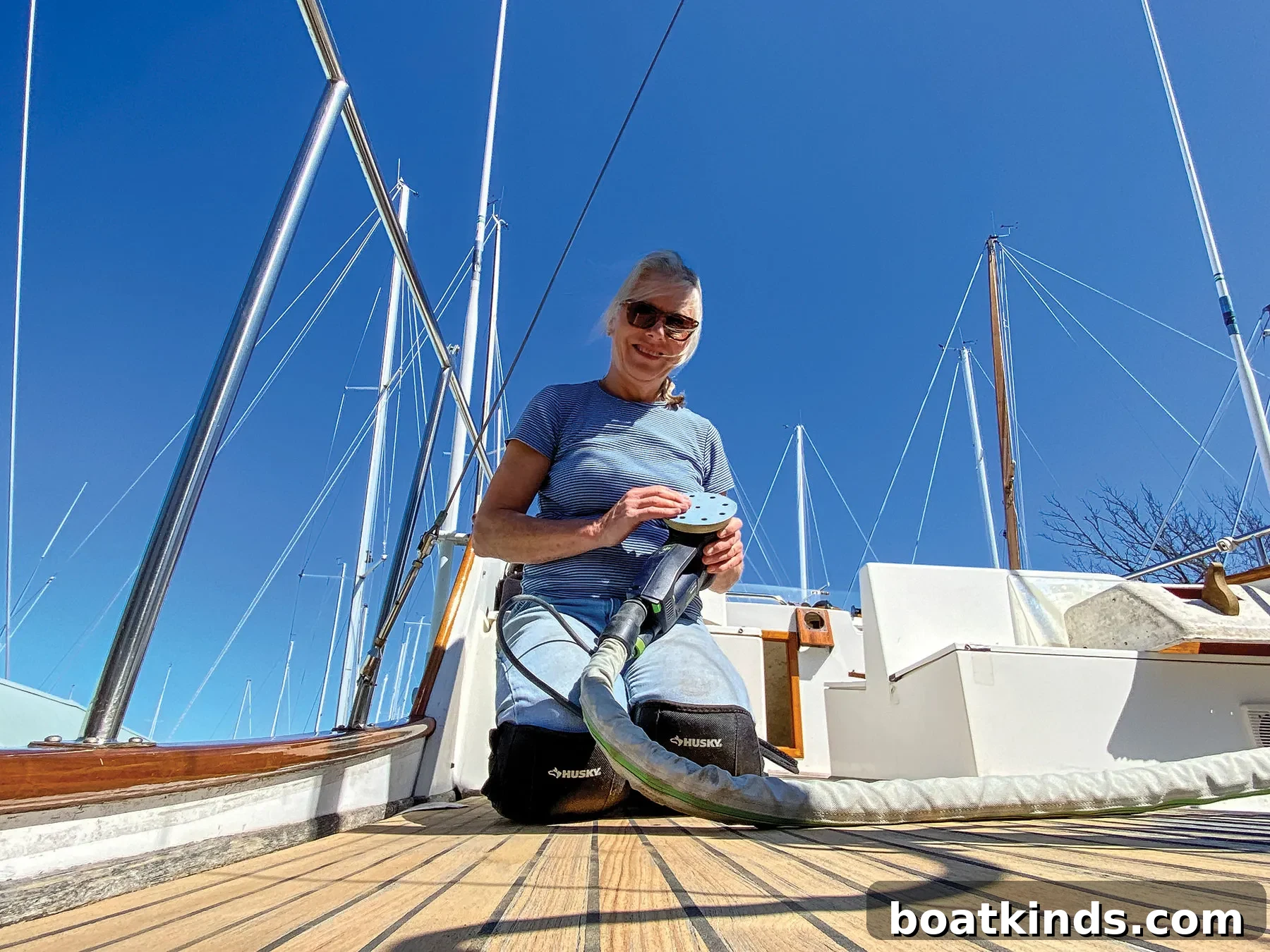
Onne and Tenley van der Wal set out to have their 1986 Grand Banks 32, Snow Goose, ready for the Northeast boating season. With a tight timeline and a long task list, Tenley asked what she could do to help move the project along. When Onne suggested sanding the deck, Tenley—who had substantial experience sanding floors in their homes—volunteered immediately.
After 35 years exposed to foot traffic and weather, the teak decking had become worn and dulled. Onne wanted to lower the black caulking slightly and remove just enough of the weathered surface to reveal fresher teak beneath. The teak on Snow Goose is generous—nearly half an inch thick—so there was ample material to work with.
Tenley tackled the sanding with a Festool sander that automatically activated the dust vacuum and 60-grit sanding discs. She sanded the entire top deck over the course of a day. “She worked all day and by evening she was exhausted,” Onne recalls. The work was physically demanding but effective.
Before buying the boat, Onne had consulted his surveyor, who confirmed the teak had been epoxied to the fiberglass. The surveyor advised that if sanding exposed any screw heads, the screws could be removed and not replaced. When sanding revealed screws or shallow plugs, Onne removed the Phillips-head screws, deepened the bung holes slightly and prepared to fit new bungs so the glued plugs would have solid material to bond to.
Onne made new bungs from a quality piece of teak purchased at Newport Nautical. He applied TotalBoat Thixo epoxy in the bung holes to keep the interior clean and provide a consistent bond, then drove each bung in with a couple of light hammer taps. After letting the epoxy cure for 24 hours, he trimmed the protruding ends with a sharp chisel and sanded the bungs flush with the deck. The end result was a refreshed teak surface that, according to Onne, “came out beautifully.”
Inside the boat, the galley and head faucets and sinks were dated. Tenley preferred single-lever mixing valves for a cleaner look and chose Italian-made Elka faucets distributed by Scandvik. To access the plumbing beneath the galley faucet, Onne removed the sink to reach the pipe junctions and nuts—standard practice when replacing fixtures.
The new faucet’s flexible hose and the old supply line both had female fittings, so Onne sourced a male pipe nipple at Jamestown Hardware to mate the two. He admits he was nervous about matching thread sizes, but the first fitting he tried worked, and the plumbing came together smoothly.
To conceal the holes left by the old faucet, Onne fabricated a small cover from King Starboard, a machinable marine plastic he prefers for small projects. He cut the profile on a bandsaw, eased the edges on a router table and drilled the new faucet hole on a drill press. After dry-fitting the components to ensure everything aligned, he sealed the new installation with TotalBoat Seal, an elastomeric marine sealant he praised for its reusability and ease of application.
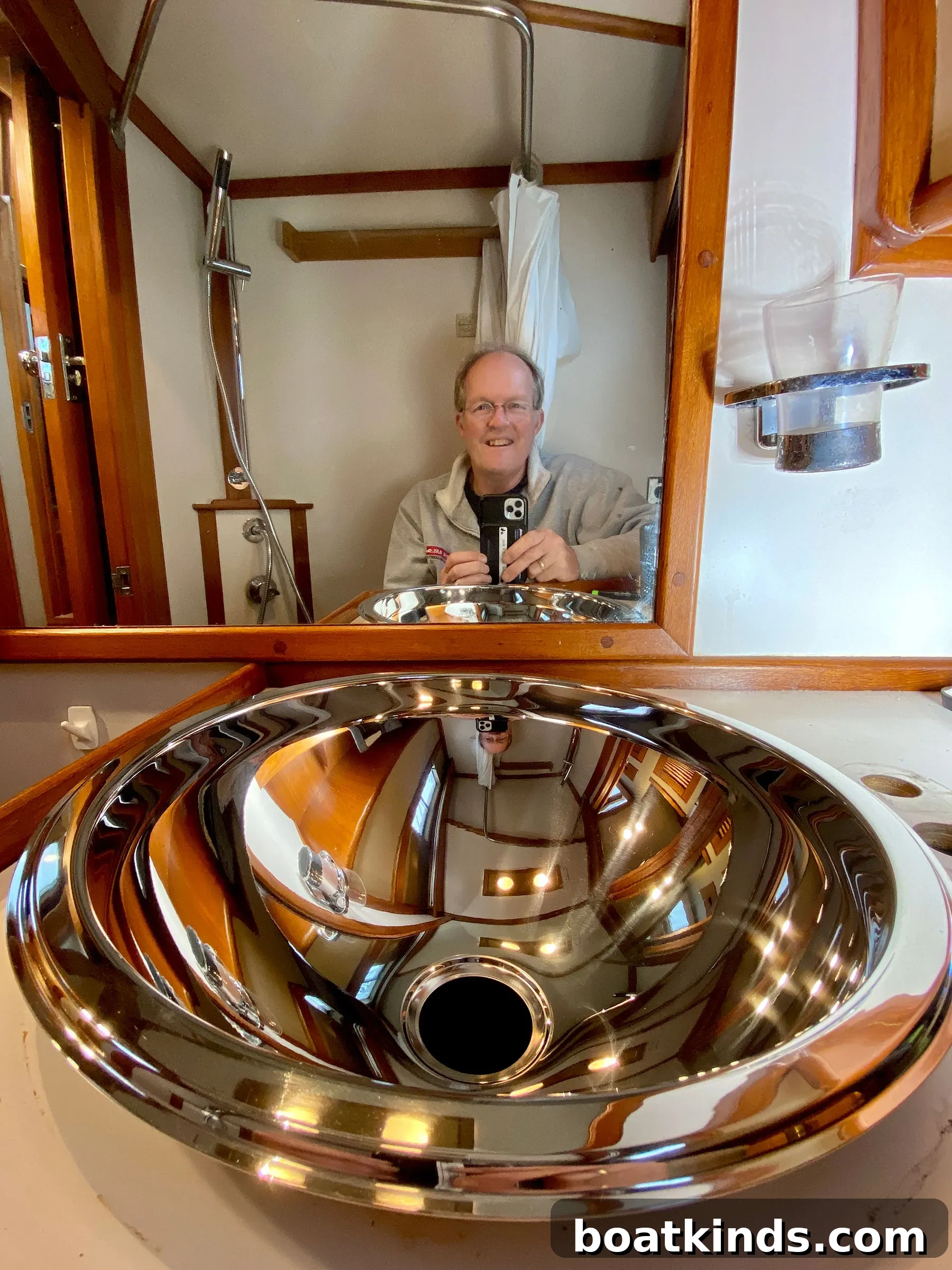
Onne cleaned the galley sink in his workshop using a wire-brush wheel on his bench grinder to remove grime from the edges, followed by TotalBoat rubbing compound to scour and polish the basin. The compound left a bright shine once dry. For the head, rust around the old drain prompted him to replace the basin entirely; he enlarged the counter opening with a router to accept a slightly larger replacement sink.
He also installed a matching Elka showerhead with a rail. The valve control trim was tired, so he buffed the original pieces on a bench grinder to restore their luster. For the valve stems themselves, which looked worn, Onne improvised sleeves from aluminum tubing. After cutting the tubing to length and adding a small slit to allow expansion, he slipped the pieces over the stems and rotated them so the slit faced downward and out of sight. The result: a clean, unified look for the entire shower head assembly.
Modernizing the boat’s electronics required a larger breaker panel. The original console panel had only three, unreliable switches and could not support the newer equipment. Onne chose a Blue Sea Systems DC 8 Position Circuit Breaker Panel and enlarged the console opening with a jigsaw. To avoid cutting into structural wood, he offset the new panel slightly, which left portions of the previous opening exposed.
For the electrical work he welcomed guidance from experienced marine electricians. Rufus van Gruisen of Cay Electronics and technician Adam Hobgood provided wiring advice. Adam drew a schematic for Onne, and Rufus produced a backing plate on a CNC router from a template Onne supplied, neatly covering the old opening behind the new breaker panel.
Onne also updated a dated 12-volt cigarette lighter receptacle with a modern 12-volt USB outlet. After sending a photo of the console to Rufus, Onne received two replacement switches to modernize the windshield wiper and horn controls—small blue-ring illuminated switches that suit the refreshed helm. He finished the electrical upgrades by installing a new horn that delivers a deep, powerful sound befitting a classic trawler.
This article was originally published in the June 2021 issue.