
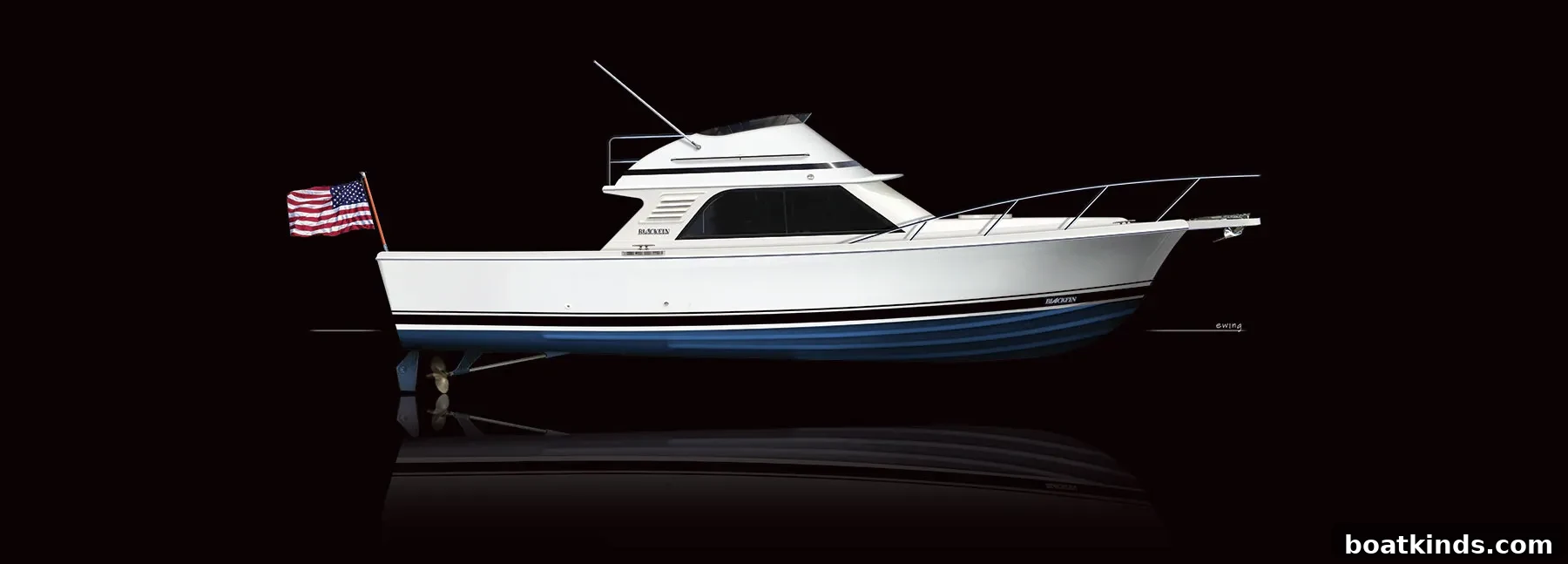
Blackfin 33 Combi: A Compact Offshore Fisherman’s Classic
Carl Herndon began his career at Bertram Yachts in the 1960s, at a moment when the Bertram 31 and its revolutionary deep-V hull were reshaping small-craft design. In 1973 Herndon left Bertram to found Blackfin Yacht Corp. in Fort Lauderdale, Florida, determined to refine the deep-V concept. He collaborated with designer Carl Jannace to develop hull features that would improve seaworthiness, ride comfort and fishing performance in a smaller, more manageable package.
The earliest Blackfin designs resulted in a 29-foot model that expanded on the deep-V philosophy. That hull combined a sharp entry with broad strakes and pronounced chines to generate lift and stability while the deadrise eased aft to roughly 21–22 degrees at the transom. With a relatively low freeboard and a low center of gravity, the boat delivered a notably dry ride and confident handling in head seas—qualities that quickly attracted serious anglers and offshore boaters alike.
Building on that success, Blackfin introduced the 33 Combi in 1993. Purpose-built for offshore fishing, the 33 Combi retained the rugged, weather-taming characteristics of an offshore hull while offering practical cruising comforts. It was conceived as a true fishing platform first, with accommodations and features that made it equally capable for nearshore cruising and weekend trips with family.
Major updates to the 33 Combi arrived in 1996 and again in 1998. Construction centered on a solid fiberglass hull with cored topsides and decking for a balance of strength and weight savings—typical choices for builders aiming to combine durability and performance. While early Blackfins were sometimes gasoline-powered, later examples more commonly featured diesel propulsion. Twin 430-hp Volvo engines were a frequently specified package, enabling the roughly 20,000-pound boat to cruise in the 20–25 knot range, with a substantial 340-gallon fuel capacity for extended runs offshore.
The deck and interior layout emphasized both helm control and practical live-aboard comforts. The bridgedeck placed a centerline helm station beneath a protective hardtop, with lounge seating opposite for guests or crew. Down below, the open-plan cabin slept four in simple but functional accommodations: a forward V-berth and an aft dinette that converted to additional sleeping space. The compact galley included a two-burner cooktop, microwave and refrigerator, and an enclosed head completed the layout for overnight trips.
Despite those cruising features, fishing remained the 33 Combi’s primary mission. The roomy cockpit was arranged for angling efficiency, with insulated fish and storage boxes, a raw-water washdown, a transom door and gate for easy access to the swim platform, a livewell and a dedicated tackle center. Rod holders mounted in the gunwales and a thoughtful, uncluttered deck plan made it straightforward to work lines and land fish safely in less-than-ideal conditions.
After the 1998 season Blackfin redesigned the model as the Blackfin 332, refining lines, systems and layout details while preserving the core attributes—solid construction, seaworthy deep-V hull design and fishability—that owners had come to expect. The model line has continued in production, with Blackfin Yachts building boats in Willston, Florida, and the 33 Combi and its successor remaining popular among anglers who need a capable offshore boat that can double as a comfortable cruiser.
The Blackfin 33 Combi’s enduring appeal lies in its blend of offshore capability and practical features. Its hull design offers confident handling in chop, its cockpit supports serious fishing operations, and its accommodations are straightforward and usable for overnight trips. For anglers seeking a compact but capable offshore fishing boat, the Blackfin 33 Combi—and the later Blackfin 332—represent a well-proven balance of performance, durability and comfort.
This article was originally published in the July 2021 issue.