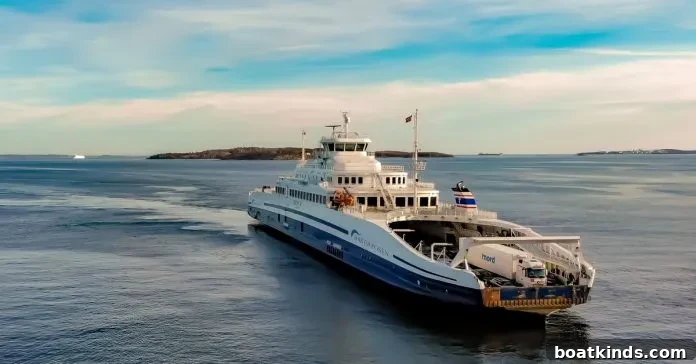
Bastø Electric: The World’s Largest Electric Ferry Now in Service in Norway
If you thought large vessels couldn’t go electric, think again. Earlier this year the Norwegian government put into service what is currently described as the world’s largest electric ferry, marking a significant milestone for battery-powered shipping.
Key specifications
The ferry, named Bastø Electric, is 457 feet long and operates across the Oslo Fjord. It is capable of making 20 to 24 crossings of the 5.67-mile route each day, carrying up to 200 cars and 600 passengers on each trip. With a top speed of 13 knots, the vessel has been designed to meet the daily rhythm of a busy ferry route while relying on battery propulsion rather than traditional diesel engines.
Operational profile and scheduling
Bastø Electric is intended for frequent, short-to-medium distance crossings, which suits battery operation well. The ferry’s schedule of multiple round trips per day demonstrates how electric propulsion can be integrated into high-utilization ferry services. The vessel’s operational profile emphasizes rapid turnarounds and predictable departure times, allowing charging windows to be incorporated into overnight and short port stays.
Charging system and infrastructure
Charging is an essential part of the ferry’s daily routine. Bastø Electric is recharged using a high-capacity cable each night; the cable’s thickness has been described as comparable to the girth of a human being, highlighting the substantial power transfer required to replenish such large batteries between operating shifts. Rapid, reliable shore charging infrastructure is a critical enabler for battery-electric ferries, and the ferry’s deployment illustrates how port-side electrical systems and vessel design must work together.
Norway’s experience with electric ferries
Norway has been experimenting with and deploying electric ferries for more than five years, and the country has used smaller battery ferries on various routes. The arrival of a much larger vessel like Bastø Electric builds on that experience and shows scalability in practice. Norway’s geography, with many short, regular ferry crossings, has made it an early adopter of electric technology in marine transport, and lessons learned there are now informing larger projects.
Benefits and broader significance
Electric ferries offer several practical advantages: quieter operation, reduced local air pollution, and the potential for lower operating emissions when charged with low-carbon electricity. For communities that rely on regular ferry links, replacing diesel-powered vessels with electric alternatives can improve air quality at ports and along shorelines, while also reducing noise for passengers and nearby residents.
Beyond environmental gains, electric vessels can simplify maintenance in certain respects, since electric drivetrains have fewer moving parts than internal combustion engines. The effectiveness of these benefits depends on reliable grid power and well-designed charging strategies, both of which are part of the infrastructure challenge accompanying this shift.
What this means for the future of marine transport
The commissioning of Bastø Electric signals a maturation of battery technology and charging infrastructure for maritime use. It demonstrates that large vessels designed for heavy, frequent use can be engineered to operate electrically when the operational profile and shore-side systems are aligned. As battery energy density and charging technology continue to evolve, and as ports invest in suitable electrical infrastructure, more ferry routes and potentially other vessel types may follow this path.
Source: Daily Scandinavian (article referenced without external link)