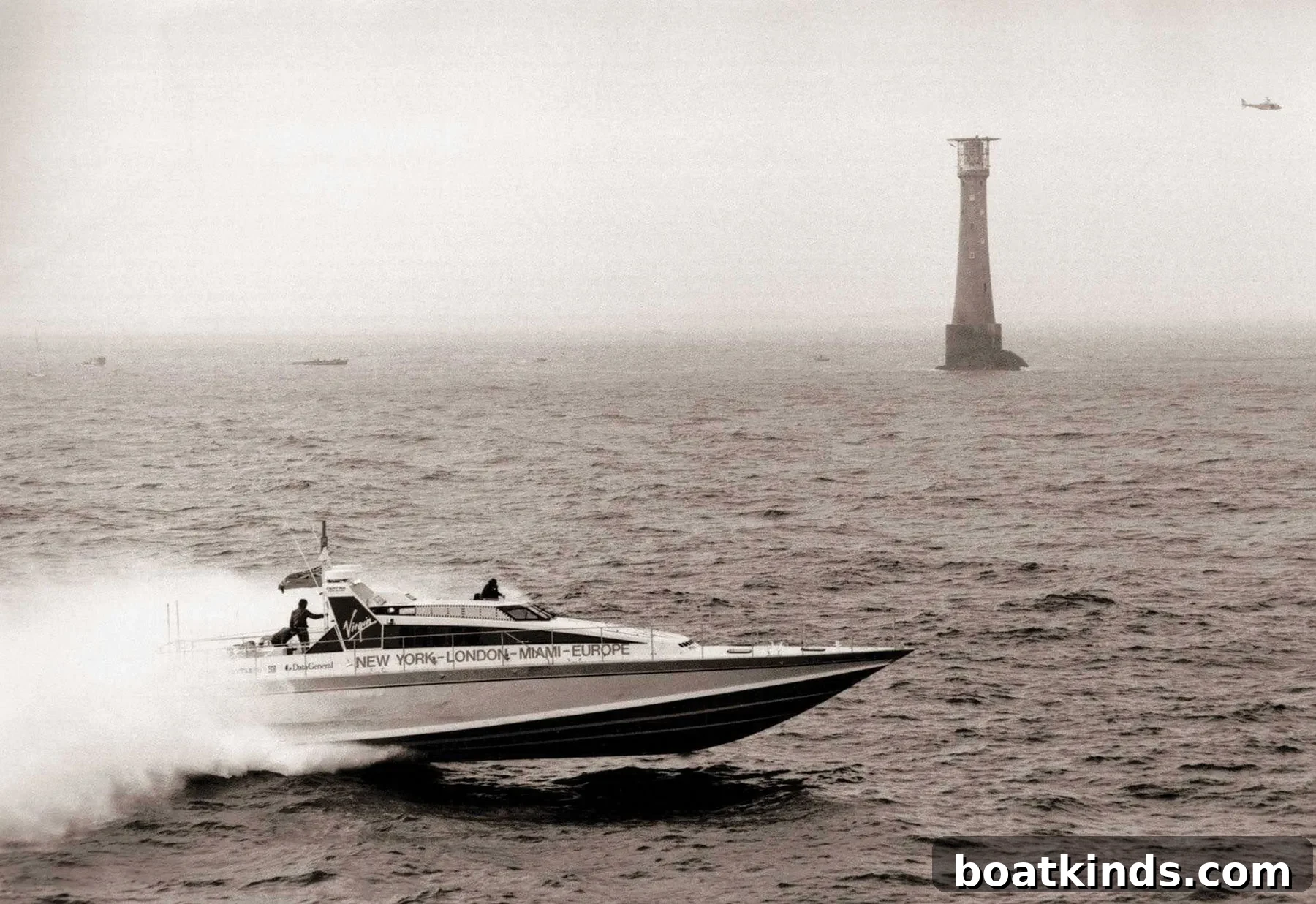
Virgin Atlantic Challenger II: Richard Branson’s Record-Breaking Transatlantic Boat and Its Revival
Long before Sir Richard Branson climbed roughly 53 miles above Earth for a brief suborbital flight aboard Virgin Galactic’s SpaceShipTwo, he was making headlines on the ocean. In 1986, Branson and his team set a transatlantic speed record, crossing the Atlantic in just three days, eight hours and 31 minutes aboard the aluminum monohull Virgin Atlantic Challenger II. That achievement came only 14 years after Branson founded Virgin Records and just two years after the launch of Virgin Atlantic Airlines, well before his later recognition as a knighted billionaire.
The vessel that carried Branson to that record was the refined successor to an earlier attempt. The original project, the 65-foot catamaran Virgin Atlantic Challenger, sank after striking a submerged object only 138 miles from its intended finish. Lessons learned from that loss informed the design and construction of Virgin Atlantic Challenger II, a larger and more robust craft measuring 72 feet and powered by twin 2,000-horsepower engines. Built to withstand the extremes of high-speed ocean crossing, she proved remarkably resilient—surviving rough conditions and demonstrating top speeds that impressed the team and the public alike.
The 1986 transatlantic push was not casual or comfortable. Branson and his crew held their breath until they had passed the very location where their predecessor sank and then only relaxed once Bishop Rock Lighthouse, the finish marker, came into view. Branson later recalled the tension of those final miles: “We listened to every beat of the engines on those last 200 miles.” The effort paid off, and the boat became synonymous with daring maritime ambition and technological boldness.
Design, Performance, and Sea Trials
Virgin Atlantic Challenger II was purpose-built for speed and endurance. As an aluminum monohull she combined structural strength with relatively low weight, and her twin engines provided the thrust required for sustained high-speed passages. During trials and in service she demonstrated the ability to operate in severe weather—recorded performance includes achieving 50 knots in a Force 6 storm on the Beaufort Scale. Even after the grueling transatlantic crossing, the hull and mechanical systems remained in commendable condition for a craft of that era.
Decline, Rediscovery, and Restoration
Despite her fame, ownership changes and neglect took a toll. After the record was won, the boat passed through a succession of owners, including a Saudi Arabian sultan and later a private owner in the Mediterranean. Over time she was allowed to deteriorate. By 2013, the once-celebrated vessel was languishing in Spain.
Enter Dan Stevens of Seahawks Boatworks, who found the distressed craft and undertook a careful restoration. The rebuild returned the boat to a condition that honored her original purpose and heritage. Stevens and his team restored structural elements, overhauled systems and engines, and prepared the boat for sale. In 2015 the boat was listed for sale at a price reportedly less than half of the original $2.3 million cost to build her. Remarkably, even after years of disuse and change of ownership, the engines showed fewer than 1,000 hours of operation and the vessel was still capable of reaching speeds around 45 knots.
Legacy and Later Life
Branson himself promoted the sale with characteristic enthusiasm, tweeting, “My old record-breaking boat Virgin Atlantic Challenger II is up for sale. Fancy an adventure?” The vessel’s reputation as an icon of 1980s maritime daring has endured, and in subsequent years she has been reported cruising around southwest England on occasion. The story of Virgin Atlantic Challenger II is one of ambition, loss, and renewal—an emblem of a particular era of high-speed ocean attempts and the entrepreneurial spirit behind them.
— Kim Kavin
This article was originally published in the December 2021 issue.