
It’s a bright October day when Paul Dobbins prepares to set out his kelp lines a little later than usual. He has been monitoring seawater temperature at his lease in sheltered southern Maine waters, waiting for the conditions to turn ideal for planting. Tomorrow he plans to deploy thousands of feet of line seeded with millions of tiny sugar kelp spores — the edible seaweed native to Maine that’s becoming a sought-after sea vegetable for chefs and consumers alike.
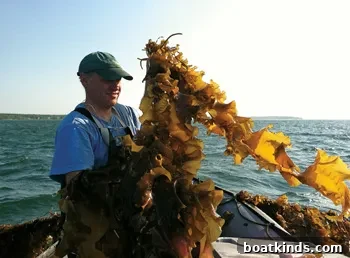
Rain and cold are in the forecast, but that’s part of life on the water. “It makes you appreciate coming home and taking a hot shower,” Dobbins says with a laugh, bundled in fleece and jeans as he pilots an inflatable toward one of his lease sites off Little Chebeague Island, about 15 minutes from the South Portland waterfront.
Dobbins is co-owner of Ocean Approved, often described as one of the nation’s first commercially successful kelp farms and a vocal leader in Maine’s emerging seaweed industry. He works through the winter, checking crops and setting new seed lines during a season that spans autumn through spring. Snow, storms and ice are real concerns: they can force lines to cross or chafe, which can damage tender plants.
That said, the work rhythm is attractive to many. “We’ll spend two or three days seeding and might be on the water a couple hours a day, then five hours the next week until the whole farm is seeded,” Dobbins explains. The more labor-intensive activity comes in March with harvest season. “We’ve shown two people can harvest 10,000 pounds in half a day,” he adds, highlighting kelp farming’s efficiency compared with other marine harvests.
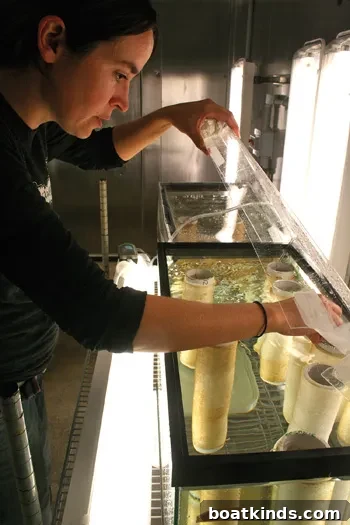
The cultivation cycle begins in a small nursery. At Southern Maine Community College’s marine lab, Dobbins maintains six tanks where PVC sections wrapped in long strands of string are soaked in seawater and seeded with kelp spores. The strings, each coated with microscopic spores that grow into young kelp, eventually become the “seed string” that gets threaded onto the main farm lines. About 30,000 feet of seed string will be affixed to roughly 20,000 feet of farm line across two compact lease sites in Casco Bay.
Out on the lease sites — among the familiar sights and sounds of a Maine bay, from lobster trap buoys to surfacing seals and overhead gulls — the kelp will grow, competing for space and sunlight. Over roughly three months a few dozen plants per foot develop into stalks 10 to 14 feet long. After harvest the kelp is processed and sold for food: cooks use it in salads, soups, stir-fries, sushi-style wraps and even smoothies.
Dobbins left a career in biotechnology, in part because travel kept him away from his children. Having always preferred the water, he explored aquaculture and saw strong potential in seaweed farming. He studied techniques abroad, adapted methods for New England, secured grants for development and partnered with researchers. He also made a point of simplifying the process so new growers can set up a nursery and farm with basic supplies — everything but a microscope and seawater can be sourced from common retailers.
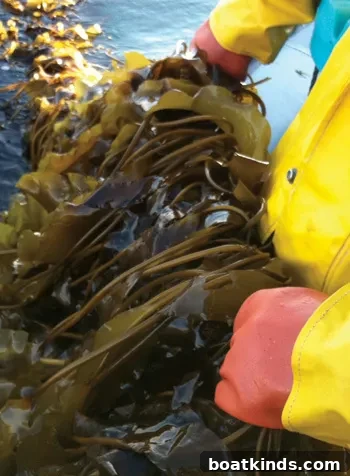
Ocean Approved began as a wild harvester, started farm trials in 2009 and achieved its first commercial crop in 2013. Today the company farms a significant portion of its product. Harvests are brought to a small processing facility where the kelp is rinsed, trimmed, blanched, flash-frozen and packaged for restaurants, institutions and wholesalers. Local buyers range from pizza companies that top pies with kelp to fine-dining restaurants that incorporate sea vegetables into contemporary menus.
To sample other edible seaweeds, I visited Sarah Redmond, a Maine Sea Grant marine extension associate at the University of Maine’s Center for Cooperative Aquaculture Research. Working with Professor Susan Brawley, Redmond has helped build the technical foundation for the industry by studying species-specific farming methods. “Each species is very different,” she notes. Successful cultivation depends on knowing when a species is ready, how best to handle it and what final products to produce.
Redmond shows several varieties: wild sugar kelp with a white powdery bloom of salt and sugar; farmed sugar kelp, greener and more delicate; skinny kelp with narrower fronds and a slight citrus note; and alaria, which delivers a mineral-rich flavor and a quick, melt-in-the-mouth texture. She also keeps jars of pickled kelp stipes and ground kelp to sprinkle on foods. “I make grilled cheese and seaweed a lot,” she says.
Sea vegetables may be unfamiliar to some Americans beyond sushi nori, but they are widely consumed elsewhere and represent a growing global industry. According to the Food and Agriculture Organization of the United Nations, global seaweed production supports a multibillion-dollar market, with human consumption forming a large segment. Most of the world’s seaweed supply now comes from cultivated crops rather than wild harvests, as farming expands to meet demand.
Maine has a long tradition of wild-harvest seaweed, dominated by rockweed, but interest in cultivation has risen over the past decade. Researchers and growers see several benefits: cultivation can supplement the wild fishery, pair well with shellfish farms, provide an affordable winter income for fishermen, and act as an environmental restorative by taking up nutrients and carbon without requiring land, freshwater or heavy inputs.
Sugar kelp has emerged as the primary focus in Maine because it grows rapidly and responds well to nursery techniques. Other species being trialed include horsetail kelp, alaria, skinny kelp, gracilaria, dulse and laver. Further east, teams such as Maine Fresh Sea Farms have launched their own trials, testing seeded lines and expanding toward commercial production while experimenting with species mixes to extend the growing season.
On their farms crew members inspect lines, lifting sections to check that baby kelp plants are securely attached by their holdfasts. Early growth must be vigorous enough to outcompete diatoms and other unwanted algae; a strong winter nutrient reserve positions plants for explosive spring growth. “December will tell us a lot about what’s coming,” one grower says. “The winter and spring are make-or-break.”
As expertise spreads, the sector’s biggest hurdle remains infrastructure for processing and marketing. When crops mature simultaneously, growers face a classic bottleneck: a field full of food that needs immediate processing space. Efforts from universities, government programs and regional partnerships are helping by funding research, offering workshops and building demonstration farms to scale up processing capacity and broaden market access.

Researchers point to other challenges as well: limited coastal space, modest public funding, small companies with restricted R&D budgets and competition from established overseas producers. Collaborative clusters that share technology, regulatory experience and market strategies are seen as one way to help Maine’s growers overcome those obstacles and build a resilient local industry.
For now, Maine’s sea vegetable community remains cooperative and energetic. “There’s a lot of energy and enthusiasm around this,” Redmond says. “Other regions are watching us take the lead.”
This article originally appeared in the March 2016 issue.