
Thomas Hoyne’s “Flying Flukes” and the Art of American Whaling
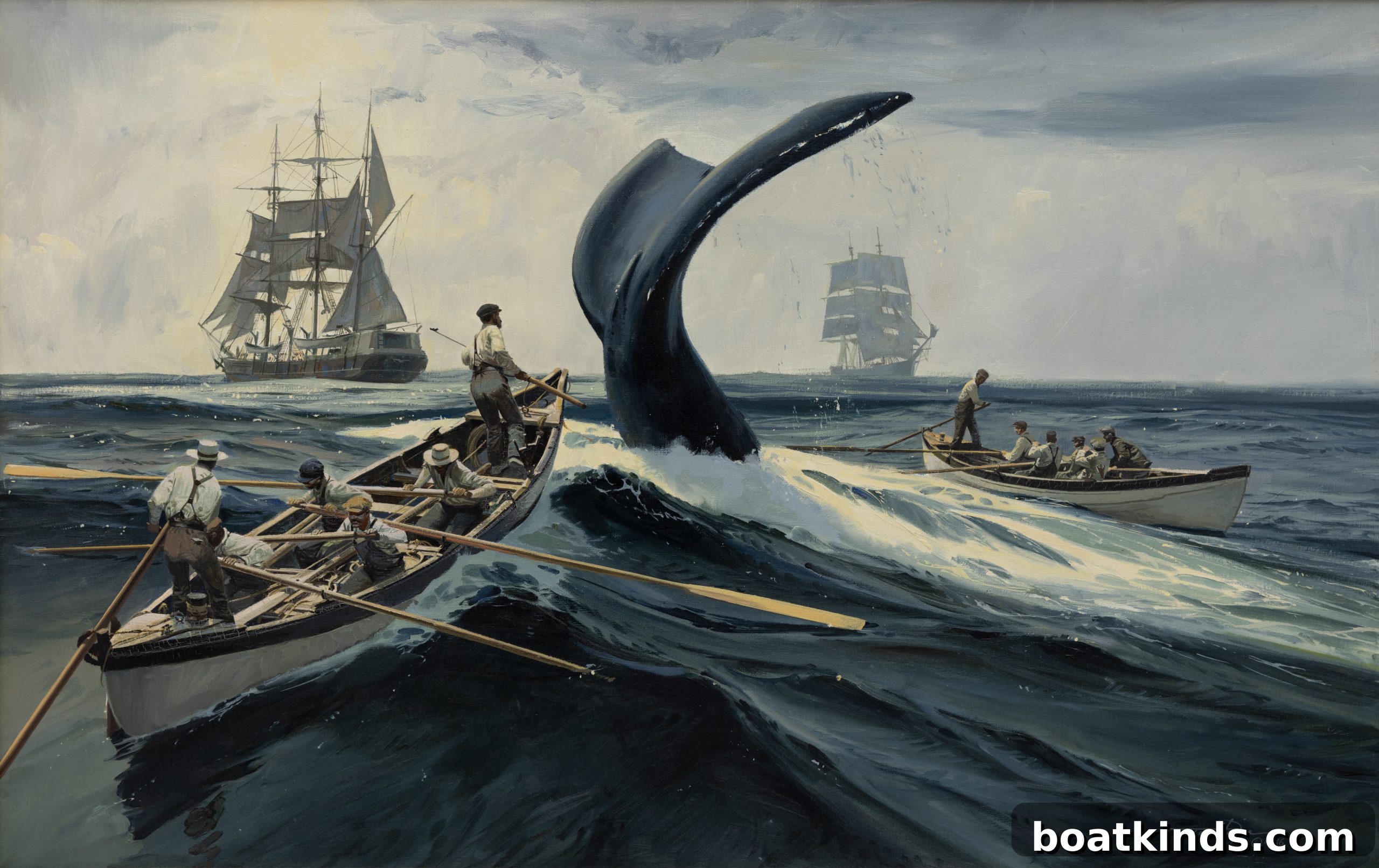
Two rowboats close in on the tail of a large whale in Thomas Hoyne’s 1986 painting “Flying Flukes.” In the distance, crews aboard whaling ships watch and wait. In the foreground a harpooner steadies his leg against the thighboard, preparing to strike. The scene captures both the drama and danger of traditional sperm and baleen whaling: a whale might drag a rowboat beneath the waves or pull it far from the ships, putting men, boats and equipment at grave risk.
Commercial whaling in the United States stretches back to the 17th century and reached its peak in the 19th century. The industry produced three primary commodities—whale oil, spermaceti oil and whalebone—each central to daily life and industry in their era. Whale oil and spermaceti were widely used in lamps and as lubricants for machinery, while whalebone (baleen) found its way into clothing supports such as corsets and into practical items like buggy whips and umbrella ribs. Paintings that depict these scenes, like Hoyne’s “Flying Flukes,” help modern viewers visualize the scale, technology and human labor behind that industry.
Thomas Hoyne (1924–1989) was born in Chicago, Illinois, and developed a lifelong interest in maritime subjects through summers spent in Ogunquit, Maine. Those coastal years deepened his understanding of the sea, the behavior of waves and the effects of light on water—knowledge that would define his artistic approach. Hoyne built friendships with captains, crew members, shipbuilders and maritime historians, and those relationships gave him valuable first-hand insight into vessels, rigging and seafaring life. That authentic knowledge is evident in the accuracy and convincing detail of his work.
Before his military service in World War II, Hoyne worked as a commercial artist and produced memorable illustrations, including early versions of the Charmin baby and the Jolly Green Giant. After serving in the U.S. Navy, he returned to Chicago and dedicated himself to illustrating and painting maritime scenes. His postwar career focused on realism: critics and viewers often noted how convincingly he rendered water, light and the tactile qualities of ships and gear. Many observers have remarked that the water in Hoyne’s paintings looks almost touchably wet—an apt compliment to his mastery of maritime realism.
“Flying Flukes” exemplifies Hoyne’s ability to combine historical narrative with painterly precision. The painting shows not only the mechanics of the hunt—rowboats, harpoons, thighboards and the whale’s fluke—but also the emotional tension among men who risked life and limb at sea. By faithfully reproducing period details and seafaring techniques, Hoyne’s work serves as both art and visual history, inviting viewers to consider how coastal communities and industries were shaped by whaling.
In recognition of his contributions to documenting America’s maritime heritage, Hoyne received the Rudolph J. Schaefer Maritime Heritage Award from Mystic Seaport Museum in Connecticut in 1983. The award honors work that best preserves and conveys maritime history for future generations. Hoyne’s paintings, rooted in observation and enriched by personal connections to seafaring people, have become a valued part of that visual record.
Hoyne passed away in 1989 after a battle with cancer, leaving behind a body of maritime art that continues to inform and inspire viewers interested in seafaring life and American whaling history. His combination of documentary detail and artistic skill ensures that scenes like the one in “Flying Flukes” are not only visually compelling but also historically useful, helping modern audiences understand the perilous craft of traditional whaling and the broader maritime culture of New England.
This article was originally published in the January 2023 issue.