
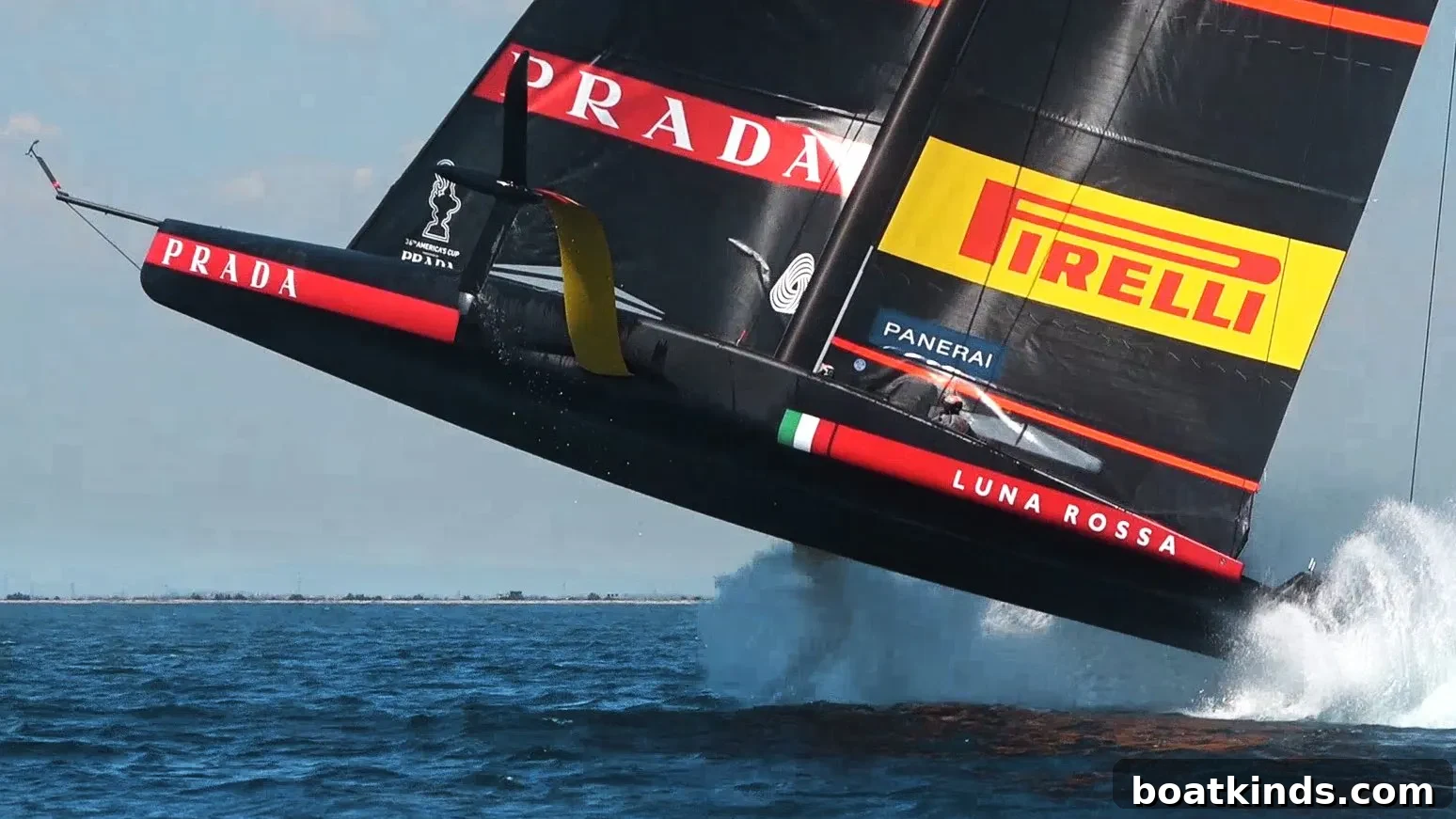
Luna Rossa AC75 Nearly Capsizes in Practice Jibe — Photo Highlights Dangers of Foiling Monohulls
As coronavirus restrictions have eased and America’s Cup teams have returned to on-water training, a dramatic photo released by the Luna Rossa team makes clear that these high-performance boats leave little room for error. During a routine jibe in roughly 15 knots of wind, the Italian team’s AC75 experienced a sudden shift: the stern lost rudder support and the bow shot upward, creating a momentary but alarming pitch that could easily have resulted in a capsize.
The crew managed to recover and the boat did not flip, but team members described the moment as “shocking.” The image circulated by Luna Rossa captures the exact instant when control was compromised and the forces on the hull and appendages pushed the yacht toward an extreme attitude. That visual underscores just how demanding and unforgiving modern America’s Cup foiling monohulls can be, even in what might otherwise seem like moderate conditions.
What an AC75 Is and Why Jibes Are Risky
The AC75 class introduced for recent America’s Cup cycles are 75-foot foiling monohulls designed to rise above the water on submerged foils, dramatically reducing drag and allowing very high speeds. While foiling transforms performance, it also concentrates loads and reduces the margin for error. Maneuvers such as tacks and jibes require precise timing, coordinated crew input, and continuous adjustments to foil and rudder settings. A small miscalculation during a jibe can rapidly change the balance of forces and cause the bow to lift or the stern to lose lift, producing sudden and extreme boat motions.
Training, Teamwork and Recovery
Practice sessions are essential for crews to refine these complex maneuvers. The incident with Luna Rossa came during routine training that many teams had resumed as pandemic-related restrictions were relaxed. Such sessions are where crews test limits, explore new trim settings, and rehearse emergency recovery procedures. In this case, the crew’s ability to bring the boat back under control without capsizing speaks to their training and immediate response, but the image also serves as a stark reminder that recovery is not always guaranteed.
Modern foiling boats require exceptional coordination. Whether adjusting foil angle, shifting weight, or modulating sail trim, the entire crew must act in concert and respond in fractions of a second. Even in 15 knots of wind—conditions that would have been considered manageable in older designs—foiling yachts can generate forces that push equipment and human reactions to the limit.
Why the Photo Matters
Photos like the one released by Luna Rossa are valuable for several reasons. They document what actually happens on the water, provide learning material for designers and sailors, and remind the public that America’s Cup boats are extreme machines operating at the edge of stability. Teams study such moments closely to understand load paths, foil behavior, and control system limits, and to refine procedures that reduce risk in future maneuvers.
For fans, the image is a dramatic illustration of the fine line between thrilling performance and perilous imbalance. For competitors and engineers, it is an invitation to investigate improvements in handling, redundancy, and crew protocols.
Conclusion
The Luna Rossa jibe incident highlights both the excitement and the danger inherent in modern America’s Cup sailing. As teams get back on the water and push their AC75s through intensive practice, moments like this will continue to shape training priorities and technical developments. The narrow escape captured in the photo demonstrates how quickly conditions can change on a foiling monohull and why meticulous preparation and split-second coordination remain essential to staying safe and competitive.