
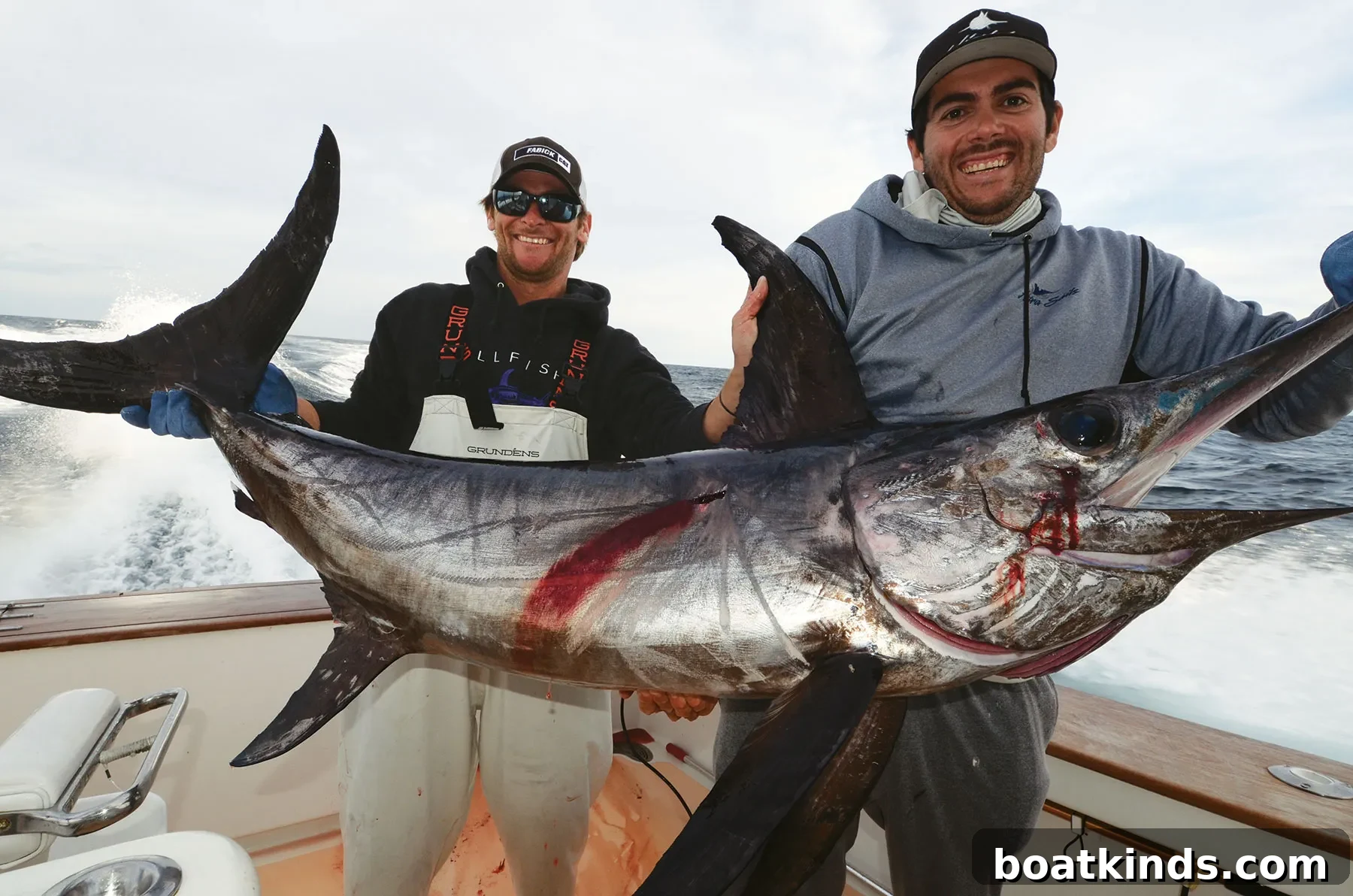
Offshore fishing rarely feels easy: long runs, big seas and searching for fish in vast expanses of ocean. Yet one bluewater fishery offers a surprisingly approachable entry point — daytime deep-drop swordfishing. With just two rods, a modest tackle box and a thousand yards of line, anglers can reach a world-class fishery that once required years of experience and specialized night tactics.
For decades, swordfish were most often targeted at night by drifting with rigged baits and powerful lights. That method worked, but it was marginally effective and technically demanding. In recent years, however, anglers in the Florida Keys discovered a daytime method that produces giant swordfish: dropping baits more than a thousand feet to fish holding near the bottom. That approach has spread to canyons and deep structures up and down the U.S. East Coast and around the globe, becoming especially popular in the mid-Atlantic and Northeast where deep-dropping in canyon edges yields consistent results.
Swordfish are the outliers among billfish. They inhabit a remarkably wide temperature range — from roughly 40 to 80 degrees — and are found worldwide. Unlike marlin, they rarely chase trolled baits. Instead, swords often take slow-drifting chunks of meat or large baits that hover near the bottom. Though they occasionally surface during the day, swordfish are built for the deep: their eyes are set in bony sockets and they can warm critical tissues, adaptations that let them hunt in near-darkness under intense pressure. In many ways, they live in a zone of the ocean we still understand very little about.
I caught my first taste of daytime swordfishing after anglers out of my homeport, Virginia Beach, began scoring fish during daylight hours. I signed up for a master class with Capt. Fin Gaddy aboard the charter boat Qualifier. Gaddy had recently started targeting swords off North Carolina’s Outer Banks and saw immediate success. His work drew in South Florida swordfish specialist Capt. Brent Feder and local skipper Capt. Jeff Ross, and one chilly November morning—with Gaddy at the helm and Feder and Ross running the cockpit—we steamed thirty miles to the drops and canyons off Oregon Inlet.
Swordfish feed year-round, but the most reliable windows tend to be spring and fall. They hold from a few hundred feet to more than two thousand feet deep, so locating them means finding steep structure on the sounder and a cloud of bait near the bottom. Once you have structure, you deploy heavy, simple rigs and let the current and the fish do the rest.
Though the basic gear is uncomplicated, swordfish anglers sweat the details. Gaddy favors an 80-pound bent-butt rod on a powerful Lingrid Pittman electric reel and also carries Daiwa hybrid electric-assist reels for a sportier option. A hybrid lets you use electric retrieve when changing locations or checking baits, then switch to manual when fighting a fish. Any robust 80-pound rod-and-reel combination will work; some purists still choose stand-up gear for the physical challenge.
Reels are spooled with lots of 60-pound braid — often more than 1,500 feet — because braided line is thinner and stiffer than monofilament. That lets the bait reach the bottom with less weight and transmits subtle bites from far below. Off the braid, anglers usually attach about 100 feet of 100-pound wind-on leader. Feder rigs that leader with rigging floss, heavyweight mono and longline clips, adding roughly 15 pounds of sinker a few feet below the wind-on connection. At the leader tip he connects a 400-pound swivel and about 12 feet of 300-pound monofilament between the swivel and the hook setup.
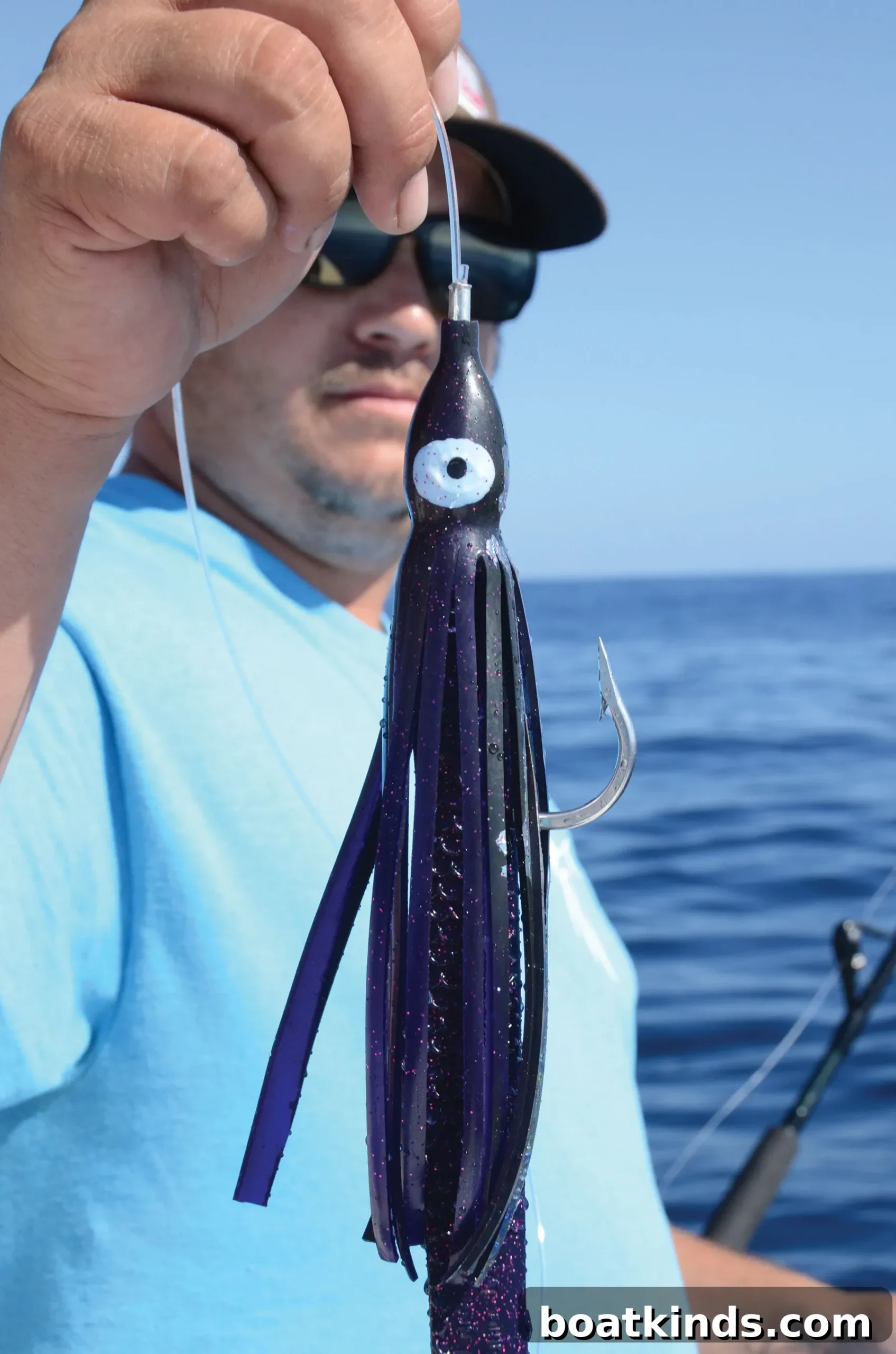
There’s debate over the terminal tackle. Feder brought a mix: whole squid, long strips of tuna belly, large eels and oversized soft-plastic eels. Natural baits are secured with rigging floss to a 1/0 J-hook, often with a rubber skirt slid over the bait for extra profile and action. Many anglers favor an 18-inch Hogy Swordfish eel soft plastic rigged with two hooks and a skirt; its size resists bait stealers and attracts large swords. The goal is a large, slow-moving presentation that a deep-feeding sword can find and engulf.
At the drop, Gaddy stopped over a seamount and Feder and Ross fed bait, leader and sinker over the rail. It took several minutes for the rig to reach bottom. Feder periodically paused the reel so the line and sinker would settle, then resumed the drop. When the sinker hit bottom he retrieved about fifty feet of line and set the drag to roughly 24 pounds.
We drifted the boat slowly over the structure, keeping the lines as vertical as possible. The rod tips rode the swell, a slow bounce that masks the faint bite of a deep swordfish. The tell is subtle: a slight dip of the tip that doesn’t match the boat’s roll. When that happens you must react quickly, retrieving line fast to try to hook the fish before it spits the bait. Hooking a swordfish at these depths is part timing, part reflex and part luck.
After a few missed opportunities, the rod finally loaded up and we had our first solid hookup. The early stages felt quiet as the fish initially came toward the boat, but when it reached a couple of hundred feet below the surface it exploded into life, surging and peeling line. Swordfish have soft mouths and sometimes hook shallow or wrap leaders, so patience and careful drag management are essential to avoid tearing the hook free.
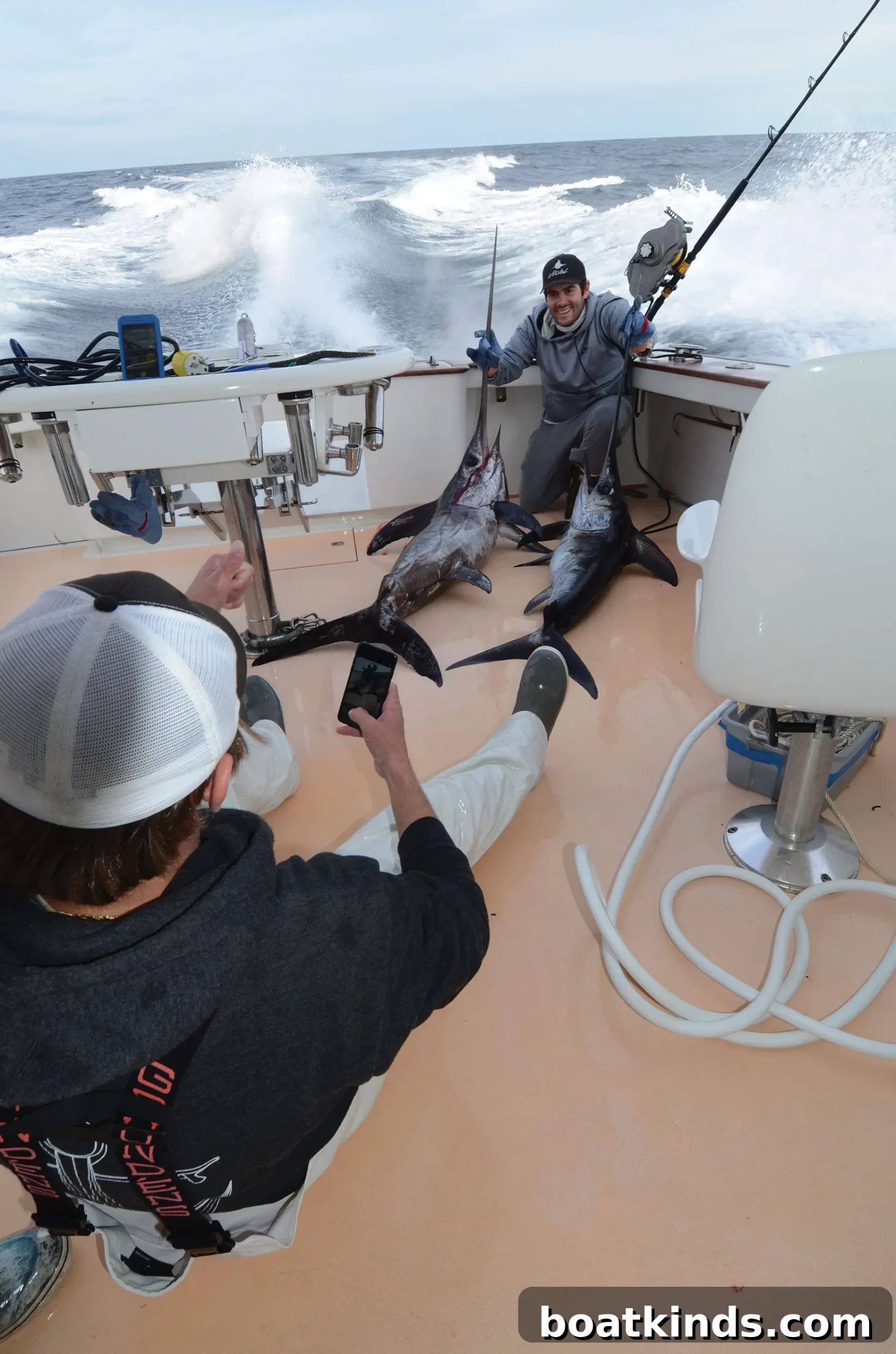
As the fish tired, a silver shape appeared in the deep blue. It was a torpedo-shaped animal with a long bill and a powerful crescent tail. When it ran, it could take yards of line in a single kick; when it tired, the crew worked the reels and gaffs to bring it to the side. At the boat the sword flashed silver and blue. Looking into its enormous eye — a creature that had been hunting in near-darkness far below — was one of those rare moments that makes deep-drop swordfishing unforgettable. After years of chasing these fish at night, seeing one brought to the surface in daylight is strikingly different and deeply rewarding.
Daytime deep-drop swordfishing is an accessible but demanding way to get into bluewater gamefishing. It requires relatively simple gear, careful attention to rigging and a willingness to work at depth, but it also offers some of the most dramatic encounters the ocean provides.
This article was originally published in the October 2020 issue.