
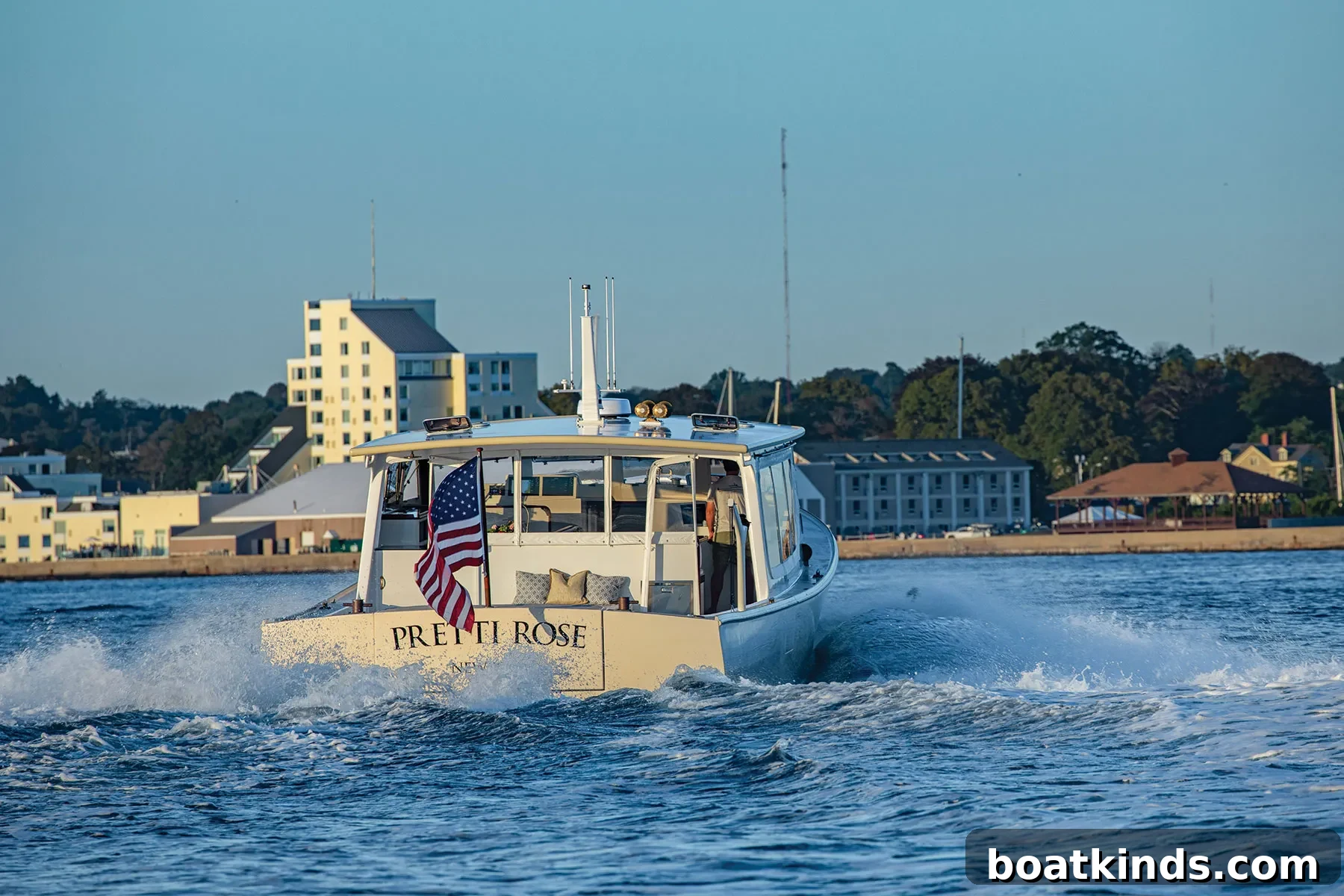
Mussel Ridge lobster yachts remain a favorite among commercial fishermen and recreational boaters alike for their wide beams, solid construction and dependable seagoing performance. Built by Hutchinson Composites in Cushing, Maine, these hulls and decks are prized for their commercial pedigree and are often finished by other yards around New England. One standout example is Pretti Rose, a Mussel Ridge 54 that blends commercial hull form with a refined Downeast-style interior and cruising focus.
Owned by Eli Dana, Pretti Rose grew from a lifelong affinity for Downeast designs. Dana, who grew up on his family’s wooden lobster boats and later owned a Holland 38, wanted a larger, modern fiberglass Downeast that preserved traditional lines while delivering contemporary comfort and systems. He partnered with Ezra Smith of Newport Yacht Builders and Ezra Smith Design to develop the concept.
Smith recalls that Dana wasn’t sure he would build at first, but both men shared enthusiasm for the Mussel Ridge hull. Working in close proximity—Smith’s office sits at Newport Shipyard and Dana served as the general manager there—the pair iterated designs until Dana was ready to commit. They then approached Hutchinson Composites to secure the hull, and the project moved forward.
Pretti Rose was the first new build for Newport Yacht Builders, the team of Ezra Smith, builder Jim Thompson and project leader Ashley Reville Hill. Although they formally organized in 2018, the three have collaborated on projects for more than a decade. Their goal was to refine an efficient production workflow for interiors, furniture and systems by combining laser scanning with CAD modeling and CNC cutting to reduce on-boat labor and improve accuracy.
Smith and Thompson had long sought a reliable way to capture complex interior envelopes. In 2017, Hill and Thompson launched CaptureRI, a 3-D scanning company using the RTC360 laser scanner capable of scanning bare hulls and interior spaces. Integrating this scanning capability with CNC machining allowed Newport Yacht Builders to move seamlessly from scan to digital design to precisely cut parts, cutting templating time and labor significantly.
Before tackling Pretti Rose, the team used this workflow on refit projects that served as practical test cases. The 136-foot motoryacht Consolidated was extensively reworked—new crew and guest spaces, deck furniture and a new captain’s cabin—using a combination of archival photos, structural drawings and hull scans to recreate and reconfigure interior components. For the 93-foot motoryacht Contraband, Smith developed a 3-D model that was integrated with on-site scans, eliminating traditional hand templating and enabling most furniture to be completed off-site.
With Pretti Rose, the team applied the full A-to-Z process. Smith produced a detailed 3-D interior model based on design specs, and Thompson traveled to Maine while the Mussel Ridge hull was still in the mold to scan the interior hull surface. That scan was imported into the model and used to trim digital surfaces so all interior components—bulkheads, soles and furniture—could be fabricated in the shop before the hull arrived in Rhode Island. This parallel workflow saved significant time.
According to the team, the scanning-and-CNC approach produced a 30–50 percent reduction in man-hours on Pretti Rose. Instead of waiting for a linear build sequence, multiple tasks proceeded simultaneously: precise shapes were modeled with a 3-mm tolerance for bonding and fiberglass, then cut on the CNC, assembled on the shop floor and dropped into the hull as finished units. Despite the challenges of the global pandemic, the boat was assembled and launched within five months after the hull’s arrival—faster than many production builds.
The finished yacht pairs a commercial Mussel Ridge hull and Downeast performance with a fully yacht-styled interior. Her Herreshoff-inspired aesthetic—white paint contrasted with dark wood—feels bright and contemporary while traditional details, such as a vintage ship’s wheel from Rosebank Ironworks Edinburgh, honor her classic lineage.
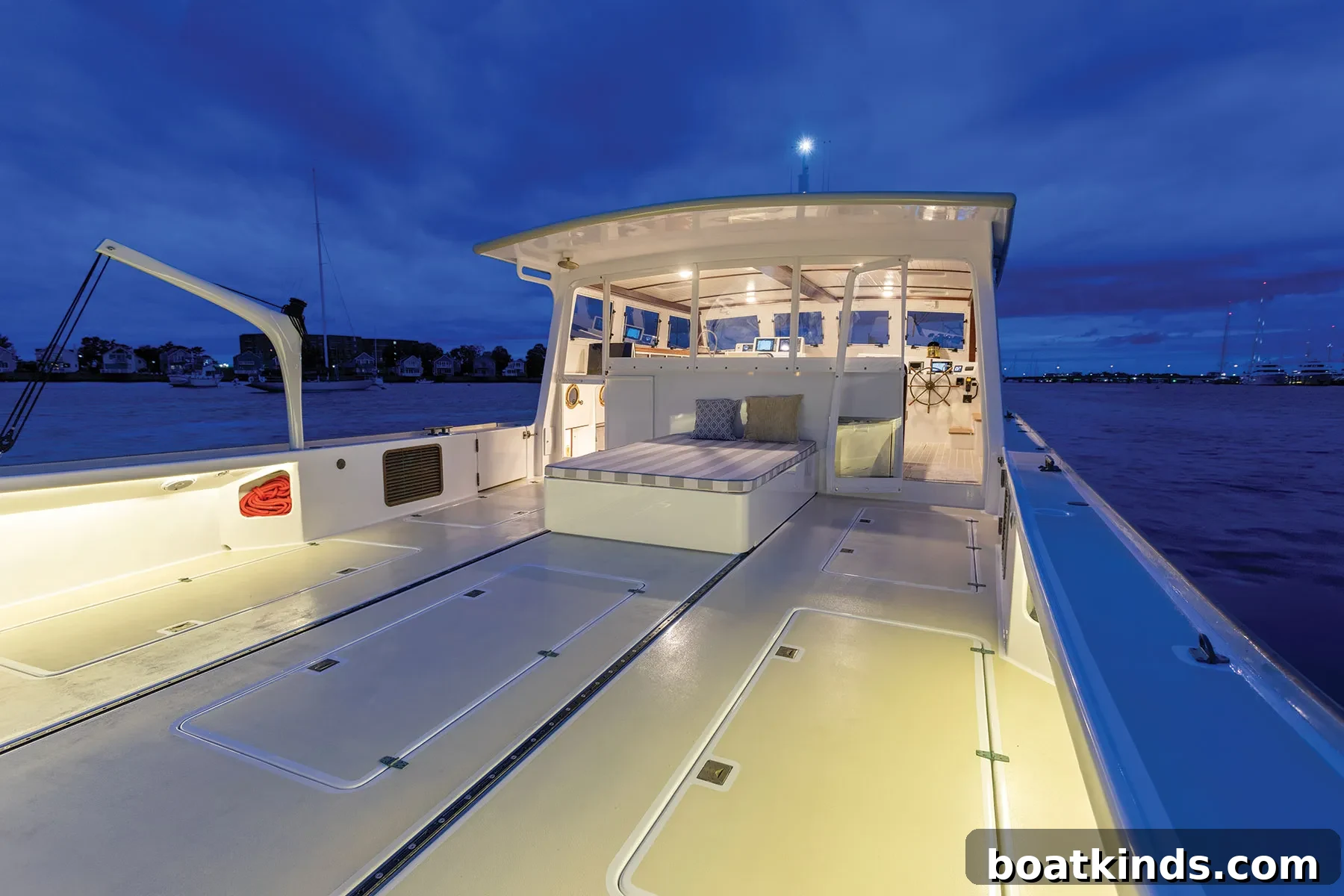
Newport Yacht Builders made practical layout choices: the cockpit is intentionally sparse, featuring only an aft bench seat and a small sunpad near the pilothouse. Both pieces are mounted on deck slides so the bench can roll forward to open the transom and the sunpad can slide aft for access to the engine room. Major machinery—the generator and the single 1,550-hp MAN V-12 engine with V-drive—sits beneath the cockpit to reduce noise in the pilothouse.
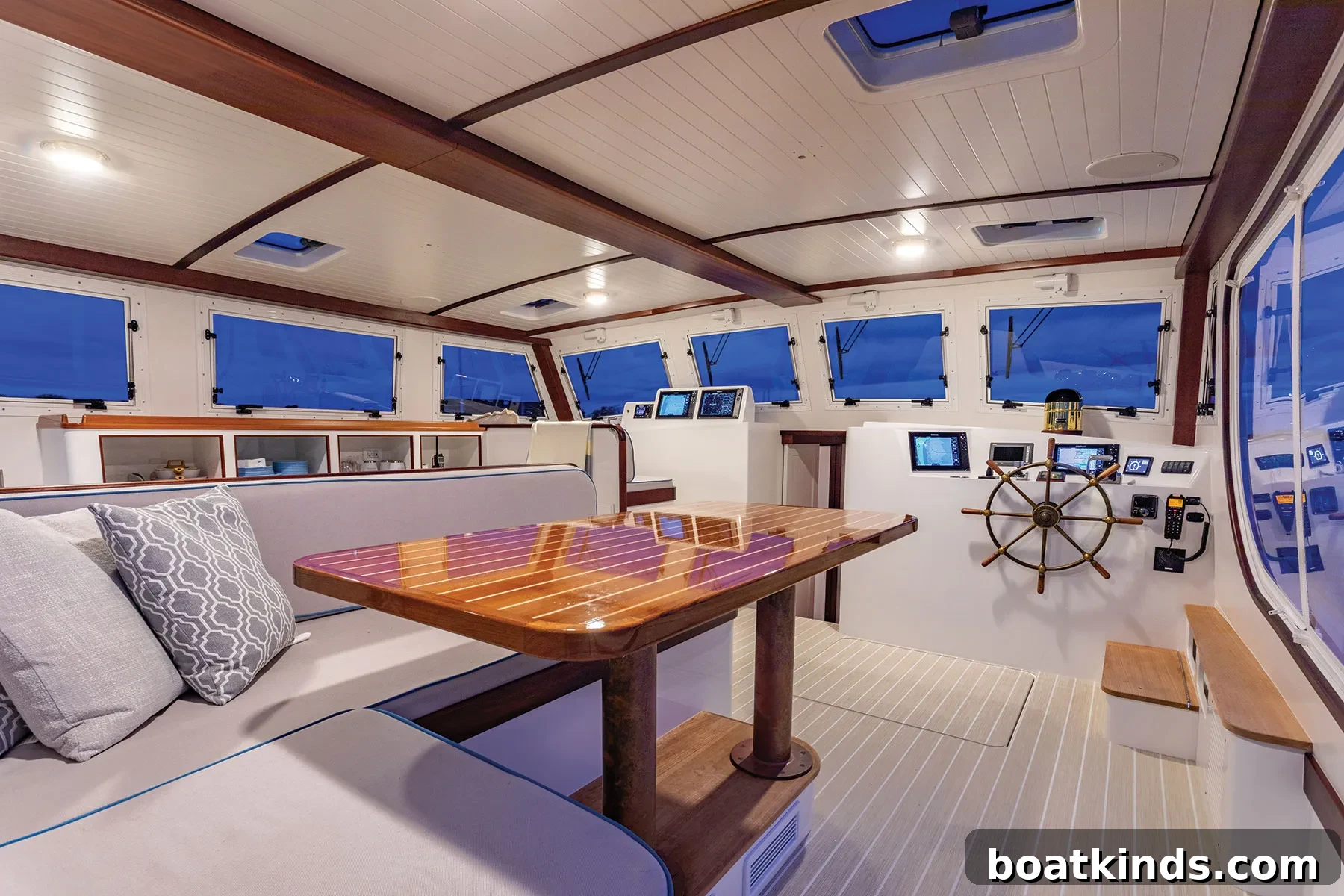
The pilothouse emphasizes social layout and livability. At a 17-foot, 4-inch beam it accommodates a galley-up plan with ample counter space, large appliances and a deep double sink, while an L-shaped lounge and dinette sit directly behind the helm for entertaining. Below, the master stateroom occupies the bow, with a smaller twin-berth stateroom to port. The main head provides system access through the shower, and a second head, reached from the cockpit, connects to a third stateroom that can serve as captain’s quarters.
Practical features include both bow and stern thrusters for easy docking maneuvers. With the MAN V-12 propulsion, Pretti Rose cruises around 20 knots and reaches about 23 knots at top speed. Launched in May 2021, Dana cruised locally with family beginning in August, but his intention was always to prove the concept and move on: he plans to sell this boat and commission another.
Newport Yacht Builders is already applying the lessons learned from Pretti Rose to a new Mussel Ridge project: a 46-foot sportfisher designed for efficient production with a straightforward trim package. As Smith notes, the team has gained valuable experience and aims to sharpen efficiency and cost-effectiveness for future builds.
LOA: 54’0”
Beam: 17’4”
Displ.: 50,000 lbs.
Draft: 6’0”
Power: (1) 1,550-hp MAN V12-1550CR diesel engine
This article was originally published in the April 2022 issue.