
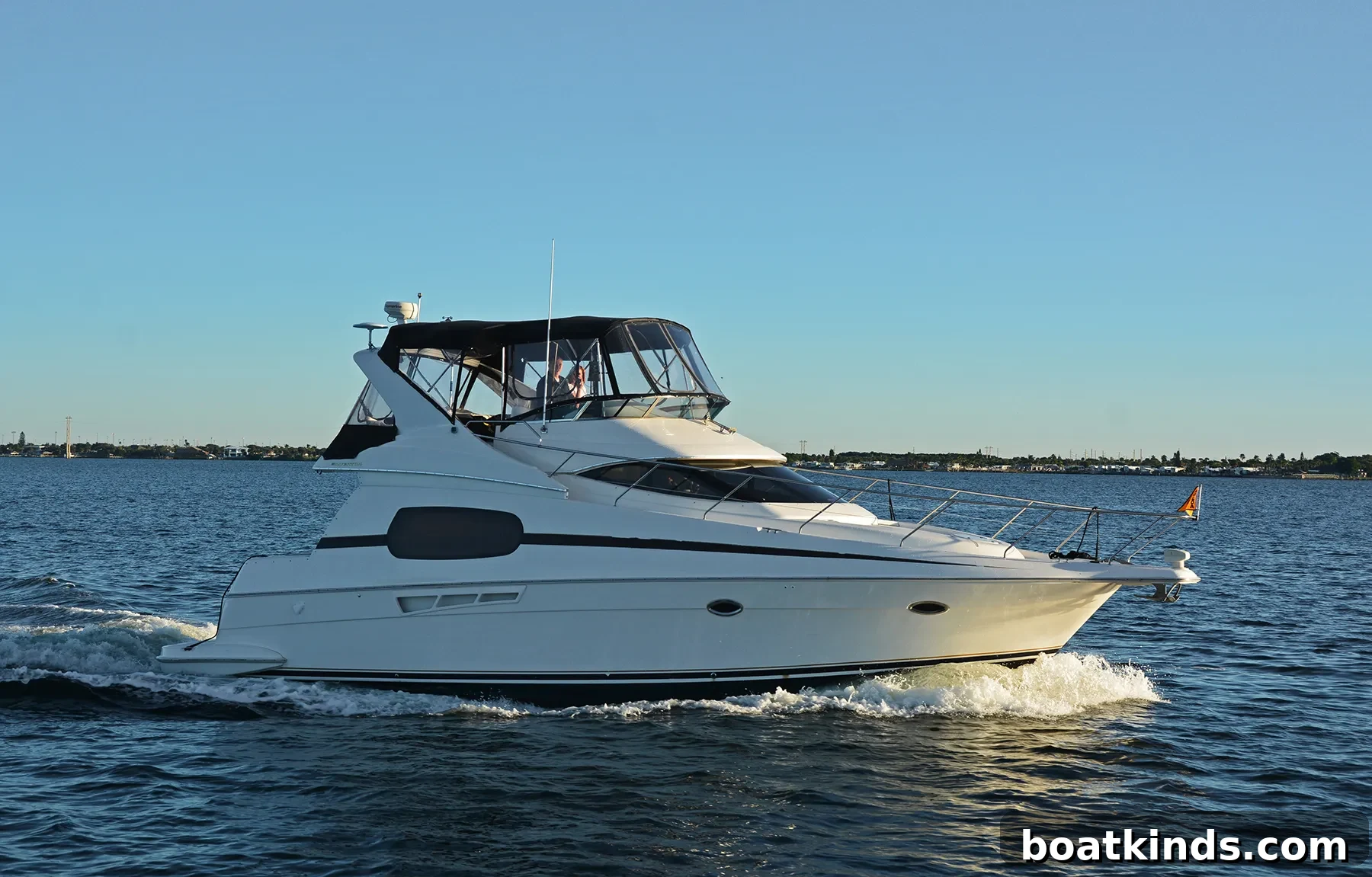
By the time you read this, Kim Russo and Michael Martin will be cruising aboard The Perch, a Silverton 410 Sport Bridge, somewhere in the Great Lakes as they loosely follow the route of the American Great Loop. The Great Loop is a roughly 6,000-mile network of connected waterways that circles the eastern half of the United States and parts of the Canadian coastline. The couple began their journey in early spring from Fort Myers, Florida. Finding the Port Lucie Lock on the east side of Lake Okeechobee closed, they opted to head south to Marathon in the Florida Keys and round the southern tip of the peninsula instead.
Russo has served as director of the American Great Loop Cruisers Association (AGLCA) for seven years and has been active with the group for about 13 years. Although she’s boated most of her adult life and has sampled pieces of the Loop on shorter cruises, this trip gives her the rare chance to see the majority of the route while living aboard full time.
Martin’s boating roots go back to the Great Lakes. After a career in the U.S. Navy and subsequent corporate work, he joined Curtis Stokes & Associates as a broker in Fort Lauderdale in 2013. For the past five to six years he’s focused largely on customers planning to do the Loop, helping them find boats suited to extended cruising. That focus turned into a personal passion.
Martin has lived aboard The Perch since 2016 and has completed the Loop, largely singlehanded. The Perch is a 2001 Silverton 410 Sport Bridge with a modified deep-V hull built to handle open water. It’s not a typical trawler many Loopers choose, but Martin grew attached to it after working with many different cruisers as a broker. “I sold a lot of Mainship 390 trawlers and thought I might end up with one,” he said. “A client suggested a Silverton for him but passed on it; the more I examined its features, the more I wanted it for myself.”
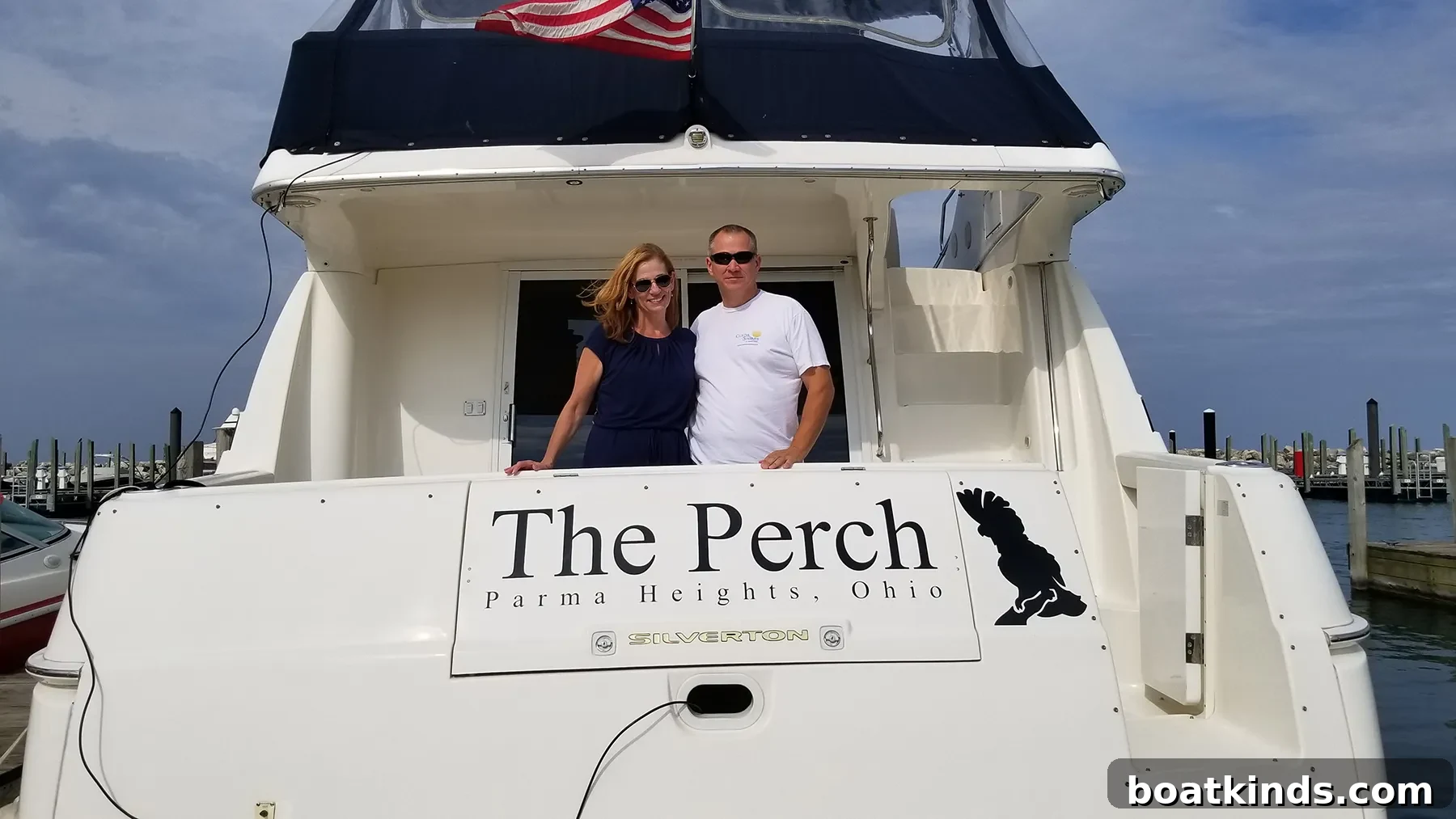
When Martin bought the boat in 2016, the only major cosmetic change he made was replacing the transom name, which had read Party Girl with a martini-glass Y. He added practical upgrades: security sensors that alert him to increased bilge pump activity, remote control of deck and interior lighting, and, recently, a Raymarine radar and chartplotter. Still, his go-to navigation tools remain a Samsung tablet running Coastal Explorer and the crowd-sourced Navionics charts, which he recommends for their abundant updates and local cruising information.
The couple’s approach to the Loop differs from many others. Both work full time and plan to attend AGLCA events along the way, but they remain close to airports so Michael can meet clients for showings and surveys. “When we reach the Hudson, we could go up Lake Champlain into the St. Lawrence Seaway, or head west through the Erie Canal and north through the Oswego Canal into Lake Ontario and onward to Canada,” Russo explains.
Russo notes The Perch can’t clear some bridges on the western Erie Canal, although many boats can and that route remains a popular segment of the Great Loop. Last year the Erie Canal’s western route was a favored option for many cruisers because U.S.-flagged vessels had limits on cruising in some Canadian coastal and canal waters; those who took the western Erie reported great satisfaction. This year Russo and Martin plan to explore Canadian waters, including the Trent-Severn Canal, Georgian Bay and the North Channel of Lake Huron.
Fuel consumption and finding the right cruising speed have been important lessons for the couple. On his first solo Loop, Martin ran at 80 to 100 percent throttle, and paid the price at the pump: a roughly $45,000 fuel bill. At wide-open throttle the twin Cummins 450-hp engines pushed the boat to 25 knots and burned about 34 gallons per hour (gph). He later discovered much better economy at displacement speeds—around 10 knots—where each engine together used about 10 gph.
“At WOT it feels like we’re ejecting $100 bills from the exhaust,” Russo says. The Silverton 410 was designed more like a motoryacht and performs comfortably above the typical 8–10 knot speeds many long-distance cruisers prefer. Finding a fuel-efficient “sweet spot” that still provides comfortable cruising performance has been an important objective.
Ultimately, Russo and Martin have found a comfortable compromise aboard their Silverton 410, enjoying yacht-style interiors while achieving reasonable fuel economy. The Silverton’s modified deep-V hull, combined with careful speed management and modern electronics, has proven capable across the variety of open water and inland waterways they’ll encounter on the Loop. The couple’s experience and thoughtful preparation suggest they’ll have a rewarding voyage.
Walkthrough
Silverton gave the 410 Sport Bridge a refreshed look with Euro-influenced styling that departs from the builder’s earlier conventional lines. Notable features include molded staircases that provide direct access from the aft cockpit to the spacious flybridge, and a companion staircase down to the foredeck. Raising the sidedecks allowed the salon sides to be pushed out to the gunwales, creating a notably roomy interior. The galley is located up to port with a dinette to starboard; both sit forward near the windshield for excellent visibility. Below, the accommodations include a midship master stateroom, a forward guest cabin and a shared head to starboard. With optional gas or diesel twins and a transom deadrise of 16 degrees, the Silverton 410 offers solid handling and performance across a range of speeds and conditions.
BACKGROUND
According to The PowerBoat Guide by Ed McKnew, the Silverton 410 Sport Bridge was built from 2001 to 2004, reflecting the company’s evolution. Silverton’s roots go back to the late 1960s when it built Sea Skiffs in Toms River, New Jersey. The company later became Silverton Marine and moved to Millville, New Jersey, in 1985, expanding into motoryachts, sedan cruisers and convertibles before closing in 2012.
Would you like to see your boat in Soundings?
We’re looking for boats and owners to feature in this department. If you’d like to share your story, contact the editorial team at [email protected].
This article was originally published in the July 2022 issue.