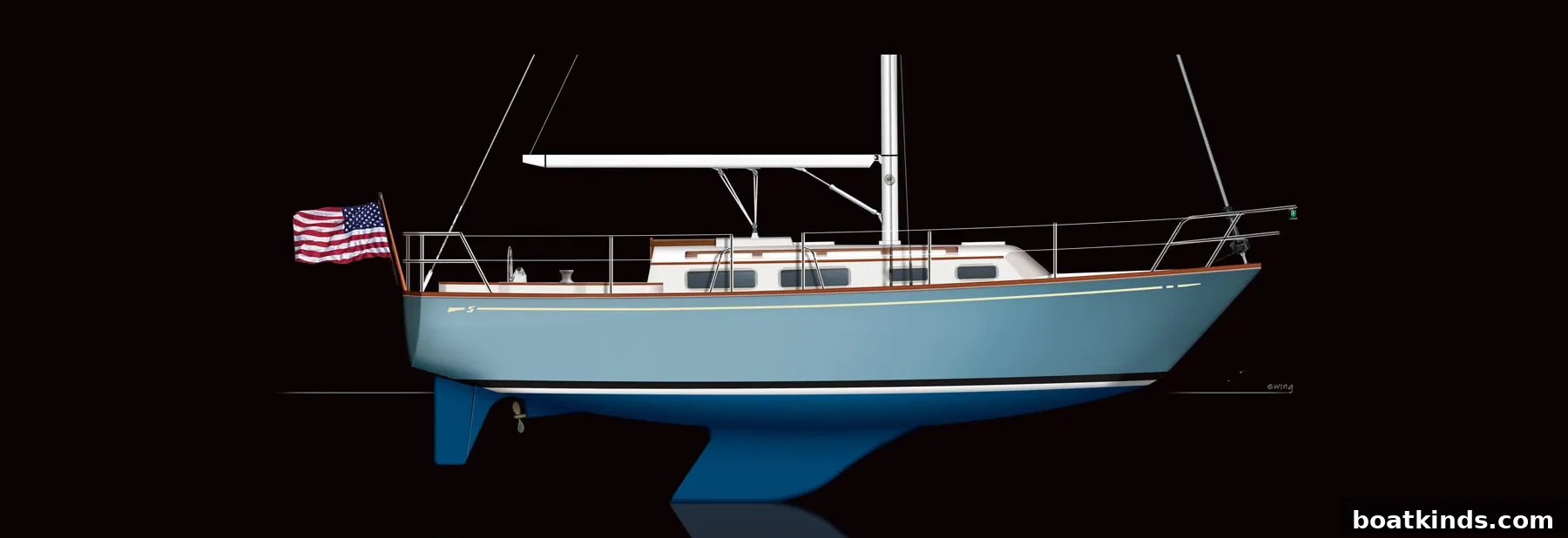
Sabre 28: A Sturdy Maine-Built Racer-Cruiser That Defined a Market
Introduced at the 1971 Newport Boat Show, the Sabre 28 quickly established itself as a well-built, practical racer-cruiser for couples and small families. Built by Sabre Yachts of Raymond, Maine, and designed by company founder Roger Hewson, the Sabre 28 met a growing demand for modestly sized sailboats that combined solid construction, manageable maintenance, and good sailing performance.
Roger Hewson’s lifelong relationship with boats informed every aspect of the Sabre 28’s design and construction. His early experiences—helping his father build a family boat, launching his own outboard hydroplane at age 14, and racing International 14s—shaped a designer who understood the nuances of hull form, handling and practicality. Hewson honed his skills by building and sailing a series of Sabre Scows before turning to production fiberglass construction. That hands-on background translated into a small cruiser that was both seaworthy and thoughtfully detailed.
Hewson and his wife Charlotte (known as Charlie) relocated from Montreal to Maine to pursue their vision: a contemporary fiberglass sailboat finished with traditional Maine craftsmanship and built efficiently to keep prices competitive. The Sabre 28 was the result of extensive research. Hewson measured numerous competing boats in the same segment to refine the hull shape, deck layout and interior arrangements—an exacting approach that helped the 28 stand out in a crowded market.
On the outside, the Sabre 28’s lines communicate seaworthiness and performance. A straight, raked stem improves wave penetration, while a slightly rockered bottom and swept fin keel contribute to predictable motion and tracking. Steering is handled by a spade rudder supported by a long centerline skeg, a configuration that balances responsiveness with protection. The low-profile deckhouse enhances forward visibility, and the cockpit is sized to comfortably accommodate a crew of four. Many owners chose the optional Edson wheel, which complemented the boat’s coastal cruising and club racing capabilities.
Below deck, the Sabre 28 is laid out for practicality and comfort. The forward cabin offers a vee-berth for two; a privacy-oriented athwartship head sits aft of the cabin; and the main salon includes a pilot berth plus a seating bench that converts into a double berth. The interior emphasizes warmth and quality, with handcrafted teak bulkheads and furniture offsetting bright white surfaces to create a pleasantly finished, durable living space suitable for extended weekends or weeklong passages.
Sabre Yachts provided a progression of reliable auxiliary power options over the production life of the 28. Early boats were fitted with the Universal Atomic 4 gasoline engine, and in 1975 a 10-horsepower Volvo diesel became available. In 1978 the 13-horsepower Volvo Penta MD7A replaced earlier options, followed by the Westerbeke 13 diesel in 1981. Shaft alignment was refined during production: very early models had a centered propeller shaft, but later boats received an offset shaft to improve handling—offset to port for right-hand-turning Atomic 4 gasoline engines and to starboard for the left-hand-turning Volvo diesels.
Between 1971 and 1986 Sabre Yachts built 588 examples of the Sabre 28. The boat found a loyal following among sailors who valued its combination of solid Maine craftsmanship, sensible systems and pleasant sailing traits. While Sabre Yachts has since shifted its focus and now concentrates on powerboats, the Sabre 28 remains appreciated in the used-boat market for its build quality and timeless design.
The Sabre 28 represents a successful blending of careful design research, traditional finishing and practical production methods. Its thoughtful hull form, protected rudder, comfortable cockpit and well-appointed interior made it a versatile choice for coastal cruising and club racing. Decades after its introduction, the Sabre 28 still illustrates the merits of a small, well-executed cruiser built with attention to detail and an eye toward everyday usability.
This article was originally published in the January 2023 issue.