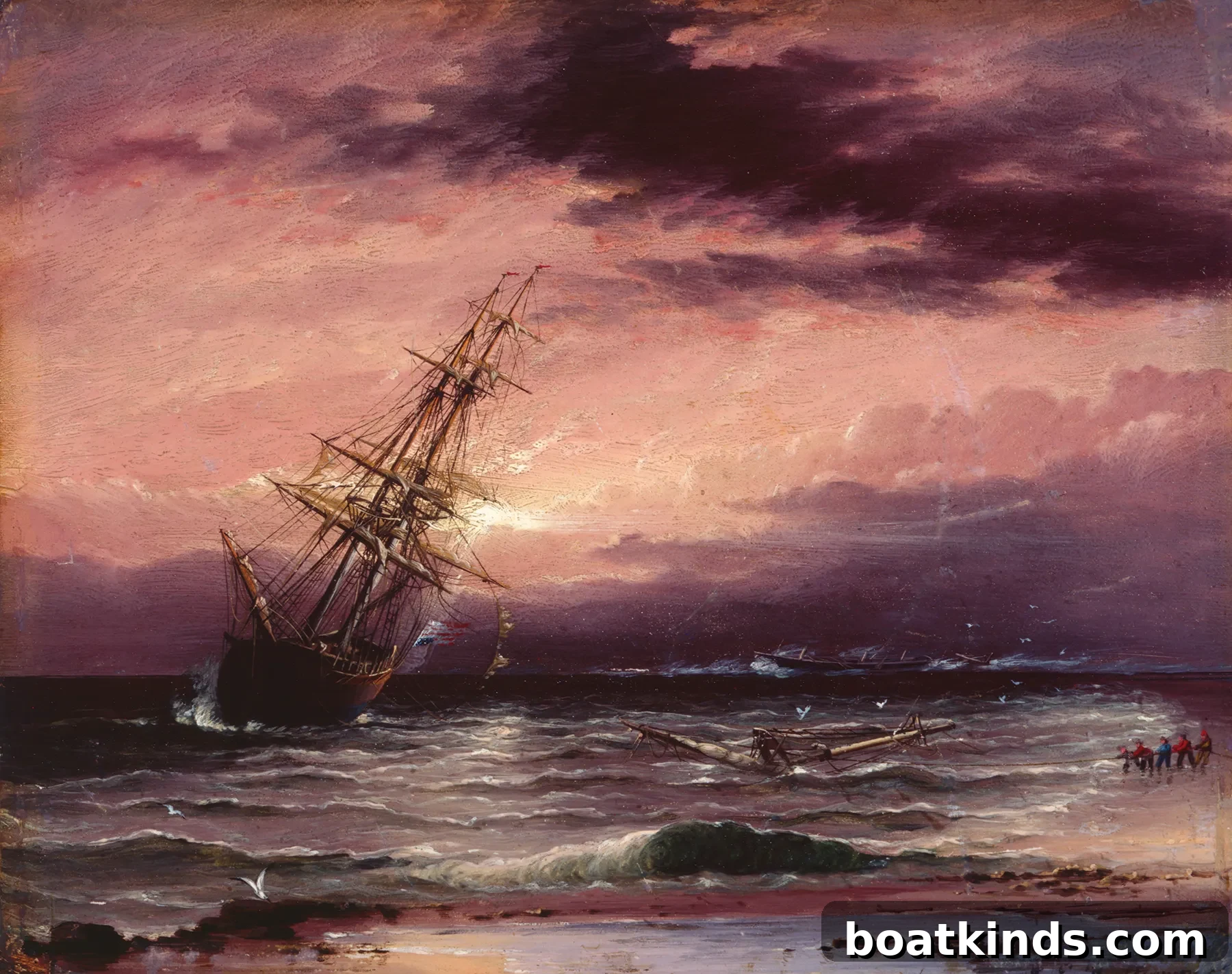
James Edward Buttersworth and “Ships Stranding”: A Study in Light, Motion, and Maritime Detail
The painting “Ships Stranding,” produced by James Edward Buttersworth around 1860, captures a moment of intense drama on the Atlantic coast: a two-masted brig stranded on the sand as a pink sky and purple clouds frame the fading sun. Buttersworth renders the scene with precise attention to the techniques and tools sailors used to reach safety, including the lines and spars deployed by the crew. Men in the foreground are tying a line to the wreckage while another, wading into the water, secures a lifeline—actions that also promised salvage rewards for those who could recover parts of a wreck. A second stranded vessel appears almost swallowed by the dimmer distance, underscoring the perilous conditions that could confront ships along New York and New Jersey beaches in that era.
Buttersworth’s handling of light and movement gives the scene both theatrical intensity and careful realism. Contemporary observers and later critics have pointed out his particular skill at suggesting transitory effects—the brief interplay of wind, wave and light that defines a maritime moment. As Hellen Comstock wrote in Antiques magazine, Buttersworth was “a master in suggesting transitory effects of movement and light, the greatness of the sea, and the beauty of sail.” That blend of drama and accuracy made scenes such as “Ships Stranding” visually compelling and historically informative.
Born in London in 1817, Buttersworth trained under his father, the established marine painter Thomas Buttersworth Jr., and developed a command of maritime subject matter early in his career. He married Ann Plowman in 1838, and in 1845 the couple emigrated to the United States, settling in Hoboken, New Jersey. Buttersworth later worked out of a modest studio in nearby Brooklyn, but he frequently worked from small boats on the water to study the scale and motion of ships firsthand—a practice that informed the authenticity of his compositions.
Buttersworth’s American debut came in 1850 at the American Art Union, where he sold five paintings at prices that ranged from $25 to $40. Around this time he attracted the attention of Nathaniel Currier of the Currier & Ives printmaking firm. Currier recognized Buttersworth’s ability to create dramatic scenes that were theatrical without sacrificing technical accuracy, especially in his depictions of large clipper ships. Currier & Ives reproduced many of Buttersworth’s works as lithographs, responding to a popular market for maritime images among shipowners, captains and shipbuilders who commonly commissioned portraits of their vessels.
Over the course of his career, Buttersworth remained devoted to capturing motion: the roll of a ship, the tension of rigging, the sweep of sails and the changing atmosphere around vessels at sea. In later years he increasingly painted steamships and documented America’s Cup races, reflecting both technological change and growing public fascination with competitive yachting. Estimates place his lifetime output at more than 1,500 canvases, a testament to both his productivity and the steady demand for his work among collectors and maritime patrons.
Buttersworth died in Hoboken in 1894. Today his paintings are valued not only for their aesthetic qualities but also for the reliable detail they offer historians and enthusiasts of 19th-century seafaring. Works like “Ships Stranding” serve as vivid visual records of how crews fought for survival and salvage, how coastal conditions could turn hazardous, and how artists translated those ephemeral moments into lasting images. Critics and collectors continue to praise his combination of dramatic composition and technical fidelity, recognizing in his canvases a rare ability to convey the sea’s grandeur while preserving the small but telling actions of sailors facing danger.
—Lidia Goldberg
This article was originally published in the March 2023 issue.