A Fire at Sea: Abandon Ship! — A Mid-19th-Century Maritime Painting Examined
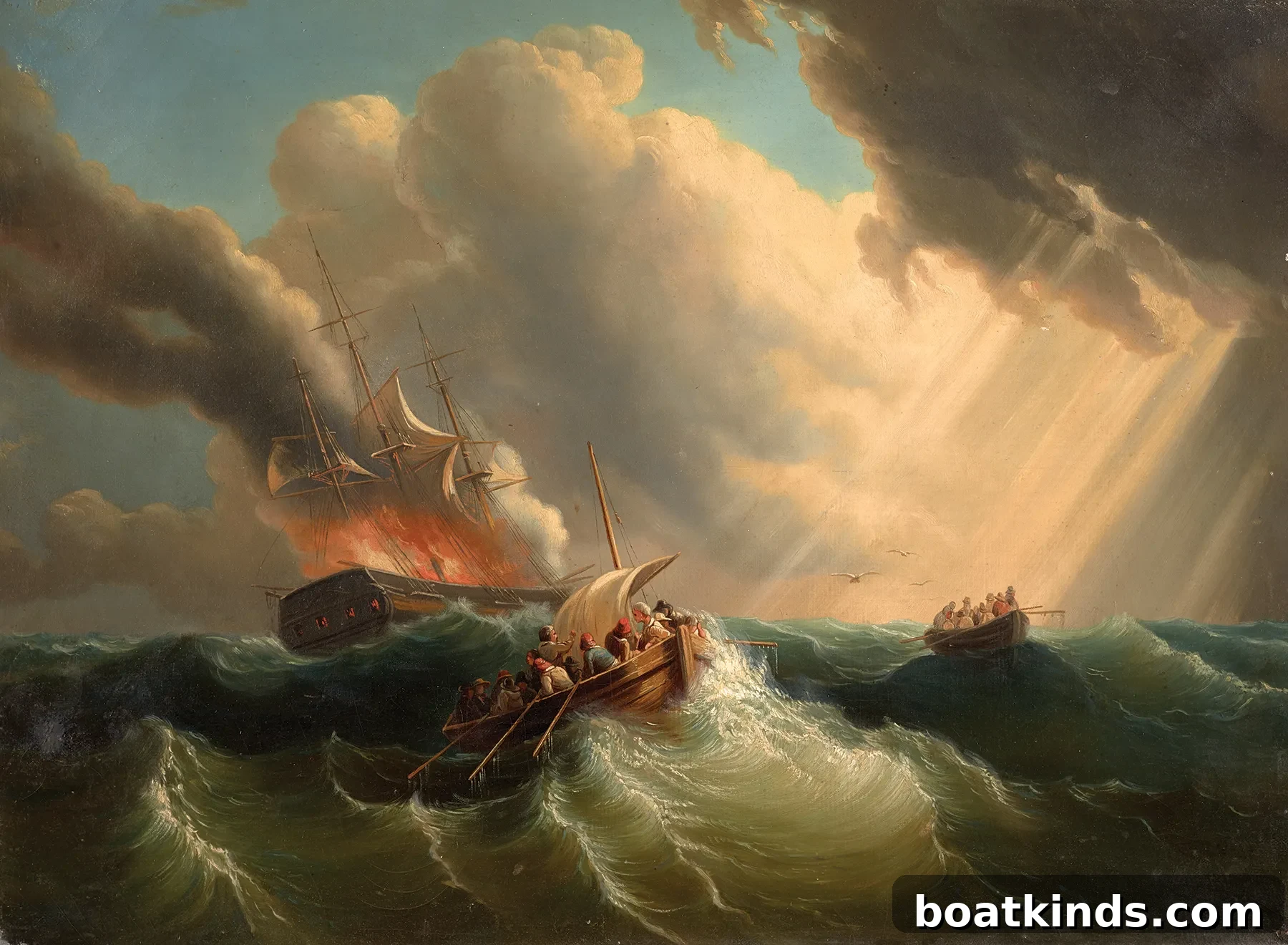
This mid-19th-century oil painting, titled A Fire at Sea: Abandon Ship!, depicts a dramatic maritime emergency: flames consume a three-masted ship while crew and passengers flee in lifeboats. The scene captures wind and smoke driving across the composition toward the burning vessel. Large clouds of black smoke hang above the ship, and a band of sunlight breaks through darker skies to illuminate the lifeboats, creating a striking contrast between peril and hope. The painting’s dramatic lighting gives the small boats a luminous, almost heavenly emphasis, suggesting a narrative of survival amid disaster.
Composition and Technique
The artist renders sea and sky with convincing realism. Waves respond to the wind, and the rigging of the distressed vessel is carefully painted to reflect how lines and sails behave under strain. Although the painter’s identity is unknown, these details indicate practical familiarity with ships and storms—either from direct experience at sea or from careful study of nautical subjects. The choice to portray the vessel at an oblique angle, rather than in pure profile as many 19th-century marine painters commonly did, adds dynamism and a greater sense of motion to the scene while remaining true to the ship’s physical behavior.
The interaction of light and atmosphere is central to the painting’s emotional effect. Darkened clouds occupy the upper right of the canvas, yet sunbeams penetrate the gloom to spotlight the lifeboats. This focused illumination not only guides the viewer’s eye but also serves as a visual metaphor: amid calamity there is a promise of rescue or divine protection. The painter’s control of tonal contrast—brightness against deep shadow—heightens the drama and directs attention to the human figures clutching for survival.
Iconography and Allegory
Shipwrecks and sea disasters frequently functioned as moral or religious allegories in European art. As Lyles Forbes, vice president of collections and chief curator at The Mariners’ Museum and Park in Newport News, Virginia, observes, “The narrative captured in the painting is more important than the identity of the artist.” In this tradition, storms and wrecks could symbolize human frailty, divine judgment, or the perilous consequences of sin. The painting’s emphatic contrast between the burning ship and the illuminated lifeboats invites multiple readings—both as a literal account of maritime catastrophe and as an emblematic tale of trial and deliverance.
Stylistic Connections
Forbes notes stylistic affinities between this work and paintings by Claude-Joseph Vernet and Eugène Delacroix. Vernet’s seascapes are known for atmospheric sky studies and dramatic coastal incidents, while Delacroix favored expressive lighting and heightened emotional content. Like those masters, the unknown painter here uses color and sky to shape mood and to heighten a narrative thrust. Whether intended as a moralizing image or as a vivid recounting of an event, the work sits comfortably within mid-19th-century conventions that balanced natural observation with symbolic resonance.
Provenance and Attribution
The painting’s creator remains unidentified, but some provenance details are available. The work passed through Bonham’s, the international auction house. According to Bonham’s records, Robert P. Weimann, Jr., of Ansonia, Connecticut, advised previous owners and suggested an attribution to an artist with the surname De Grayley. While this possible attribution offers a clue, it has not established a definitive authorship, and the painting continues to be valued primarily for its narrative power and technical skill rather than for a named hand.
Historical Value
Before the widespread use of photography, paintings often served as visual records of dramatic events, and marine scenes like this one could stand as eyewitness testimony or commemorative images. Whether the scene portrays a specific incident the artist witnessed or is a composite informed by many accounts, it illustrates how painters documented maritime hazards and human responses at sea. The work’s enduring strength lies in its capacity to convey both the physical realities of a storm and the emotional stakes faced by those on board.
Although the artist remains unknown, A Fire at Sea: Abandon Ship! demonstrates the continued importance of anonymous marine painters to our understanding of maritime history and visual culture. Its careful observation of nautical detail, powerful use of light, and layered narrative meaning make it a compelling example of mid-19th-century marine art.
— Lidia Goldberg
This article was originally published in the April 2023 issue.