
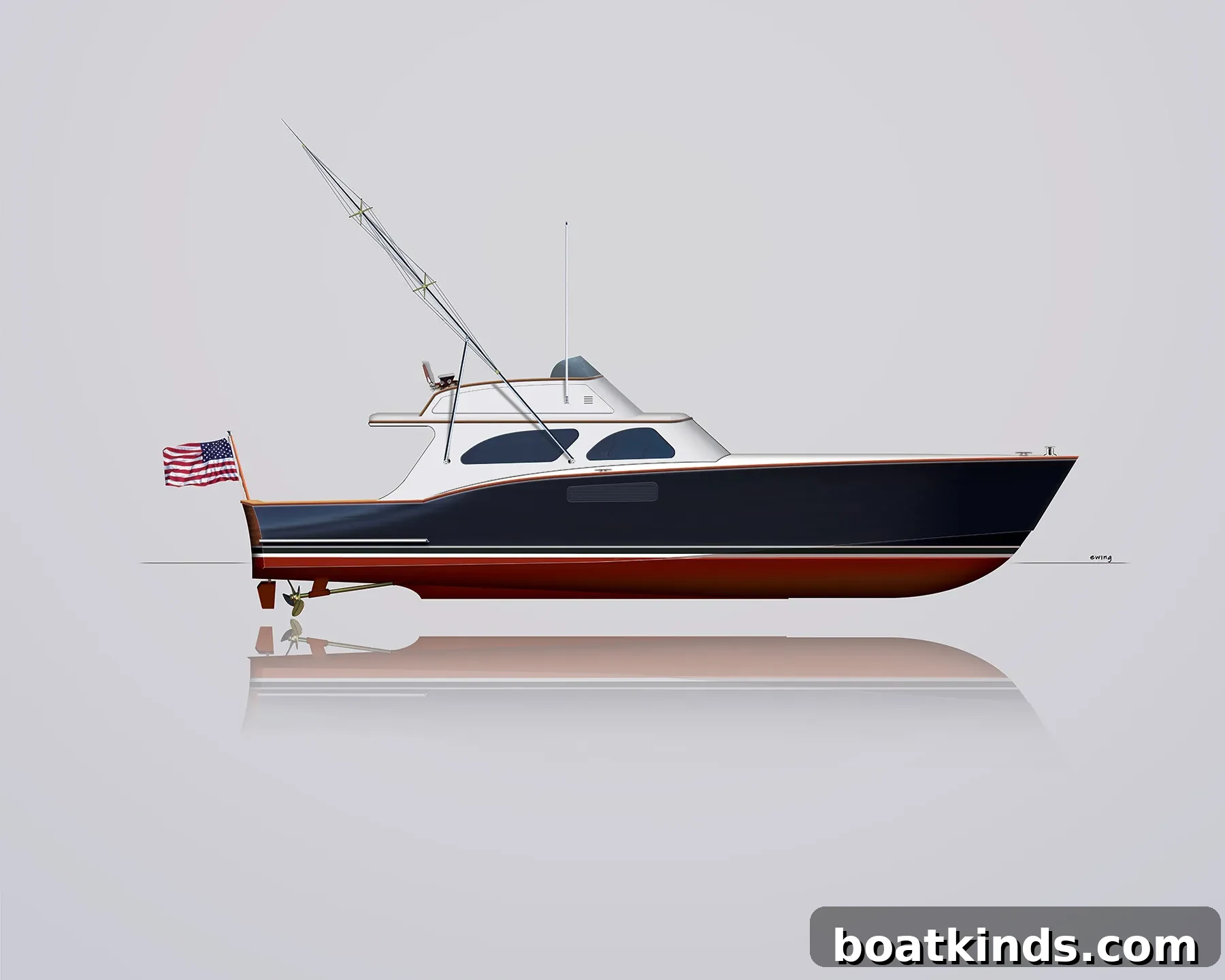
Whiticar Boat Works: A Century of Sportfishing Craftsmanship in Stuart, Florida
In 1917, Addison Whiticar relocated his family to the quiet oceanside town of Stuart, Florida, to pursue commercial fishing. The area offered a rare combination of advantages: a large, navigable inlet and proximity to the Gulf Stream, which regularly brings desirable gamefish into nearby waters. Those natural assets, together with growing transportation links, made Stuart an attractive place to build a life on the sea.
How Infrastructure and Location Shaped a Boatbuilding Tradition
One factor that amplified the opportunity in Stuart was the expansion of Henry Flagler’s Florida East Coast Railway. By 1912 Flagler’s line connected Jacksonville to Key West, increasing trade, tourism and land development along Florida’s eastern coast. That broader economic growth helped create a market for sportfishing and the boats that made it possible—both for local commercial fishermen and for visiting anglers seeking billfish, tuna and other offshore species.
From Fishing Boats to Purpose-Built Sportfishermen
In the mid-1930s, Addison’s son Curtis began building boats that reflected the evolving needs of offshore anglers. He first constructed a single-screw 33-foot boat for himself and followed that with a 38-foot twin-screw sportfisherman for his father. Those early efforts established a focus on seaworthiness, practicality and performance that would define the Whiticar name.
By 1947 Curtis turned his talent into a business, and in 1949 he formed a partnership with his brother-in-law John Dragseth. Together they produced customized, tournament-ready designs that quickly earned respect among saltwater anglers. Whiticar boats became known for careful construction, attention to detail and layouts tailored to serious fishing: ample cockpit space, durable teak soles, well-placed fighting chairs and storage for bait and fish.
Construction Evolution: From Carvel Planking to Cold-Molded Hulls
Over time Whiticar adapted its construction methods to improve strength, speed and handling. The company moved from traditional carvel-planked hulls to cold-molded construction. Cold-molded hulls are built from multiple thin layers of wood laminated with epoxy and cloth, often vacuum-bagged to create a stiff, lightweight structure. This approach yields a hull that can run faster, respond more crisply to steering inputs and better withstand the often-turbulent conditions of Gulf Stream waters.
Whiticar’s boats ranged from compact 33-foot models to large 90-foot sportfishermen, and many were outfitted with the era’s state-of-the-art fishing gear: outriggers for trolling, tall tuna towers for spotting fish and birds, robust fighting chairs for landing large gamefish, and flybridge helms that offer excellent visibility of the cockpit and surrounding water.
A Notable Example: The Whiticar 56
One especially illustrative build was the Whiticar 56 named Picasso, launched in 2001. Its hull design featured a deep forefoot, a modestly raked stem and generous forward freeboard to handle big seas with confidence. The bottom construction included triple-planked solid mahogany laminated with epoxy and cloth, then vacuum-bagged to achieve exceptional strength and structural integrity.
Originally powered by twin 1,150-horsepower Detroit Diesel/MTU 12V183 engines, Picasso could reach a top speed of about 35 knots and remained on plane down to roughly 15 knots—performance that balanced speed with seakeeping for long runs offshore. In 2012 the boat underwent a major refit at the Michael Rybovich & Sons yard, receiving new engines and updates before being relaunched under the name Never Enough.
The Legacy and Continuation of Craft
Curtis Whiticar retired in 1986 at age 75 and passed away in 2017 at 106. The company he helped build continued for decades, with the next generation of Whiticar and Dragseth family members taking over operations and preserving the brand’s reputation for custom, fish-focused yachts. In 2022 Whiticar Boat Works was sold to HMY Yachts, marking a new chapter in the company’s long history.
Throughout its existence Whiticar Boat Works earned a place in the story of American sportfishing by combining practical fishing layouts, thoughtful construction techniques and an understanding of the local marine environment. Their boats remain appreciated by anglers and boat aficionados who value traditional craftsmanship married to performance and durability.
—John Wooldridge
This article was originally published in the April 2023 issue.