
Trinidad: Rediscovery of an 1867 Great Lakes Cargo Ship
Built at Grand Island, New York, in 1867, the schooner Trinidad spent much of its working life in the busy grain trade of the Great Lakes. For years she carried grain between Milwaukee, Chicago and Oswego, New York, making the routine but vital runs that kept regional commerce moving. Over time the vessel began to show signs of wear and age, like many wooden and iron-hulled freighters that faced harsh weather and constant loading and unloading on the lakes.
On May 11, 1881, under the command of Captain John Higgins, Trinidad began to take on water while on Lake Michigan. Captain Higgins and his crew of eight abandoned ship as the situation deteriorated and watched from their lifeboat as the vessel slipped beneath the surface. Higgins later produced a detailed report that described the sinking and the location where Trinidad had gone down, a record that proved invaluable to future shipwreck hunters.
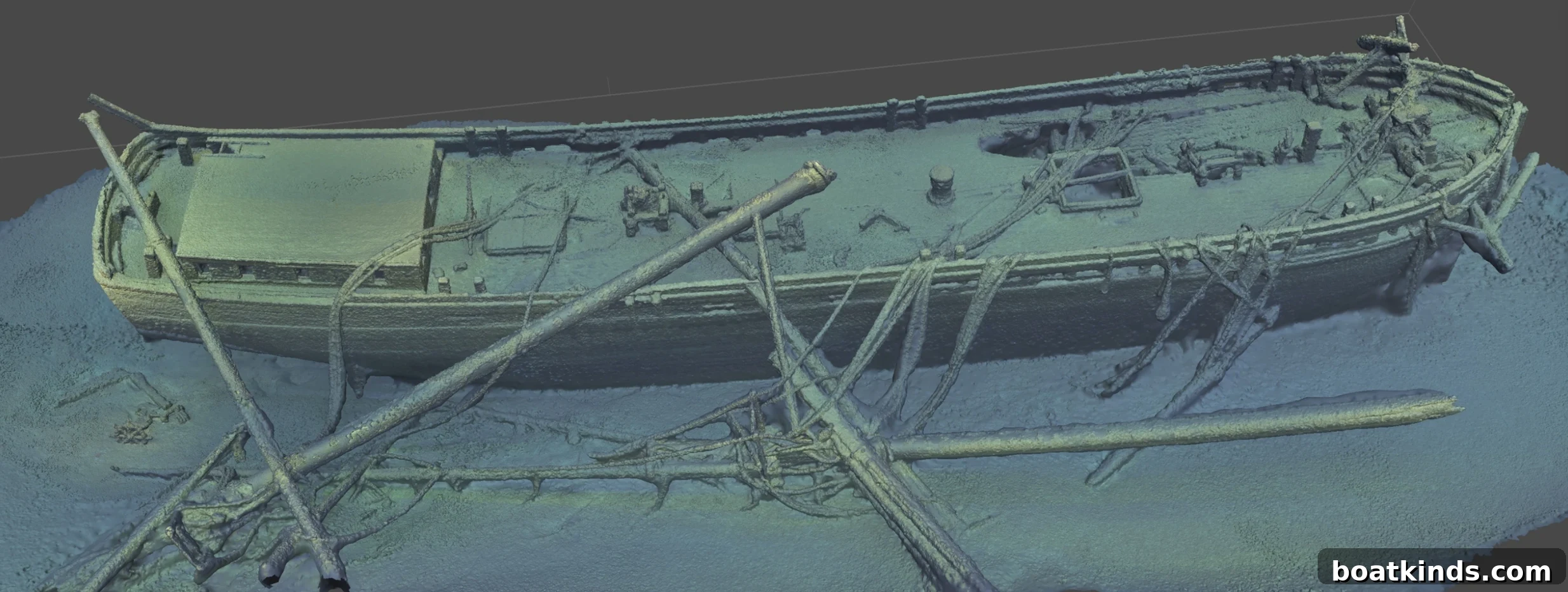
After 142 years on the lakebed, wreck hunters Brendon Baillod and Robert Jaeck located the Trinidad nearly 300 feet below Lake Michigan’s surface. The discovery revealed a remarkably intact vessel. Investigators found the deckhouse still attached, and cabinets inside the structure with dishes stacked on their shelves—an evocative snapshot of life aboard before the sinking. Baillod described the scene to reporters as “like a ship in a bottle. It’s a time capsule,” a phrase that captures both the preservation and the emotional resonance of finding a vessel so well preserved after more than a century.
The Trinidad’s rediscovery adds to a growing list of Great Lakes shipwrecks that shed light on regional maritime history. The lakes have long been both a transportation corridor and a graveyard for hundreds of vessels lost to storms, collisions and structural failures. Each wreck that is located and documented offers historians and the public a tangible connection to the people, technology and commerce of earlier eras. In the case of Trinidad, the preserved interior objects—dishes and cabinetry—offer unusually intimate details about daily life aboard a 19th-century cargo ship.
Discoveries at depths of nearly 300 feet require specialized equipment and careful planning. Modern wreck hunters and underwater archaeologists typically use remotely operated vehicles (ROVs), side-scan sonar and submersibles to locate and examine wreck sites without disturbing them. When a wreck is as intact as Trinidad, documentation becomes a priority: detailed mapping, high-resolution photography and video surveys record the site’s condition and context, allowing researchers to study construction techniques, cargo arrangements and personal effects while leaving the site as undisturbed as possible.
Beyond the technical achievement of locating a long-lost vessel, the Trinidad’s condition highlights the cold, fresh water of the Great Lakes as a preservative environment. Unlike saltwater environments that accelerate metal corrosion and biological decay, the lakes can preserve wooden and iron-built hulls and onboard artifacts for many decades, sometimes centuries. That preservation creates unique opportunities for historians, conservators and divers to learn about shipbuilding practices, the grain trade routes that linked Midwest ports, and the everyday lives of sailors who worked those routes.
While the Trinidad’s story is compelling on its own, it also serves as a reminder of the many untold stories resting beneath the lakes’ surfaces. Each shipwreck has a human element—captains, crews, passengers—and each discovery prompts questions about safety, navigation and the economic networks of the past. When explorers like Baillod and Jaeck document these sites, they help preserve maritime heritage and make it available for future study and public awareness.
The Trinidad is now part of a larger narrative about the Great Lakes’ maritime past: a vessel built to carry grain, lost after a single critical voyage caused by flooding, and recovered as a remarkably intact time capsule more than a century later. The discovery invites renewed interest in shipwreck preservation, underwater archaeology and the stories of the people who once sailed and worked on these inland seas. Read contemporary coverage for more details on the rediscovery and the condition of the wreck reported by news outlets.