
David Witbeck’s Playful Maritime Paintings: A Look at “Some Lumpy”
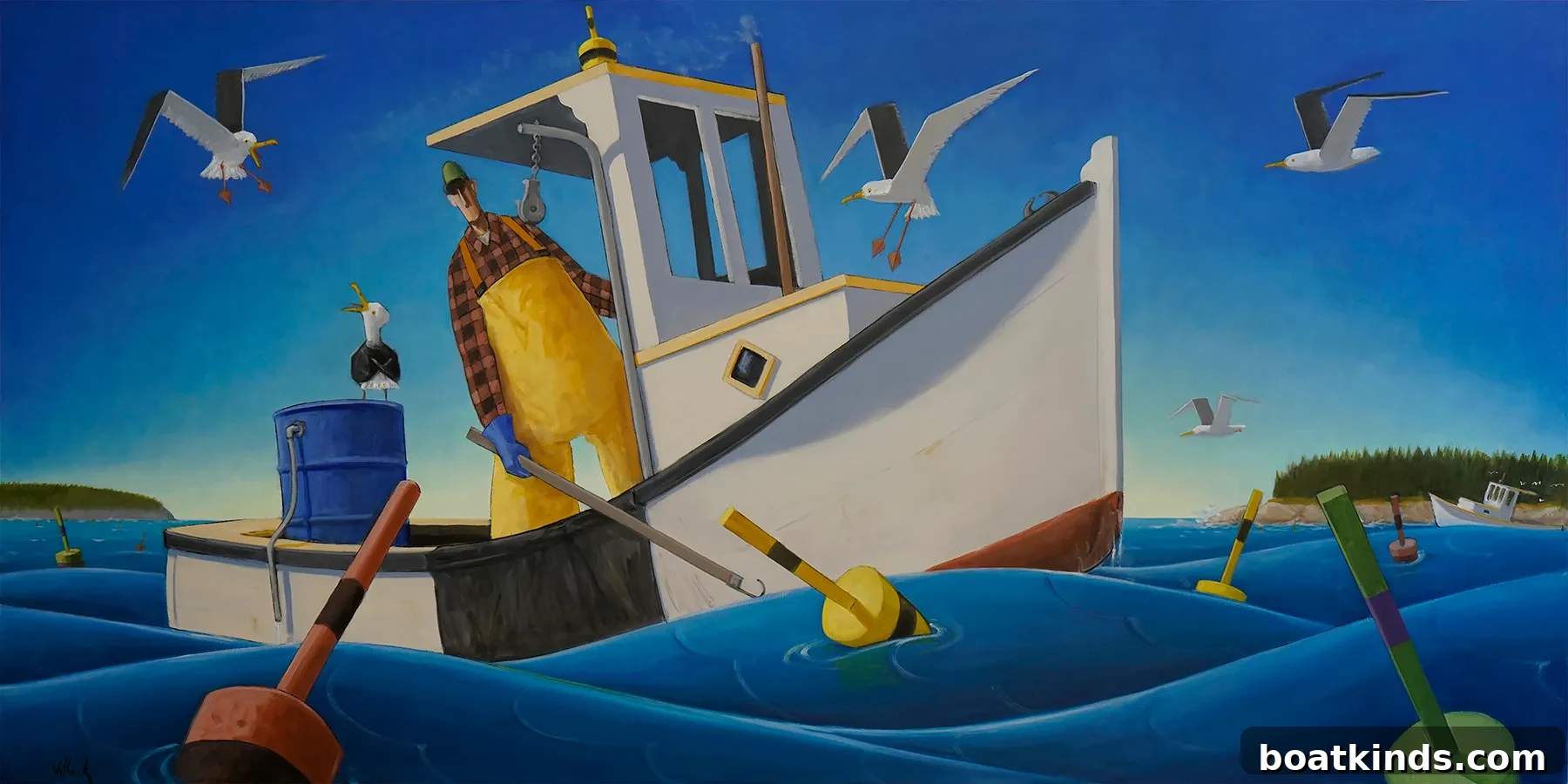
The painting Some Lumpy by David Witbeck captures a whimsical moment at sea: seagulls wheel and cry above a small fishing boat and its lobsterman, while oversized buoys and exaggerated proportions lend the scene a comic energy. Bold blues form the rolling waves and open sky, creating a clear, graphic backdrop that lets the humorous scale differences—the wide hands, the tiny heads, the squat boat—take center stage. Witbeck’s use of saturated color and simplified shapes gives the piece a signature mix of warmth and wit that defines much of his maritime work.
Roots on the Water and an Artistic Path
Witbeck was born in New York and raised in Rochester, where his earliest memories of being on the water were shaped by outings on the Hudson River and the Erie Canal. Those early experiences fostered a lifelong connection to sailing and coastal life. He learned to sail in a Cape Dory Typhoon and later owned a Marshall catboat—small, traditional craft that informed his familiarity with boats and their personalities. After high school he studied art at the Rhode Island School of Design from 1965 to 1969, establishing a foundation in drawing and painting that would resurface decades later.
From Painting to Photography and Back Again
Becoming father at a very young age shifted Witbeck’s focus in the 1970s from painting to photography, as he balanced creative ambitions with family responsibilities. For several decades photography became his primary visual language. He returned to painting in 2000, bringing with him a photographer’s eye for framing and perspective. Although some paintings begin from photographs he has taken, most of his compositions come from imagination—visual ideas shaped by memory, observation, and a desire to play with scale and form.
A Distinctive Visual Language
Witbeck’s paintings are often recognizable for the same playful distortions that wide-angle lenses produce: hands that dominate the foreground, heads reduced to small, expressive features, and vessels rendered with simplified, strong silhouettes. He appreciates how photography can shift emphasis to a person’s hands and activities rather than to detailed surroundings, and he translates that sensibility into paint. Rather than repeating the same motif verbatim, he deliberately varies how he approaches a subject—finding new ways to emphasize gesture, color, and composition.
Boats, Family, and Everyday Inspiration
After art school, Witbeck spent more time living in Rhode Island, which provided the marine environment and visual references that recur in his work. His personal Sisu 22—a small, sturdy boat he still owns—influenced the distinctive lobster-boat silhouette that appears repeatedly in his paintings. Family outings, time on deck, and the tactile experience of working with ropes, buoys, and nets feed his imagination. Some studio days are quiet and unproductive; other days erupt into a rush of ideas where strong colors, compact boats, and exaggerated human figures come together into lively canvases.
The Joy in Making
Witbeck describes his process with candid simplicity: sometimes nothing happens, and sometimes the work pours out of him. The paintings that do come alive tend to be boisterous, humorous, and affectionate toward their subjects—the people and vessels that populate coastal life. He embraces the mystery of inspiration, acknowledging that he often cannot predict where a painting will begin or how a composition will resolve. That openness is key to the spontaneity and charm found in pieces like Some Lumpy.
This article was originally published in the December 2023 issue.