
“I’d never owned a saltwater boat before, let alone a twin-screw,” said Alex Pyle-Struzinski of Chester, Connecticut. “I had lake boats growing up but was boatless for several years before moving closer to Long Island Sound. I wasn’t looking for a boat when I bought the Egg from my friend Lars, who had purchased it from an estate. It had been sitting unattended for several years and he did little more than get it running. When he decided to buy another boat, it just kind of fell into my lap.”
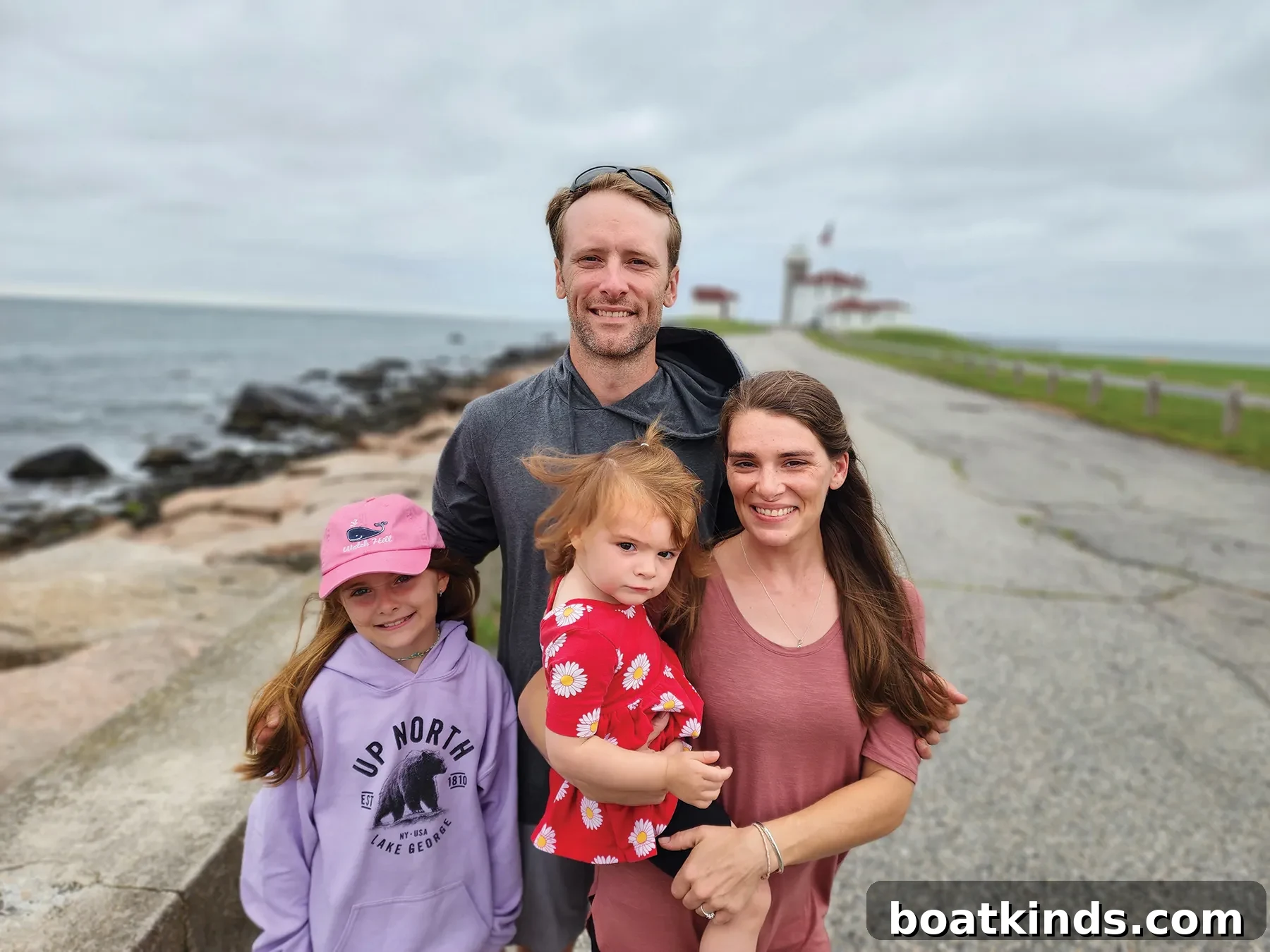
Alex knew the Egg Harbor would need work, but he welcomed the project. Today Misbehavin’ III — a 1989 Egg Harbor 35 — looks and performs better than when he first bought it. The boat retains its original name on the transom, which Alex kept because it suits his family: “Misbehavin’ was the perfect description of my wife, Nicole, and our two daughters, Abigail and Ellie, so I kept it.”
The Egg Harbor 35 SF is one of the builder’s most popular models. Introduced in 1986 and produced into the late 1990s, the 35 was developed from the 33 Convertible that debuted in 1982. Designers added two feet to the hull to improve seaworthiness and to create space in the cockpit for a fighting chair and better fishing accommodations. According to Robert Hazard, who worked with Egg Harbor beginning in the mid-1980s, hundreds of these boats were built and sold during the marque’s long history.
Misbehavin’ III is a twin inboard, gas-powered 35-foot sportfisherman with a roomy cockpit and a dedicated tackle station. This example is the “galley-up” layout, meaning the galley and salon are on the main deck in the deckhouse. That arrangement frees up the lower cabin for a forward master stateroom, a separate twin bunk room and a head, while the helm sits on an all-weather flybridge above.
At first Alex admits he felt intimidated by the boat’s size and twin-screw handling. “It’s a lot of boat, but it came naturally to me,” he said. “Operating twin screws reminded me of the skid-steer and bulldozer controls I used at work. I did take Lars’ advice: ‘Just don’t go any faster than you want to hit something.’ I took it slow the first year, and now I’ve really got the hang of it.”
Nicole came to boating with less experience than Alex, but she embraced what the 35 provides: time together exploring nearby waters and comfortable cruising for weekends away. “This summer we went to Watch Hill, Rhode Island, anchored for a couple of days and used our Highfield RIB to get ashore,” Alex said. “From there we port-hopped south to Mystic Seaport, which is my favorite anchorage. After that we returned up the Connecticut River to our slip at Ferry Landing Marina in Old Saybrook. We spent a week sightseeing, eating and sleeping aboard — a relaxed family cruise that everyone enjoyed.”
Since purchasing Misbehavin’ III, Alex has completed a number of mechanical and systems upgrades. He replaced carburetors, manifolds and risers and addressed other engine components. He installed a windlass and fitted all-new electronics, including radar, VHF radios and antennas. Inside, the couple refreshed the interior and added a Xantrex Freedom inverter tied to two large house batteries. The inverter lets them run refrigeration and make coffee at anchor without firing up the generator. “We’ve spent two days on the hook without turning on the genset,” Alex said. “We just recharge the batteries while underway.”
The restoration and daily care have taught Alex a few lessons. “My next boat probably won’t have any teak,” he joked. “I enjoy woodworking, but keeping teak in good shape is tedious and time-consuming.” Even so, he appreciates the traditional finish and feels the solid, well-built Egg Harbor hull remains the right boat for family passages and fishing on Long Island Sound. He values the boat’s seaworthy construction and confidence-inspiring ride when conditions get challenging.
Beyond the practical benefits, the boat has brought the family closer. “Abigail has become my boat buddy,” Alex said. “Early in the season she insists we sleep on the boat every weekend, even when we aren’t going anywhere. That habit lasts until the Fourth of July, and by then we start planning longer cruising trips.”
Alex also hopes this story reaches the vessel’s original owners. Since the boat still bears its original name and the home port of Providence, Rhode Island, he would welcome any information about its early history. “It would be really cool to learn more about the boat’s past,” he said.
About Egg Harbor
Egg Harbor Yacht Company traces its origins to 1946. The first Egg, a wooden 29-foot Jersey Sea Skiff designed by E. Lockwood (Ted) Haggas, helped establish the company’s reputation. Later designs, such as George Stadel Jr.’s celebrated 1959 Egg Harbor 37 Sportfisherman, earned praise for their aesthetics and seaworthiness. The company was founded by Russell Post and John Leek; both men later moved on to other ventures in the marine industry. Over the decades Egg Harbor changed hands several times. In 1999 many of its assets were purchased by Dr. Ira M. Trocki, and while only a few new Egg Harbors have been built in recent years, the brand remains respected among classic sportfisherman enthusiasts. John Leek IV later sold the remaining manufacturing facility to Viking Yacht Company and now oversees operations at the Valhalla facility on that site.
Egg Harbor 35 Sportfisherman
LOA (with pulpit): 38’2” • Beam: 13’2” • Draft: 3’2” • Fuel: 400 gallons • Water: 50 gallons • Power: twin Crusader gas or Caterpillar diesel
This article was originally published in the February 2024 issue.