
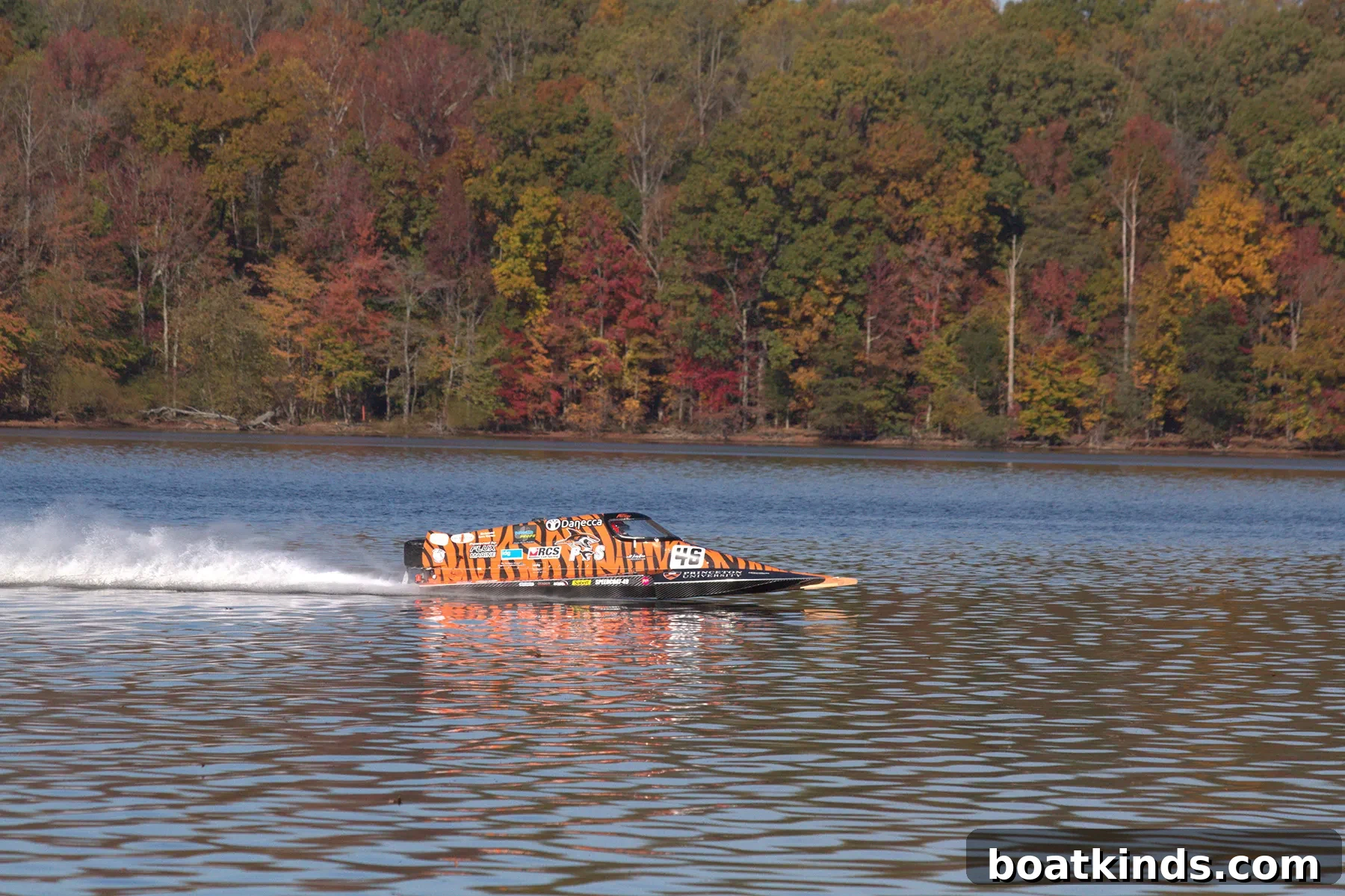
Speed records have long been a powerful way to showcase new technology—whether a daring Atlantic crossing by schooner or a jet breaking the sound barrier. As electric marine propulsion has matured, attention naturally turned to the fastest battery-powered boats. In a striking development in late 2023, Princeton Electric Speedboating (PES), a student-run club from Princeton University, claimed a new Union Internationale Motonautique (UIM) Circuit Outright Electric Class top speed: 114.2 mph. The run, aboard the tiger-striped hydroplane Big Bird on Lake Townsend near Greensboro, North Carolina, shattered the previous record by more than 25 mph and underscored how quickly electric propulsion is advancing.
PES began in 2020 when Princeton junior Nathan Yates answered a call for entries to the Promoting Electric Propulsion competition. The original five-person team worked remotely during the Covid pandemic to build an electric powertrain for a small hydroplane. Their first boat swamped shortly after launching at the 2021 competition in Boston, but the effort continued to attract new student members. The team acquired a 12-foot D Stock hydroplane called Tiger and proved that electric propulsion could push small craft—Tiger reached 42 mph on electric power and as much as 85 mph on an internal combustion outboard.
That performance inspired freshman Andrew Robbins, a Michigan native who grew up waterskiing behind his family’s 17-foot Boston Whaler and piloting a 42-foot Cigarette. Robbins proposed that, with a more powerful electric outboard and a larger hull, PES could defeat the existing electric speed mark of 88.61 mph. The idea gained momentum. The team expanded to include undergraduates and graduates—ultimately 44 students from engineering, physics and economics—bringing broader technical and project-management skills to the challenge.
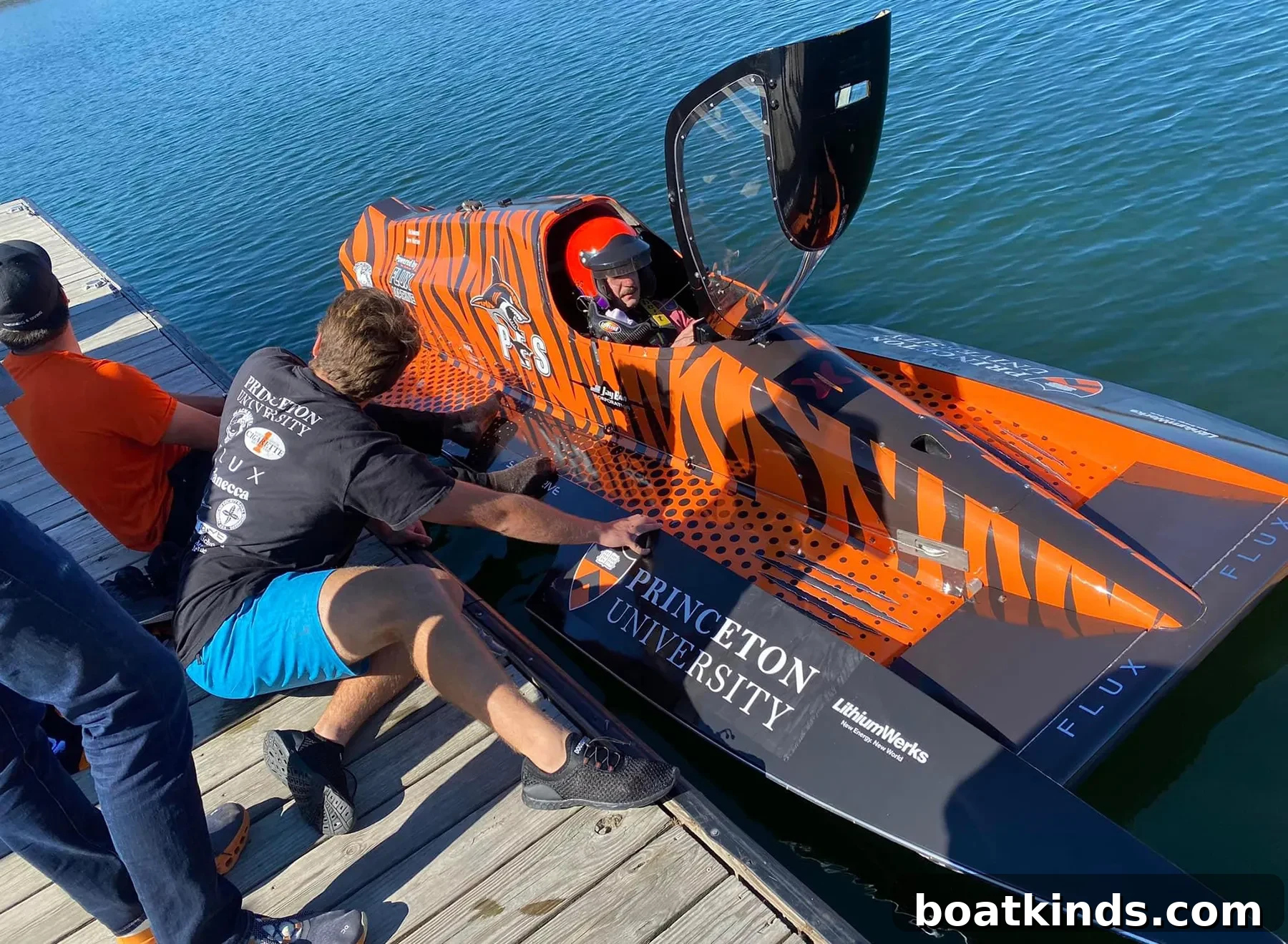
To find the right platform, Robbins worked with powerboat racer J.W. Myers, who connected him to Jim Dernoncourt, owner of Big Bird. Big Bird is a 14-foot Pro Outboard canopied hydroplane designed by Ed Karelson and built in 1993 for the late Howard Anderson, a respected record-setting racer. The boat had recently undergone a complete refurbishment and, importantly, was known for being fast and safe—making it an ideal candidate for PES’s conversion to electric power.
For propulsion and batteries, PES partnered with Flux Marine through Ben Sorkin, a 2017 Princeton graduate and one of Flux’s co-founders. Flux supplied a 400-volt, 24-kWh battery pack and its motor, which the team tuned by modifying the motor controller to raise rpm and increase peak output from 150 to 180 hp. Because the official record runs are short—well under a minute—the team could allow the motor to operate at peak power for those bursts rather than relying on lower continuous ratings.
Engineering challenges included designing a midsection to mount the Flux motor to Big Bird’s transom and developing a closed-loop cooling system for both the motor and the inverter. The drive system used a Bass Machines lower unit with 6 percent overdrive gearing and a four-blade Dewald 8 x 19 propeller. While the motor and controller weighed only about 80 pounds, the four lithium battery modules added roughly 330 pounds—compared to only about 35 pounds of liquid fuel when the boat ran on internal combustion. Overall boat weight with driver rose from about 700 pounds to 975 pounds, which required careful trim and performance tuning.
PES assembled and tested the converted hydroplane in the Princeton mechanical and aerospace engineering lab before a first public trial on Lake Carnegie in March 2023. The initial run was disappointing—just 7 mph—but iterative adjustments to motor height, trim and drive components quickly improved results. By August the team had raised the boat’s top speed to 98 mph, putting them within reach of an official record attempt.
UIM and the American Power Boat Association (APBA) govern world record certification for speed: the measured event is an average over a one-kilometer course, with the boat allowed to accelerate before entering the measured section. To qualify, the boat must make two runs in opposite directions within 15 minutes, and no recharging or battery replacement is permitted between those runs. PES scheduled a sanctioned attempt on Lake Townsend with veteran powerboat driver John Peeters at the helm and support from 18 team members handling operations and timing.
On Oct. 26, Peeters completed the required two passes. The first measured run recorded 111.08 mph and the return pass reached 117.50 mph, producing a certified average speed of 114.2 mph—enough to claim the UIM Circuit Outright Electric Class record. The boat still had more than 80 percent battery charge remaining, so additional attempts were possible, but the team’s day ended when a prop shaft broke.
Looking forward, PES plans to continue pursuing higher speeds. The club is working with Black Sheep Racing to build a new 16-foot hydroplane and intends to test different battery chemistries capable of higher discharge rates to deliver more peak power. Beyond chasing records, the project highlights how electric marine propulsion can be competitive, scalable and increasingly viable for high-performance applications.
“Setting this record has raised awareness of advancing electric marine power,” said Robbins. “We are demonstrating that electric power can be competitive and will get better and better. It’s also not a bad resume builder for everyone on the team.”
This article was originally published in the March 2024 issue.