
For more than fifty years Sam Devlin has been designing and building boats. By his own tally he’s built 434 vessels and estimates that another thousand or so have been built from his plans by other builders. He has also authored two books about the stitch-and-glue technique he favors for assembling small craft.
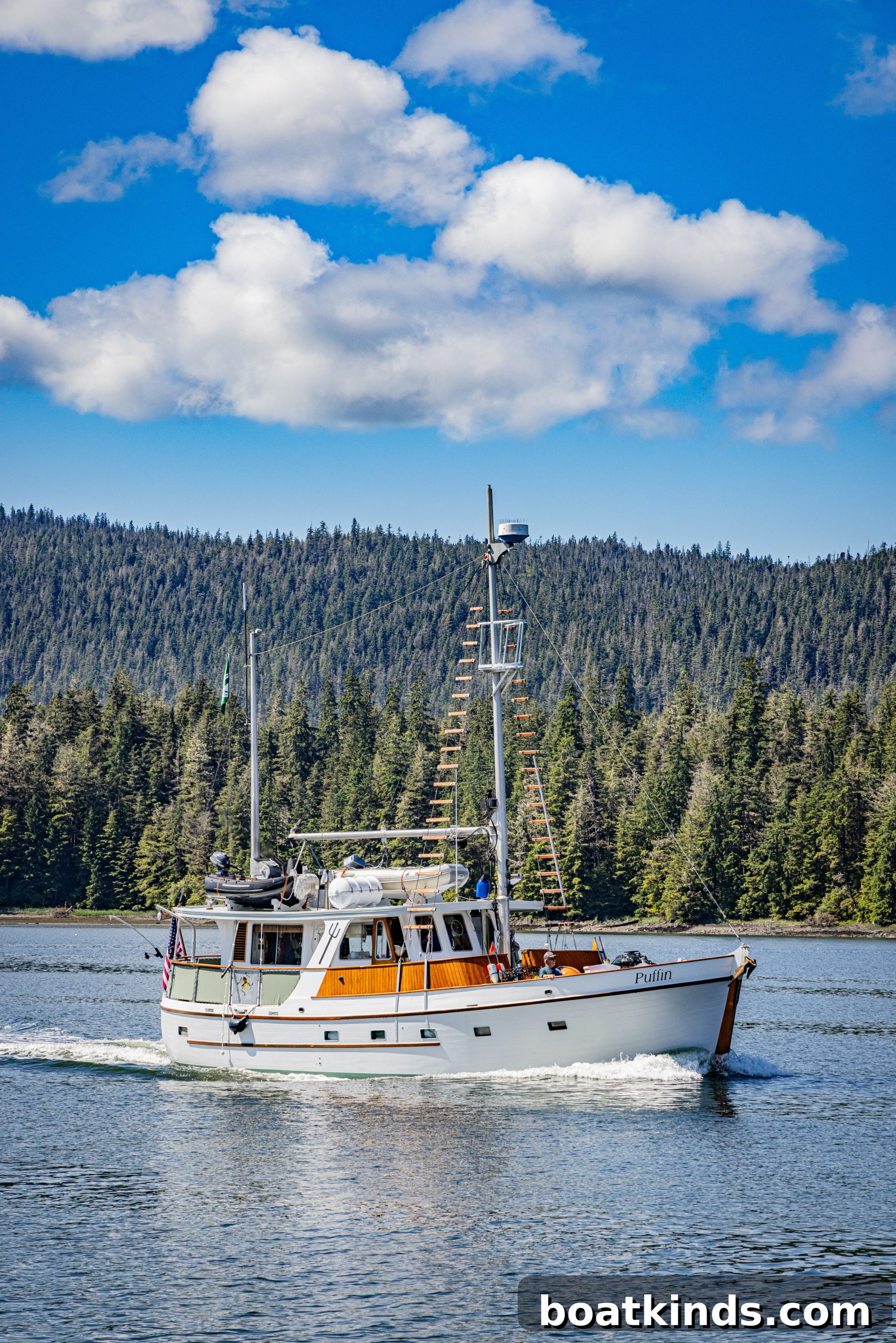
Now, at 70, Devlin is attempting something different: learning how to slow down. He admits he isn’t sure he knows how. “This is going to be an interesting experiment,” he told me from his shop in Olympia, Washington, a few months before I joined him aboard Puffin, the 1966 wooden trawler he acquired for a summer trip to Alaska. “I’m not sure if I know how to slow down,” he said, “but Puffin can only do six knots, so we’re going to find out.”
I met him two months later in Ketchikan. Jim Miller, former president and general manager of WoodenBoat magazine and a friend of Devlin’s for three decades, helped me load my gear at the marina. Devlin emerged from the salon and gave me an immediate, thorough tour.
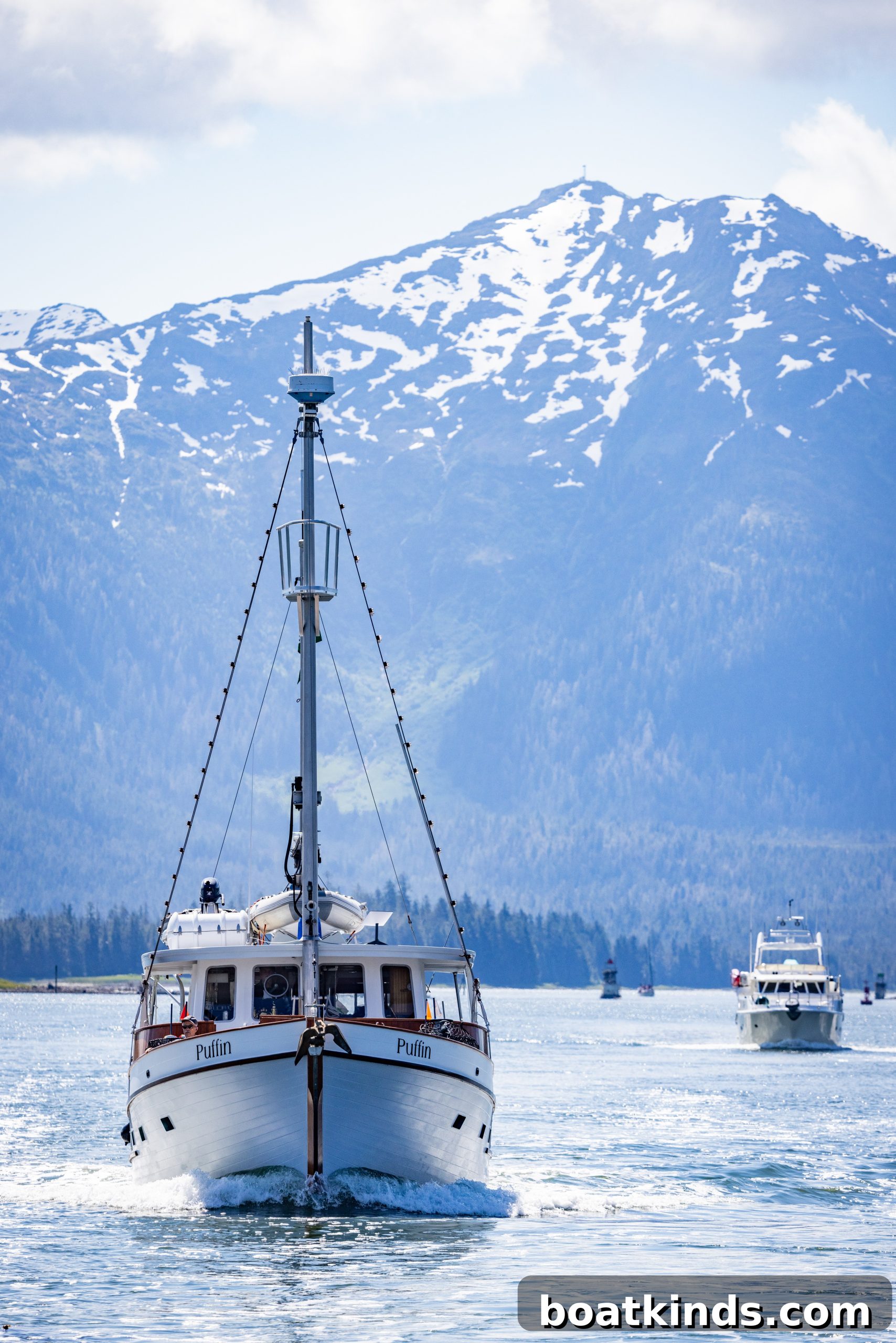
Puffin is a substantial vessel: 47 feet in length, weighing roughly 88,000 pounds, with a 15-foot, 5-inch beam and 6-foot draft. She’s a traditionally built plank-on-frame trawler with roomy topsides. Ahead of the full-beam engine room are three cabins, each with two bunks, and a single large head with a separate shower — a luxury Devlin was especially pleased to have. “I’ve never had a boat with a head,” he said with a grin.
Devlin explained that building a boat specifically for the trip wasn’t an option. “I can’t afford my own boats,” he joked, but purchasing a classic Garden design wasn’t hard to justify. Puffin was designed by William Garden, Devlin’s favorite designer, and she is a double-ender with a Gardner engine — two more features he admires. “Puffin checked all the boxes,” he said.
Is this an extended retirement cruise? Devlin answered that question with a quick, firm “No.” Miller scoffed at the idea of retirement, saying simply, “He’ll never retire.”
Over dinner at Ketchikan’s Oceanview restaurant I met the rest of the crew. Mark Bunzel, editor and publisher of the Waggoner Cruising Guide, has sailed with Devlin since organizing an Alaska flotilla in 2004. Bunzel invited Devlin to lead the 2024 Waggoner cruise to mark their twenty years of cruising together. The flotilla left Anacortes, Washington, on May 28, an eleven-boat group with Bunzel providing routes, weather reports and daily advisories. “I’m trying to push cruisers to extend themselves,” Bunzel said. “To go to places they haven’t gone before.”
The crossing at Queen Charlotte Sound tested that resolve. Cape Caution, the most exposed portion of the Inside Passage, can deliver large swells, vicious currents and wind-stacked waves. “We ran into 20-foot seas,” Devlin said. “That wasn’t a particularly fun day.”
By the time I joined the group in Ketchikan the flotilla was down to six boats: Imagine (a Selene 40), Paqui (a Nordhavn 50), Green Eyes Too (a Carver 32), and two Fleming 55s called Why Knot and Passage. Bunzel’s wife Danielle, who runs a travel business with him, also sailed along.
On my first morning Miller already had the coffee on. Puffin’s galley is fitted with a Washington oil stove that heats the salon as well; because it runs steadily on diesel, a kettle is always hot and ready for French press coffee. Devlin descended to the engine room to check the Gardner 6LXB. The standing-headroom engine space was immaculate, well lit and lined with tools. Devlin cares for his engine meticulously — he checks for seepage each morning and wipes it down. He told me it had burned three gallons of oil over 120 hours, which he considers normal for older engines. “An engine needs its oil, like a sailor needs his rum,” he said as he topped it off.
We pushed off and headed north through the Tongass Narrows. Ketchikan sits on the Alaska Marine Highway and is a popular stop for cruise ships; despite a population under 9,000 more than a million people visit each year. As we threaded the Clarence Strait, Princess Cruises’ Grand Princess and Cunard’s Queen Elizabeth passed by, and Holland America’s Zaandam came down the Narrows on the other side. Puffin held a steady course, equipped with a mix of vintage and modern navigation gear — a Furuno 1700 radar and a brass Sea-Master compass with oil lamps, alongside an iPad with current navigation software and AIS.
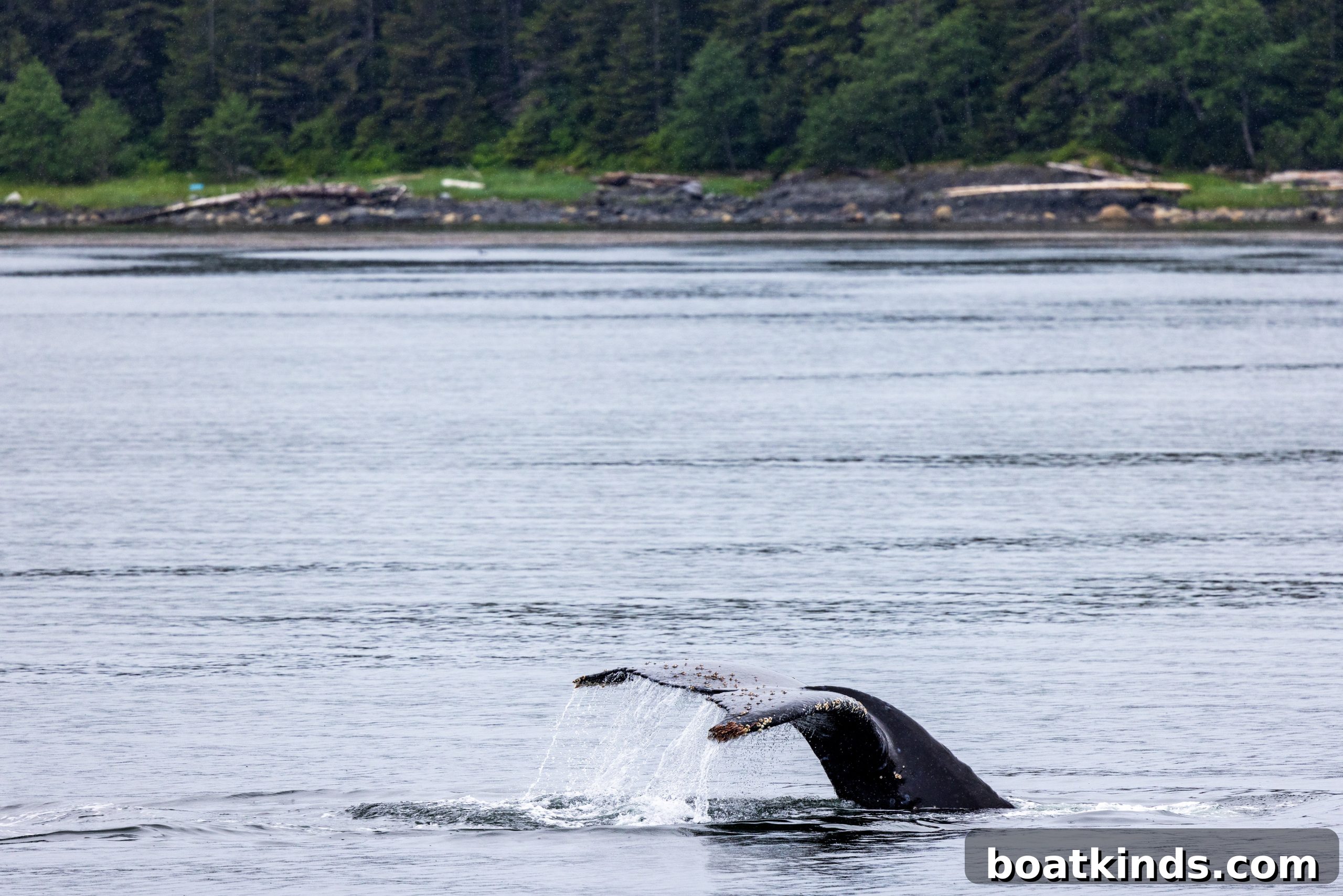
On one watch Devlin smelled diesel and went below to investigate. Around the boat, marine life was everywhere: humpback whales surfaced nearby and bald eagles patrolled the sky. Miller quipped that the eagles were “like pigeons,” one of many dry one-liners he delivered over the trip.
The crow’s nest that Devlin had installed before the cruise quickly became my favorite vantage. It sits about 25 feet above the water and is accessed by rat boards to port and starboard. The first climb up tested my nerves — the transition into the platform feels like stepping into thin air — but the view was worth it.
We stopped at Meyer’s Chuck for a potluck on the dock and Devlin accepted an invitation to a reunion dinner with a friend from his days on Alaska tugs. Miller lounged on the stern, calmly issuing household reminders in a voice that matched his pipe-smoking demeanor. Early the next morning I returned to the crow’s nest, and we delayed departure for a Cassie’s fresh cinnamon bun delivery from a town resident who bakes to order.
Heading into Clarence Strait and up Zimovia Strait the water changed as glacial meltwater met the sea: a clear, distinct line where cold, sediment-laden fresh water rests atop warmer, saltier ocean water. We called Olympia on Starlink — a useful safety feature but also a distraction — and kept scanning the horizon for wildlife and scenery.
We spent a night in Wrangell, known for inexpensive dock rates and a lively liveaboard community. At the Lodge of the Hungry Beaver we ate among locals who seemed plucked from an Alaskan-set drama, and the next morning the flotilla entered the Wrangell Narrows — a twisting 22-mile channel marked by about 60 navigation buoys.
Life aboard settled into a routine: coffee, docking chores, breakfast underway, scenery and wildlife sightings. Miller kept the mood light and handled many galley tasks; Mark and Danielle Bunzel worked the logistics and publishing responsibilities from the boat. I took turns at the wheel, helped in the galley, and soaked up the landscape. Devlin, however, remained responsible for the vessel and the safety of everyone on board. Between engine checks, cleaning and preparing meals, he stayed steadily occupied. “Puffin has been keeping me busy and has kept me from thinking about work, which is good for my psyche,” he said.
Photographing Puffin underway meant transferring to Luis Jimenez’s Carver 32, Green Eyes Too. Jimenez proved to be an excellent handler and a gracious host with a great playlist. Back aboard, we watched Petersburg appear to starboard, framed by the towering snowcapped peaks of the Stikine-LeConte Wilderness. Settled by Norwegian and Swedish immigrants in the early 20th century, the town still bears that tidy, neat character. Miller and I found ourselves walking its neat streets multiple times for supplies, laundry and meals, each time musing that we could live there.
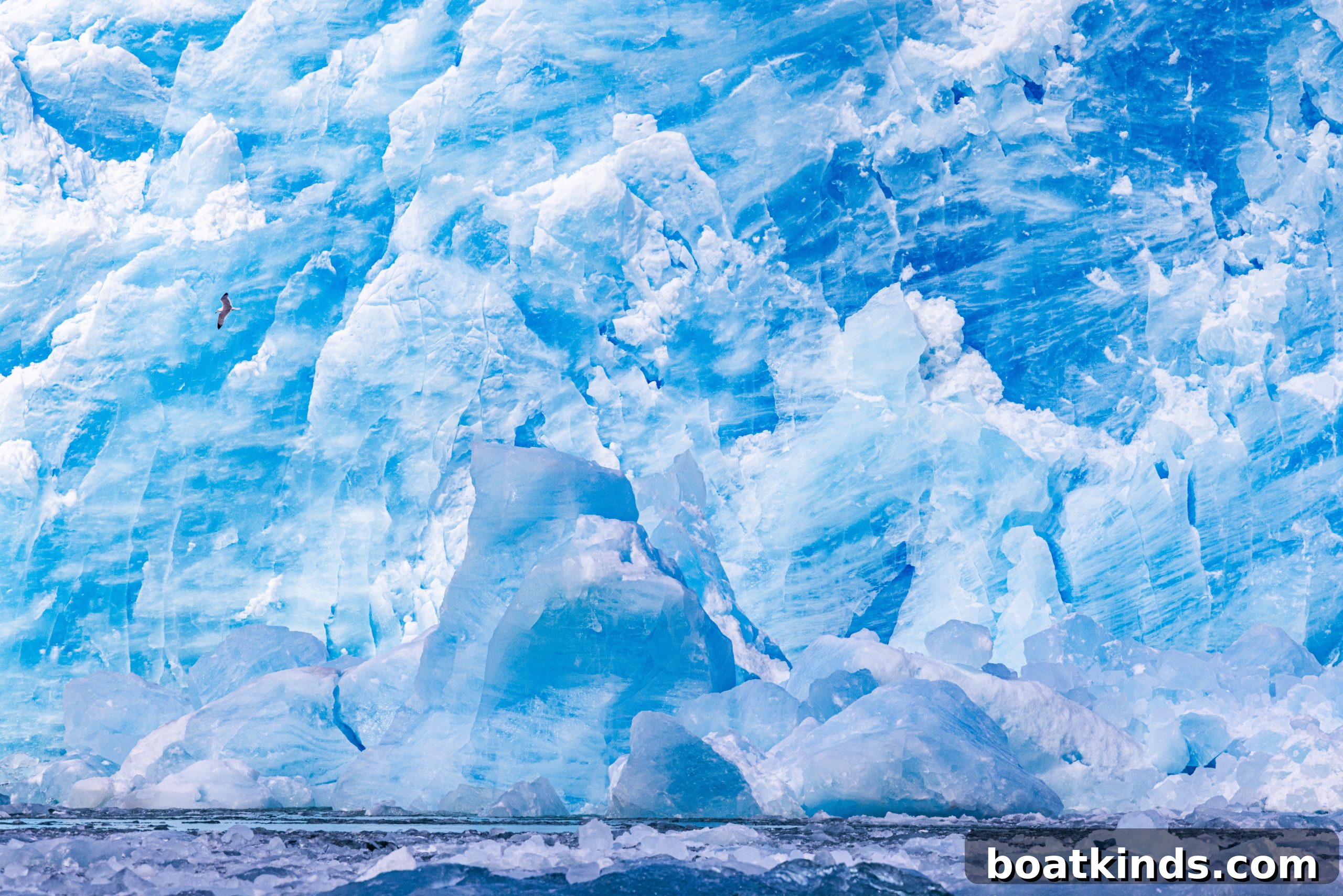
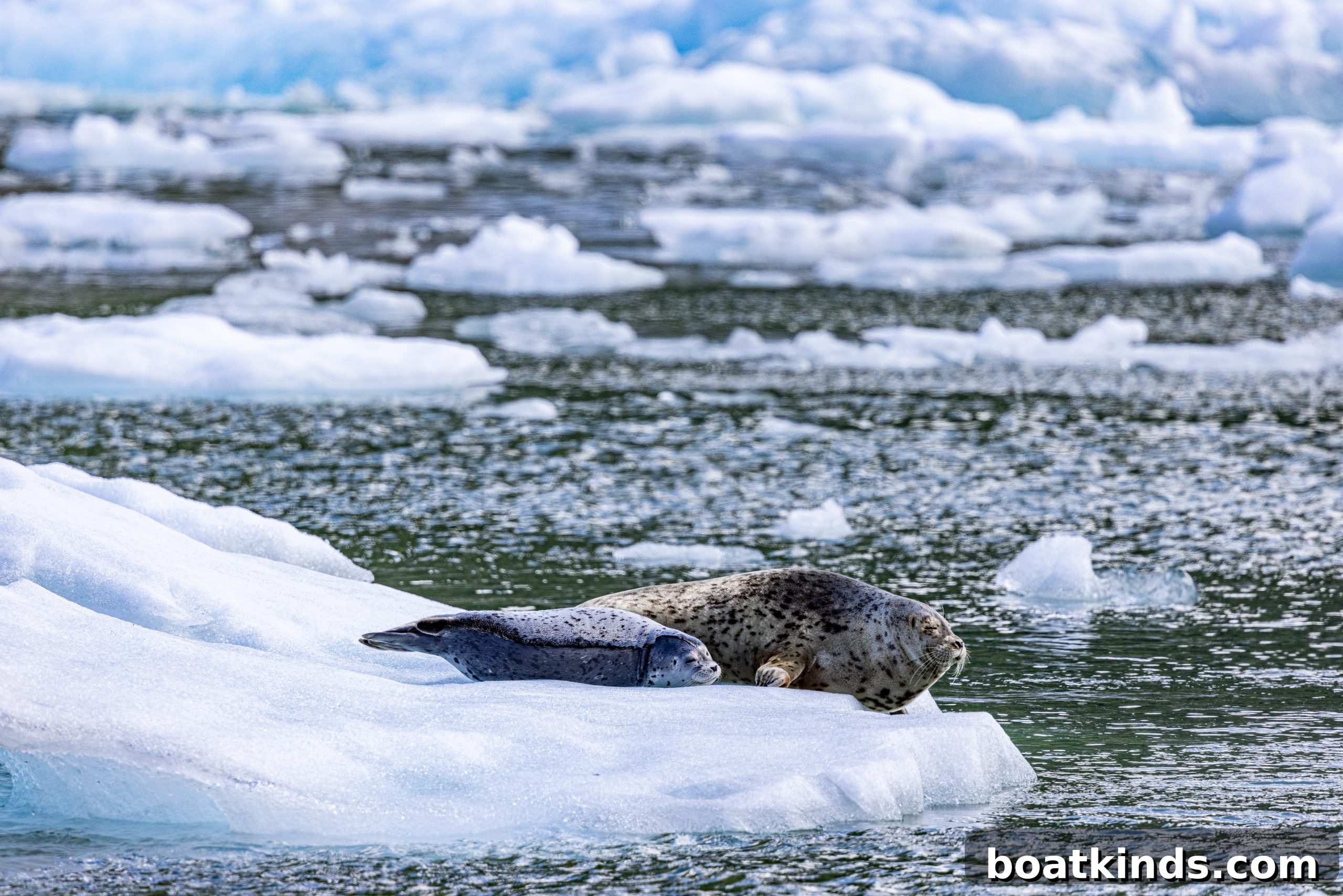
After the Waggoner flotilla dispersed in Petersburg, a smaller group took a side trip to LeConte Glacier with Rob Schwartz of Seek Alaska Tours. In his aluminum jet boat Schwartz nosed up to blue icebergs so close we could touch them and see elongated air bubbles trapped deep within. The color of the ice was surreal, glowing like a giant gemstone. Seals rested on the floes and the fjord narrowed as the glacier came into sight. When large sections calved and crashed into the water the waves lifted our boat; the sound of aluminum pinging on ice echoed like a can being tapped.
We supplemented the spectacle with a small, improvised ritual: Devlin broke chunks of glacial ice with a mallet and we sipped bourbon cooled by millennia-old ice as the glacier loomed ahead. “This is one of the greatest days of my life,” he said, grinning from the bow.
Later, music choices revealed Devlin’s eclectic taste. A Megan Thee Stallion track briefly appeared on the playlist and he laughed at how it had crept in, switching instead to Ella Fitzgerald and then the Doobie Brothers. As we made our way through Frederick Sound the tide worked against us; despite traveling eight knots through the water our speed over ground dropped to 4.2 knots. Devlin mentioned that a prop shop had tweaked Puffin’s prop to add bite, boosting her speed closer to seven knots — a little more than his earlier estimate.
From the crow’s nest I watched for whales. At first I saw nothing, then a lone sea otter, and later the unmistakable blowholes of a sleeping humpback. Moments of silence and sudden activity were common: Dall’s porpoises burst alongside, a pod of humpbacks surfaced nearby, and we lowered a hydrophone though the soundscape was mostly quiet.
We finally anchored in Pybus Bay after an eight-hour run that should have taken five. Surrounded by snowy peaks, the bay was perfectly still. Admiralty Island, nearby, is famed for its brown bears, but despite scanning the shoreline late into the night and early morning I saw only seals and swarms of mosquitoes.
At Pybus Point Lodge four soaked, ragged bald eagles fed on filleted salmon, invoking Benjamin Franklin’s old jibe about the species’ scavenging habits. Fog and fine mist over Stephens Passage reduced visibility at times, prompting extra radar watches and close lookout. The sea offered constant small dramas: a pigeon guillemot slipping by, porpoises popping up, mountains vanishing and reappearing through the mist.
Onboard, the practical and the human intersected. Devlin’s six-foot-two frame nearly brushed the low salon ceiling; we joked about being hobbits in the cozy space. A fan in the oil stove failed and set off a smoke alarm; after a careful repair and some persistence to silence the chirping unit — even a mallet had to do — the ship settled back into quiet.
On my final night we tied up at a public dock in Taku Harbor State Marine Park. The next morning, as Puffin chugged slowly toward Juneau, I took coffee on the stern and watched a mountain materialize through the overcast while another cloud poured rain astern. Even in gray weather, Alaska’s landscapes felt elemental and extraordinary.
Two weeks later I texted Devlin as he motored south from Glacier Bay and asked whether he’d learned to slow down. His first answer was not printable, and when he tried again he summed up his mindset plainly: “What can I say. I’m a busy guy with stuff to do.”
This article was originally published in the September 2024 issue.