
Joan Maxwell on Building Smooth-Riding Regulator Center Consoles
For 21 years, Joan Maxwell has focused on one central goal: producing the smoothest riding center consoles available. “It’s all about the ride,” says Maxwell, 49, president of Regulator Marine.

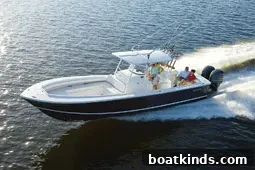
Joan and her husband Owen founded Regulator Marine in Edenton, North Carolina, in 1988. They built their first 26-foot boat in a converted grocery store and have since expanded the lineup to include five center-console models and a 30-foot express, all designed by naval architect Lou Codega. The newest model, the 34 SS, is the company’s flagship. Regulator is represented by 17 dealers along the Eastern Seaboard, the Gulf Coast, and the Great Lakes.
Below, Maxwell discusses the future of deep-vee hulls, how Regulator boats have evolved, design choices for the 34 SS, and the boating public’s ongoing appetite for speed.
Q: Do you think center consoles will keep getting larger, or will economic pressure slow that trend?
A: I don’t think builders will stop making larger boats, but practical limits will come into play—primarily horsepower. The size a builder can realistically sell is often determined by what owners can mount on the transom and how much power is needed to reach comfortable operating speeds. That balance between hull size and available propulsion will dictate growth more than the economy alone.
Q: Will boat owners be willing to slow down, or will the desire for speed persist?
A: The need for speed is likely permanent. People may tell themselves they want to slow down or choose less horsepower, but the first question most buyers ask is, “How fast will it go?” They want the top end, even though experienced operators know ocean conditions usually prevent opening the throttle fully. Still, top-end capability remains an important part of a buyer’s decision.
Q: Was it a priority to make sure the new 34 could perform well on twin outboards? Did you consider triple engines?
A: We designed the 34 SS to perform well on twin outboards. From the start we wondered whether triples might be needed someday, but our goal was to achieve strong performance—mid-50s top speed—with a pair of 350s. In real-world conditions, most owners won’t run the boat at top speed in open water; the focus is midrange performance and handling comfortably in 4- to 6-foot seas. We analyzed triple configurations, but the market and rising fuel costs at the time tempered interest in triples.
Q: How have Regulator boats changed over the years?
A: The one constant has been the hull design: deep-vee, substantial, and tuned for ride quality. That hasn’t changed. What has evolved is the styling and the level of onboard comforts—rounded consoles and tops, more seating in the bow, and added features like a berth below the console in the 34. Over time we’ve added creature comforts to make the boats more family-friendly, but the ride and seaworthiness remain the top priorities. All the amenities mean little if the boat can’t be used comfortably offshore.
Q: Have construction materials and methods changed?
A: Materials and finishes have improved—better resins, better gelcoats, and longer-lasting colored hulls thanks to improved materials. We haven’t pursued aggressive light-weighting because weight contributes to ride quality in a deep-vee hull. On our larger models—the 30, 32 and 34—we do use cored side construction to keep overall weight manageable without compromising strength. Solid-glass on those sizes could make them too heavy to perform well.
Q: Will the deep-vee hull remain popular if fuel prices rise again?
A: Yes. Flat-bottom boats can be efficient in calm conditions, but they don’t deliver the comfort and safety needed in most real-world fishing and offshore scenarios. The deep-vee’s ability to cut through seas and provide a stable, comfortable ride will keep it relevant, even if fuel costs fluctuate.
Q: What is the overall purpose and mission of a Regulator?
A: Regulator hulls are built around fishing performance, but customer demand has pushed the boats toward a more family-oriented, multi-use platform. Today’s buyers want boats that can accommodate fishing, family outings, cruising to dinner, and relaxation. As boats become more expensive, they also become a family’s primary recreational platform, so manufacturers must combine fishing utility with comfort and flexible spaces.
Q: How did you get started building boats?
A: Owen and I started Regulator in 1988 with the idea that customers should get real value for their money. Owen focused on design and manufacturing; I managed the business. We combined our skills and launched the company in our late 20s, learning as we went. It’s been a rewarding career.
Q: What boat brands influenced your designs?
A: Early on we admired classic builders—SeaCrafts, Bill Potter’s SeaCrafts, Carolina builders with pronounced flare, and the workhorse Bertram 31. Those designs, their hull forms and lines, informed the first 26 we built and influenced the distinctive family look across our models.
Q: What will a center console look like in 10 years?
A: The center console will still be popular because of its versatility, but it will continue to add comforts. We’re already seeing refrigerators and more cabin-style amenities integrated into center consoles. Expect continued evolution toward increased comfort and multi-function use while preserving the core advantages of the center-console layout.
Q: What do you own personally?
A: We own a 20-foot Pathfinder and a 16-foot Hewes—fun, playful boats for inshore running and recreation rather than offshore work.
Q: Any news about upcoming Regulator models?
A: We are working on new projects but are not ready to share specifics. Innovation is part of our future—our engineering and product development committees meet regularly. We operate with safety first, quality next, and delivery after that, always striving to exceed customer expectations.
This article originally appeared in the December 2009 issue.