
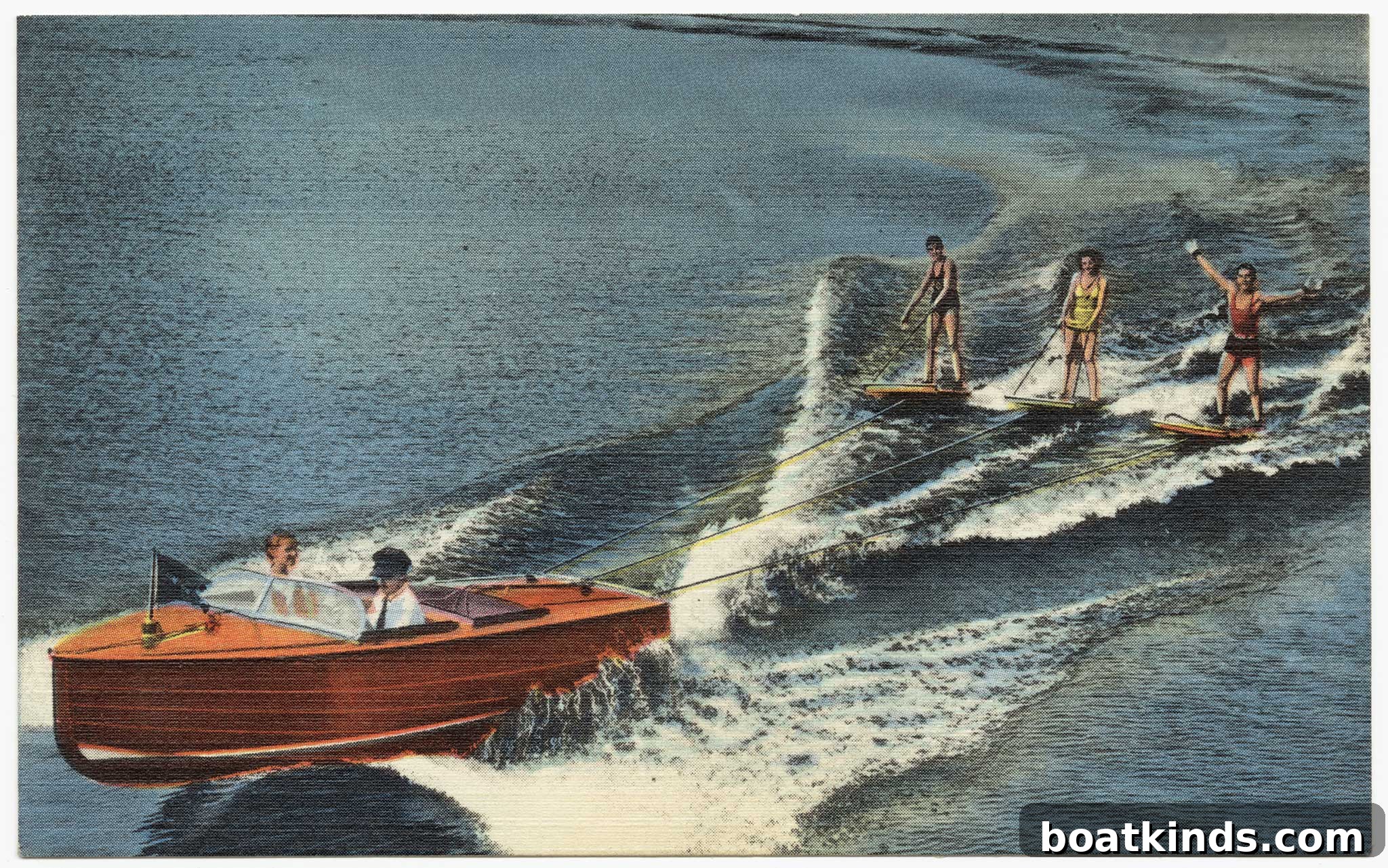
Courtesy Boston Public Library-The Tichnor Brothers Collection
Before waterskiing became the dominant tow sport on lakes and coastal waterways, aquaplaning captured the public imagination. Emerging around 1910 as small recreational motorboats grew more powerful and affordable, aquaplaning quickly became a favorite summer pastime. This vintage postcard, dated between 1930 and 1945, shows a wooden launch towing three riders on aquaplanes off Atlantic Highlands, New Jersey—an era when the activity was both a popular leisure pursuit and a spectacle.
An aquaplane was essentially a flat, toboggan-like wooden board designed to skim the water behind a motorboat. Riders stood on the board while it was tethered to the boat by a tow rope. A secondary short rope or handle attached to the board served as a means of balance and rudimentary steering. Newcomers typically started by lying prone on the board, gripping the handle. As the boat accelerated, they shifted into a crouch and eventually to a standing position, shifting weight from side to side to carve turns and control speed. The sensation, often described in contemporary advertisements as a near “speed intoxication,” made aquaplaning an adrenaline-filled pastime long before modern tow sports took hold.
Many riders bought factory-made aquaplanes, but a strong DIY culture also surrounded the sport. Typical home-built boards measured roughly 4 to 6 feet in length and 2 to 2.5 feet in width. Popular boat- and board-building magazines of the period recommended materials such as Philippine mahogany, cedar, spruce, or cypress for their buoyancy and durability, while corrugated rubber mats were commonly tacked to the surface to improve traction. Construction techniques were straightforward, which helped the activity spread among boating enthusiasts and weekend sailors.
As aquaplaning matured, participants and promoters experimented with more daring techniques, and organized competitions began to appear. Skilled riders developed stunts that tested balance and nerve: standing on one’s head, riding astride a partner’s shoulders, or managing multiple riders on a single tow line were all part of the spectacle. Boat operators adapted as well, often towing several boards simultaneously to accommodate groups and to stage competitive events. One notable competition tradition began in 1935 with an annual 44-mile aquaplane race from Santa Catalina Island to Hermosa Beach, California. Backed by the American Power Boat Association, that race drew international competitors and demonstrated how aquaplaning had evolved from backyard fun to organized sport.
Aquaplaning also played a key role in the evolution of modern watersports. The activity inspired inventors and athletes to experiment with different board shapes and tow techniques. In 1922, Ralph Samuelson famously used a pair of boards as skis on Lake Pepin, Minnesota, a development widely credited as the birth of waterskiing. Although waterskiing eventually eclipsed aquaplaning in popularity, the two coexisted for decades; aquaplaning enjoyed its peak in the 1920s and 1930s and remained a common sight into the mid-20th century.
By the 1950s, aquaplaning’s prominence began to decline. Waterskiing, with its refined equipment and competitive circuits, attracted many former aquaplane enthusiasts. Later innovations—such as kneeboarding and the rise of personal watercraft—further shifted recreational preferences. The introduction of the Power Ski in 1960 by Fort Lauderdale marina owner Fred Guiliano, for example, offered a new kind of powered, personal tow experience and helped accelerate the transition away from traditional aquaplanes.
Today, aquaplaning occupies an important place in the history of watersports. Its simple design, do-it-yourself ethos, and early popularity helped set the stage for the modern recreational infrastructure around motorized boating and tow sports. Vintage postcards and period photographs, like the one featuring riders off Atlantic Highlands, capture both the exhilaration and the communal spirit of an activity that entertained generations and influenced innovations in boards, boats, and competitive water events.
Collectors, historians, and watersports enthusiasts continue to study aquaplaning for insights into early 20th-century recreation, boat technology, and coastal culture. Whether viewed as a stepping stone to waterskiing or appreciated on its own terms, aquaplaning remains a vivid example of how simple equipment and adventurous spirit can create a lasting social and sporting legacy on America’s waterways.