Practical Docking Techniques: Using Lines, Wind and Seamanship
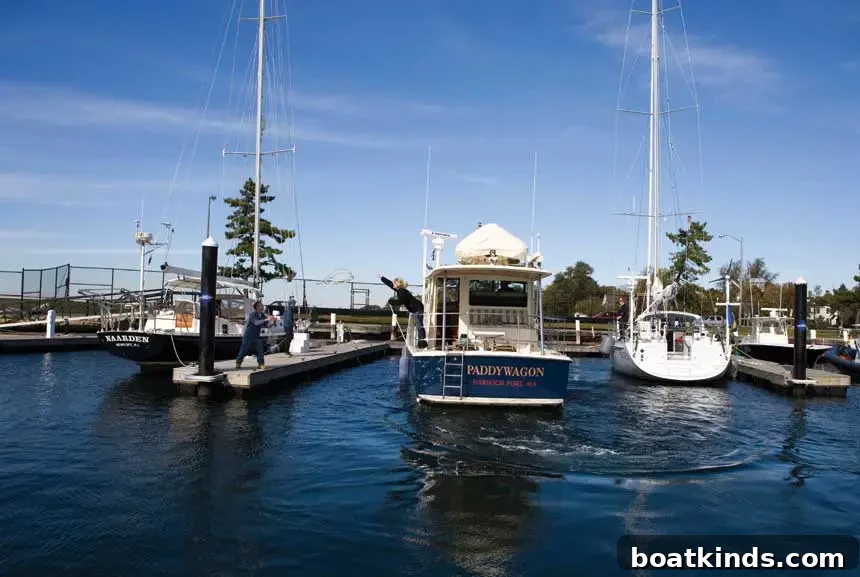
One of my most memorable docking lessons happened more than forty years ago. We were sailing a gaff-rigged catboat with no engine and were forced into a downwind approach into a marina basin. Our plan seemed simple: sail into the basin, round up, lower the mainsail and drift downwind onto the face dock. We reduced the sail by lowering the peak halyard and made a few passes to read the wind and the boat’s behavior. Confident, we began the final approach.
Everything went well until the clew outhaul on the long boom snagged a nail driven into a piling. The boat stopped suddenly and began to weathercock under the boom. We found ourselves fending off amid a crowded maze of boats while trying to lower the sail—an embarrassing, dangerous situation. The takeaway was clear: when you must approach downwind, use the natural forces to help you or switch to a controlled method like paddling. That humiliating moment became a valuable lesson in seamanship.
Why Docking Skills Still Matter
Few boaters routinely dock under sail today, but handling a vessel as you come alongside is still one of the most rewarding and essential seamanship skills. Proper technique prevents damage to your boat and to others, reduces stress among crew, and makes docking quicker and safer. Even if you have modern aids—bow thrusters or twin engines—mechanical help can fail. Learning old-fashioned line work and boat handling pays off, especially for single-screw boats that often rely on dock lines to maneuver precisely.
Fundamentals: Lines, Commands and Safety
Teach your deckhands to coil, pass, and heave a line reliably. Most docklines are three-strand nylon or braided core with an eye splice. Eyes are easiest to land ashore and can be slipped over pilings or cleats. When you share a piling with another eye, “dipping the eye” lets you remove your line without disturbing the other: run your eye up and drop it through the other eye to release it cleanly.
Standard, concise commands keep operations smooth. Train crew to respond to orders like “surge” (suddenly ease a line in a controlled way), “take up” (remove slack), and “hold” (keep the line as is, not belaying it yet). Always avoid letting lines enter the propeller area. Make sure everyone understands line loads (how much strain a line may carry), pinch points where hands can be caught, and recoil zones where a parted line might snap back.
Names and Uses of Dock Lines
Docklines are named for where they lead on the boat and where they land ashore: bow and stern lines, forward and aft springs, and breast lines. Technically, a bow or stern line may lead forward (forward spring), aft (aft spring), or athwartships at a right angle (breast line). Amidships springs are named by which side of a chock or cleat they lead toward. For most docks, the practical minimum is a bow line, stern line, and forward and aft spring lines.
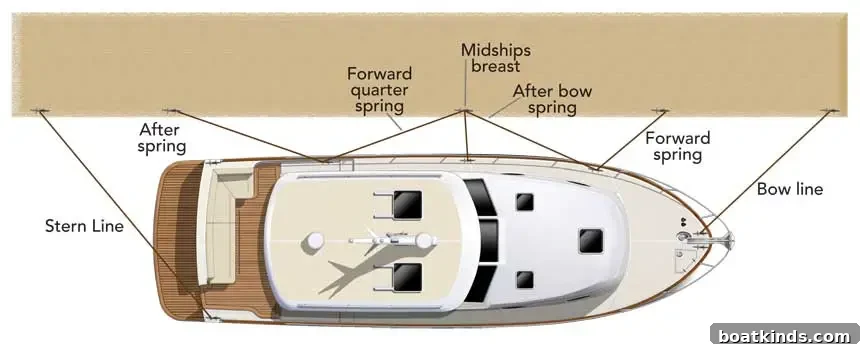
A breast line holds a boat close to the dock temporarily, useful in an offshore wind or when keeping the boat snug for boarding. A line run “on a bight” is routed around a piling or cleat ashore and returned to the boat so you can slip free if no one is on the dock to release the line.
Know Your Boat and Crew
Ship handling depends on weight, draft, windage, pivot point, propulsion type and horsepower, plus prop walk. Most single-screw recreational boats have right-hand props, which tend to push the stern to starboard in forward gear and to port in reverse. Learn how your boat behaves and practice repeatedly so these traits become predictable. Also evaluate your crew’s skills and assign clear roles before attempting a docking maneuver.
Planning and Teamwork
Plan every approach. Consider wind and current, set the lines in place before the final move, and brief your crew and any shore handlers so everyone understands the plan. As helmsperson, give clear, succinct orders so actions are coordinated rather than improvised. If a maneuver becomes unsafe or unworkable, back off and try again. Ignore unsolicited advice and keep confidence in your plan and training.
Using Wind and Current to Your Advantage
Whenever possible, approach with wind and current toward the bow. Facing into the natural forces gives you the most control: a small burst of throttle can maintain position or advance, while easing forward corrects an unwanted set. On a side-tie, if the wind is on the outboard beam, make a slow approach and let the forces set you alongside—well-placed fenders will protect the hull.
To get off the dock with the wind on the outboard beam, use an aft-leading spring from the bow and put the helm toward the dock while powering ahead to kick the stern away. Alternatively, to kick the bow out, power astern against a forward-leading spring from the stern and adjust the rudder as needed. Always have fenders ready and a crew member or dock attendant to fend the boat off until you have clear room to maneuver.
When entering a bow-in slip with forces on either beam, judge the set, give room for the boat to drift into position, and have crew secure the windward lines first. Often the only practical way to get alongside with wind on the inboard beam is to power against an aft-leading spring with the helm away from the dock. Throw a spring line aft into the slip, take it aboard, and snug it tight so you can apply forward rpm with the helm hard over to pivot the stern in and ease the boat to the dock.

The Reward of Good Docking
Successful docking under challenging conditions is one of boating’s greatest satisfactions. Bringing a single-screw cruiser into a tight slip using a spring line, fenders and careful throttle control feels every bit as rewarding as any other seamanship achievement. Compliments like “Nice job, skipper” reflect practice, calm judgment and teamwork.
This article originally appeared in the February 2019 issue.
