
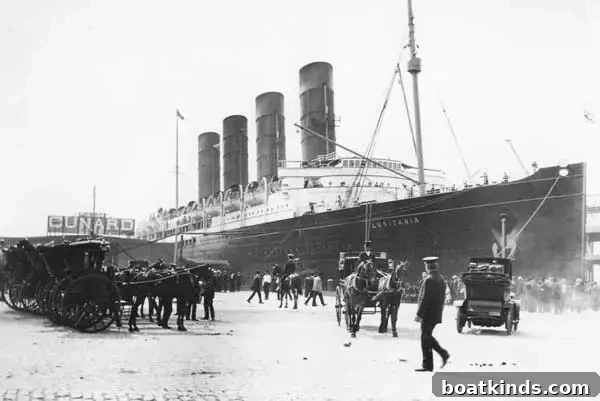
RMS Lusitania: The Story of the Cunard Line’s Ill-Fated Ocean Liner
When RMS Lusitania was launched on June 7, 1906, she represented the cutting edge of early 20th-century shipbuilding. Built for the British Cunard Line, the vessel combined impressive size, speed and modern engineering to become one of the era’s most celebrated passenger liners. For a brief period she was the longest ocean liner in service, measuring 787 feet overall, until the launch of her sister ship, Mauretania, later that year. On only her second Atlantic crossing, Lusitania claimed the Blue Riband, the unofficial distinction given to the passenger liner achieving the fastest average speed on a transatlantic crossing.
Designed for the regular Liverpool–New York service, Lusitania completed 202 transatlantic voyages during a seven-year career. The ship accommodated roughly 2,198 passengers across nine decks, blending different classes of accommodation to serve emigrants, tourists and wealthy travelers alike. With a top speed of about 28 knots and four direct-acting steam turbines generating a combined 76,000 horsepower, she was engineered for both pace and reliability. That combination of capacity, comfort and speed made Lusitania a symbol of maritime achievement and a flagship of Cunard’s transatlantic operations.
Throughout her civilian service, Lusitania became known not only for speed but for the range of services she offered aboard ship. Passengers experienced modern conveniences and public spaces designed for long ocean crossings, while the vessel’s engineering reflected contemporary advances in turbine propulsion and hull construction. Her operational profile—fast, frequent crossings between Liverpool and New York—helped define early 20th-century Atlantic travel and contributed to a growing competition among shipping lines for prestige and speed.
That prominence made the ship’s sinking on May 7, 1915, all the more shocking. Less than a year into World War I, a German U-boat fired a torpedo that struck Lusitania approximately 11 miles off the southern coast of Ireland. The ship foundered rapidly and sank within about 18 minutes. The disaster claimed nearly 1,200 lives, including 128 American citizens. The loss of civilian passengers in such dramatic circumstances resonated internationally and had significant political repercussions.
The sinking of Lusitania intensified public outrage in the United States and beyond. The incident was widely reported and debated, contributing to a shift in public sentiment against Germany. Although the United States did not enter World War I immediately, the cumulative effect of unrestricted submarine warfare and incidents like the Lusitania sinking helped push American opinion toward intervention. Two years after the sinking, the United States declared war in 1917, an event often cited as a turning point in the conflict’s wider course.
Beyond the immediate political fallout, the tragedy of Lusitania has had a lasting impact on maritime safety discussions and historical memory. Her loss prompted scrutiny of naval strategy, the risks of wartime shipping, and the balance between military objectives and protection of civilian lives. Over the decades, the wreck and the story of the ship have drawn researchers, historians and descendants of passengers who seek to understand the circumstances and consequences of the sinking.
Today, Lusitania remains a focal point in studies of early 20th-century maritime history, transatlantic travel and the civilian costs of naval warfare. Her short but eventful service life—marked by technological achievement, commercial success and sudden tragedy—captures key themes of that era: rapid technological change, intense international rivalry and the unexpected human toll of global conflict. For readers interested in further narrative accounts and analysis, contemporary maritime publications and historical magazines have published in-depth features on the ship and her legacy, including pieces that explore both the technical details of the vessel and the broader political and social aftermath of her sinking.
RMS Lusitania endures in public memory as both an icon of pre-war passenger travel and a stark reminder of the risks civilians faced during wartime. Her story is frequently revisited in histories of World War I, maritime engineering studies and commemorations of those who lost their lives at sea.