
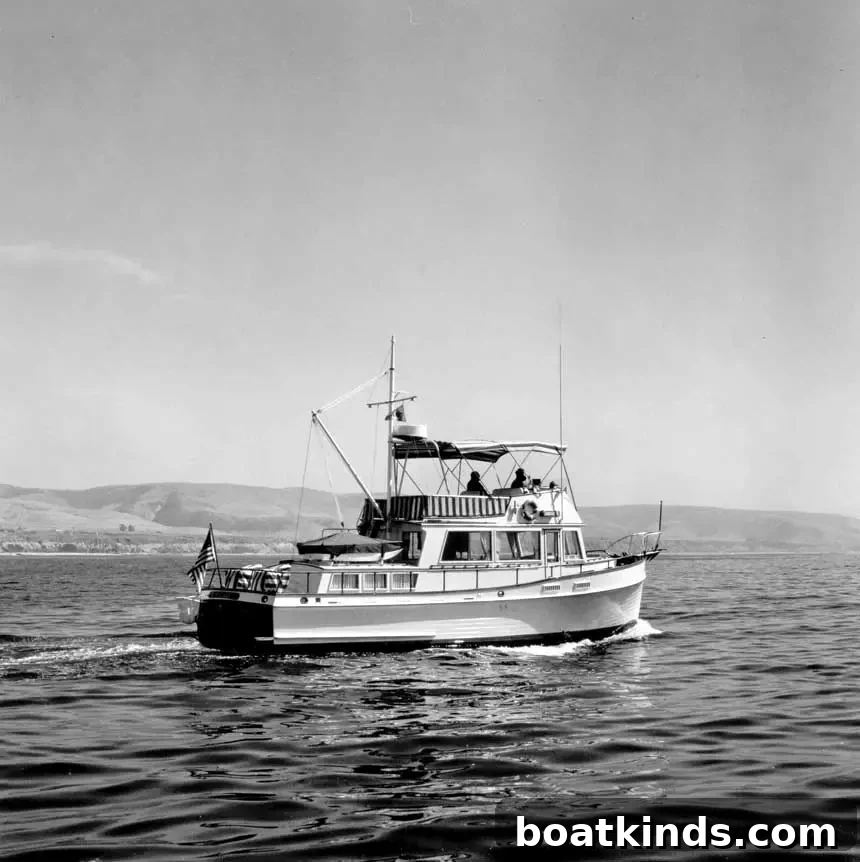
 An early Grand Banks 42
The Grand Banks 42: How a Simple Trawler Redefined Recreational Cruising
A Grand Banks 42 cruises the coastline in this idyllic scene captured in 1969. Today the trawler-style cruising yacht is a familiar sight on American waterways, but there was a time when this classic silhouette—high sides, prominent wheelhouse and diesel reliability—was a novel idea that helped create a new segment of recreational boating.
The trawler-style cruiser first emerged in the early 1960s with the Chantyman, a wooden hull conceived and built by Robert Newton at American Marine Ltd. in Hong Kong. At just under 35 feet, the Chantyman looked more like a working fishing vessel than the leisure motor yachts of the era. It was solidly built, seaworthy and fitted with a large diesel engine, providing economical cruising at modest speeds. Those qualities—stability, fuel efficiency and plenty of usable interior volume—proved attractive to boaters who wanted long-range comfort and a rugged, seaworthy platform rather than sheer speed or flash.
Seeing the potential of this new approach to recreational boating, Newton asked marine architect Ken Smith to refine the concept. Smith designed a 36-footer that retained the working trawler aesthetic while offering more interior room and the new option of a flybridge. The first of that design appeared in 1963, and within a couple of years American Marine shifted its focus away from custom yachts to concentrate on producing these trawler-style boats. In 1965 the company introduced the 36 as a production model and named it Grand Banks, after the storied fishing grounds of the Atlantic. The recreational trawler market was born, and it quickly found a devoted audience.
Not long after the 36 established itself, the Grand Banks 42 arrived as a further refinement of the recreational trawler concept. Larger and more refined, the 42 combined traditional lines with practical, livable interiors and the same durable, diesel-powered underpinnings. It struck a balance between seagoing capability and comfortable onboard living—qualities that appealed to serious cruisers, liveaboards and weekend sailors alike. The model went on to become one of the most successful and recognizable trawler designs, enjoying a production run that lasted roughly three decades.
What made the Grand Banks 42 influential was not a single breakthrough but a collection of sensible decisions: a hull form inspired by working boats for predictable handling, a heavy emphasis on fuel-efficient diesel power for long-range cruising, and an interior layout optimized for both comfort and functionality. These attributes created a new kind of recreational boat that prioritized safe, steady passage-making and extended time aboard over speed or flashy styling. The high freeboard, sturdy wheelhouse and optional flybridge became hallmark features that many later trawler designs would adopt.
Beyond its practical virtues, the Grand Banks 42 also established an aesthetic that resonated with boaters: a rugged, maritime character that conveyed durability and purpose. That look—weathered teak, substantial railings, and the classic profile—helped the model become an icon of a particular cruising lifestyle: slow, deliberate passages, exploration of coastlines and waterways, and extended stays aboard. As trawler ownership grew, marinas and anchorages began to fill with these purposeful yachts, reinforcing the model’s long-term cultural impact on recreational boating.
The Grand Banks 42’s legacy can be seen in the enduring popularity of trawler-style yachts that followed. Designers and builders took the core principles of seaworthiness, economical propulsion and liveaboard comfort and adapted them to new materials, layouts and systems, but the basic recipe remained the same. For many enthusiasts, owning a trawler like the Grand Banks 42 meant embracing a slower, more deliberate approach to cruising—one focused on reliability, comfort and the open water.
This article originally appeared in the February 2019 issue.