
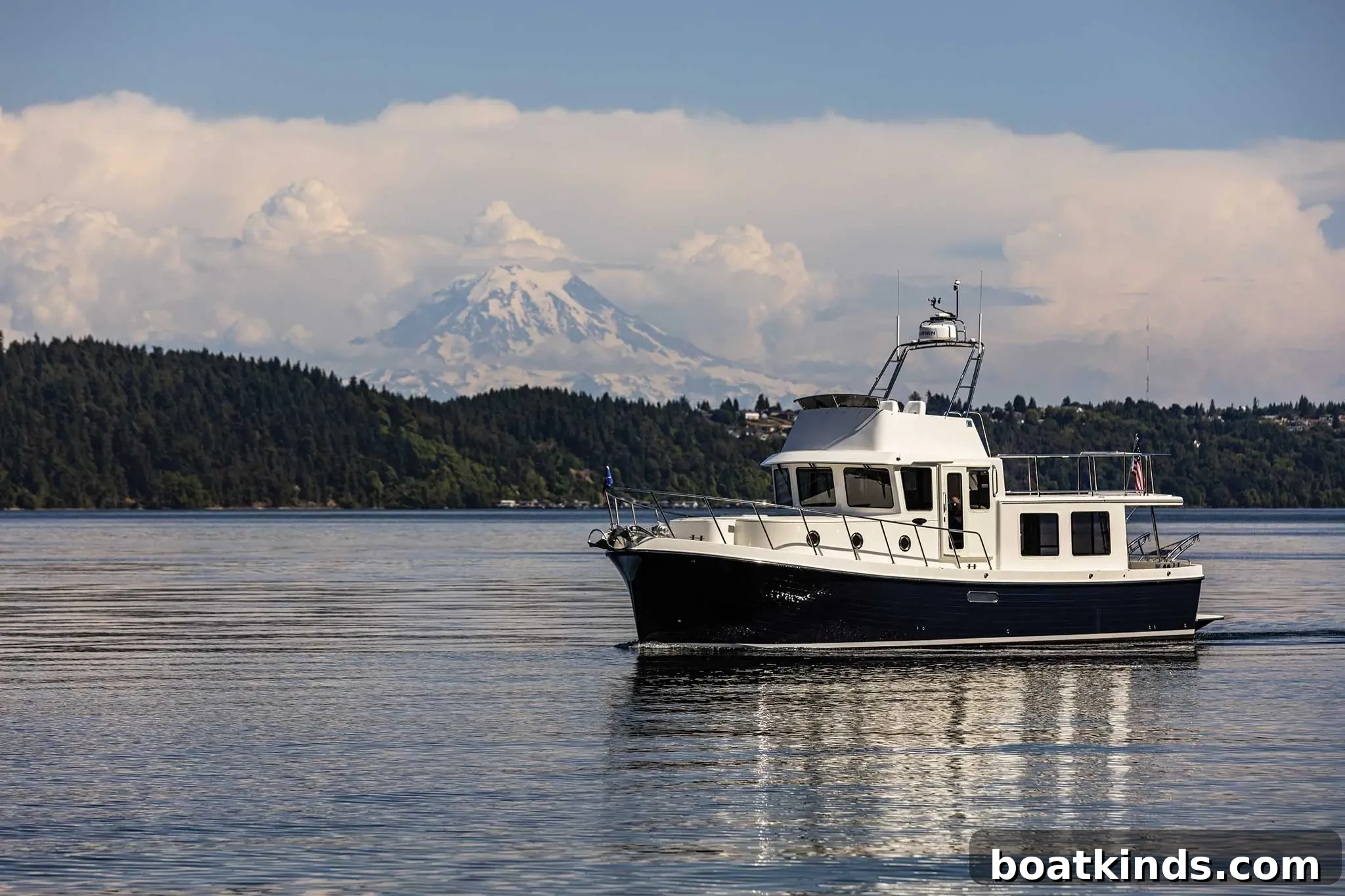
The bankruptcy announcement in June left buyers who had placed deposits on Kadey-Krogen and American Tugs boats reacting with shock, disappointment, frustration and anger. Many are now second-guessing whether they could have done more due diligence before sending additional payments that may never be recovered.
“When we did the contract with them in 2025, American Tug had been doing good,” says Joe Ganete, who had an American Tug 365 under construction when the bankruptcy was announced. “They had orders. They were building boats. They had a factory full of employees. They’ve been around a long time. Kadey-Krogen has been around a long time. There were no concerns going into this deal.”
Another buyer of an American Tug 435, who asked to remain anonymous, echoed that sentiment: “We went to the factory. We met the people. They were building boats. They were at boat shows. People I know work for them. They’re a real thing up here in the Northwest.” For many customers, a long-standing brand, visible production, active owner communities and scheduled rendezvous create a strong sense of security that makes bankruptcy seem unlikely.
That confidence is exactly what can mask risk, says Michael T. Moore, founding partner of Moore & Company in Coral Gables, Florida. Moore’s firm, established in 2004 and specializing in aviation, art and maritime law, has handled numerous disputes involving boat buyers and shipyards. From his experience, a widespread problem is the lack of meaningful due diligence before signing contracts for custom yacht construction.
“There is a way to protect yourself, but the problem is that no one does it,” Moore says. “The due diligence before signing a contract for yacht construction? That is absolutely epidemic. Nobody does the due diligence.” Moore’s firm routinely conducts financial-health checks on shipyards and advises clients on contractual protections that address three critical needs: establishing liability, proving damages and ensuring collectability.
It is the third requirement — the ability to collect — that is proving most difficult for many Kadey-Krogen and American Tugs buyers now. As Moore puts it, “It’s like in Las Vegas. You get three lemons, you get the payout. You have two lemons, you have nothing.” Without clear mechanisms to force payment from a solvent third party, buyers who are owed refunds or completion funds can be left empty-handed after a yard collapses.
One common and effective protection Moore recommends is a performance guarantee. Roughly 80 percent of his firm’s clients who build yachts insist on this clause. A performance guarantee is issued by a third party — typically a bank or insurer — promising that the yard will deliver the yacht according to the contract. That shifts risk from relying solely on the yard’s credit to relying on a deeper-pocketed guarantor.
“The difference is that the yard is not saying, ‘Trust me,’ ” Moore explains. “The yard is saying, ‘I’m giving you this performance guarantee issued by this insurance company or guarantor of some sort.’ A third party is involved. You are no longer relying on the credit of the yard.” He cautions that not every yard will accept a performance guarantee; some count on buyers’ emotional attachment to their product to avoid pushing for stronger protections.
When a guarantor like a major bank issues a guarantee, Moore says it typically follows lender due diligence—meaning the bank has already evaluated the yard’s finances and creditworthiness. If the yard fails to deliver, the guarantor can be required to pay, and those funds can be used to hire another yard to finish the project. Moore recalls a case with a German yard: after insisting on and obtaining a guarantee, the yard failed, the guarantor funded completion at a different shipyard, and the client’s boat was finished.
Buyers can also act during construction if they suspect liquidity problems. Moore recommends practical steps, such as requesting immediate transfer of title if a yard begins to demand early payments or otherwise shows signs of distress. Holding title can offer buyers a stronger position in the event of bankruptcy, increasing the chance that their investment will be protected or recoverable.
The Kadey-Krogen and American Tugs situation illustrates how even established brands and visible production lines do not eliminate financial risk. For prospective boat buyers and anyone contracting for a custom yacht, careful due diligence, contractual performance guarantees and practical title protections are essential tools to reduce exposure and improve the likelihood of recovery when problems arise.
This article was originally published in the October 2026 issue.