
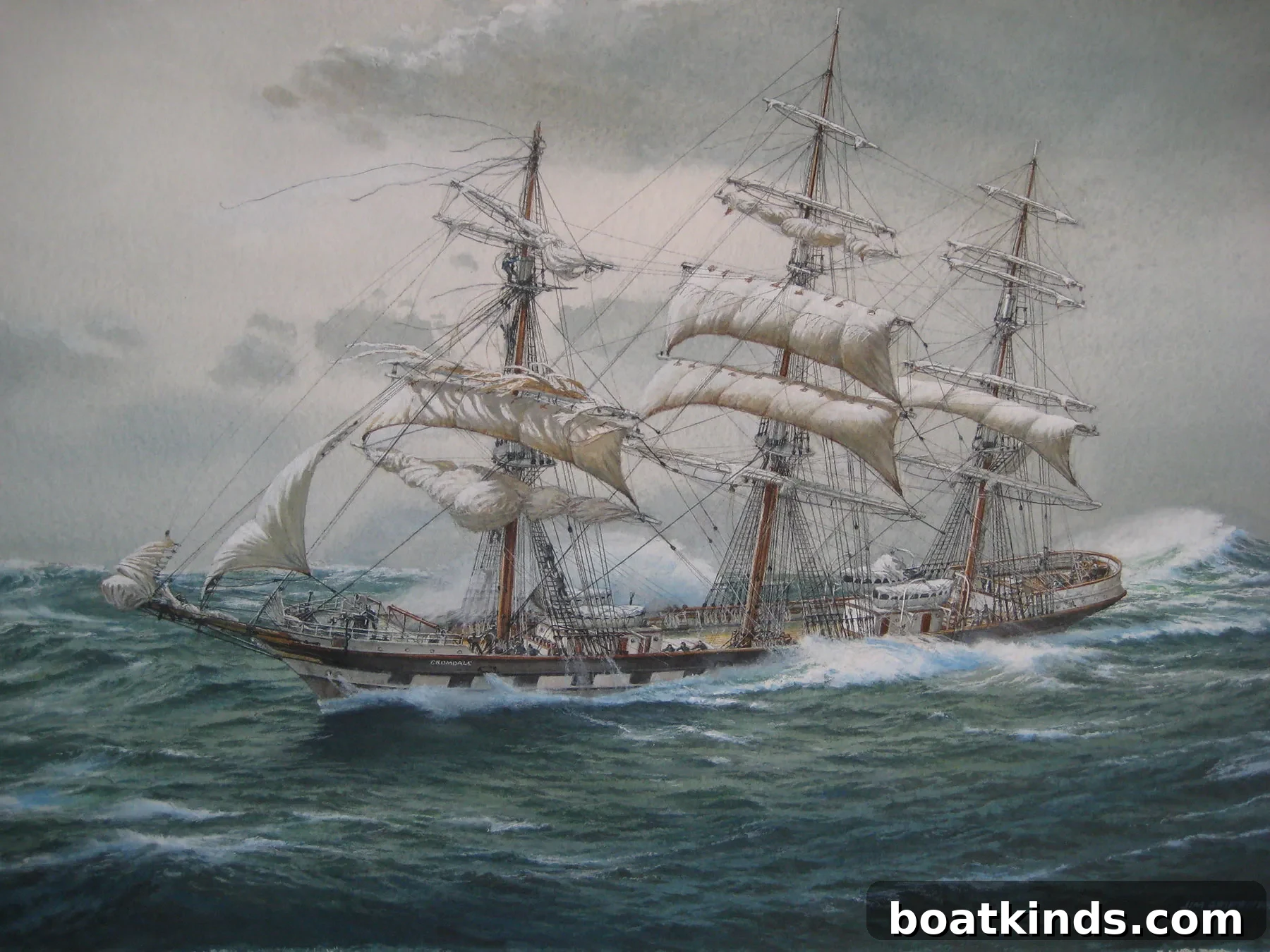
Dangerous Weather: Jim Griffiths’ Maritime Painting of the Clipper Cromdale
On a storm-tossed sea, the topgallant sail of the 19th-century clipper Cromdale has snapped, leaving the crew scrambling to secure rigging and protect the ship. Jim Griffiths captures that tense, dramatic moment in his painting Dangerous Weather, where roughly twenty sailors rush across the deck, working against wind and rain to preserve their vessel. Griffiths renders the scene with careful attention to historical detail and the raw energy of a ship under stress.
Cromdale was built in 1891 by the British shipbuilder Barclay Curle and is noted as the last clipper constructed for the Australian wool trade. Unlike the extreme clippers built solely for speed, she was designed with a greater emphasis on cargo capacity. Her distinctive hull markings—a white hull highlighted with black stripes and white squares—were intended to mimic a warship’s appearance, a visual deterrent against potential attackers, according to Griffiths. That kind of authentic detail comes naturally to him because of his deep research and extensive library of historic sailing references, which inform both his compositions and technical choices.
Historical accounts confirm that Cromdale encountered severe weather and sustained damage at sea, but records do not fully describe the extent of that damage. Griffiths used the known facts as a starting point and applied artistic judgment to create a compelling but respectful portrayal. “I really like this ship and didn’t want to dismast her too much,” he says. “She has beautiful lines. She’s just a good-looking vessel.” The result is a depiction that honors the ship’s form while dramatizing a plausible moment of peril.
Griffiths’ connection to the sea is rooted in family history. His father served in the Navy during World War II as part of an air squadron that hunted German U-boats in the Atlantic, and those stories fueled an early fascination with ships and maritime life. Yet maritime painting was not his original career plan. He attended Amherst College intending to become a magazine illustrator, then studied at the ArtCenter College of Design in California, graduating in 1973. After a year working in industrial arts, he shifted toward fine art, beginning with landscape watercolors.
For years, Griffiths painted landscapes and admired ships from afar, unsure how to convincingly render water. His turning point came when he discovered the work of maritime painter Carl Evers, whose realistic treatment of sea and light showed Griffiths that it was possible to capture water effectively. A further technical breakthrough occurred when he switched from transparent watercolor to gouache. The opacity and layering possibilities of gouache allowed him to build the subtleties of surf, reflections, and spray that maritime subjects demand. “I realized the gouache would let me achieve all the techniques I need to do water,” he explains. That revelation redirected his focus toward nautical subjects, and clippers in particular soon became a favorite.
Clippers, with their tall masts, sweeping lines, and complex rigging, provide dramatic visual subjects, and Griffiths has devoted decades to studying their form and behavior on the sea. His approach blends careful historical research with painterly technique: accurate hull shapes and rigging informed by primary references, combined with layered gouache strokes that recreate light on water, the gloss of wet sails, and the tumult of a storm. The effect is both technically precise and emotionally engaging.
Now based in the Chicago area, Griffiths continues to be drawn to maritime themes despite not having sailed in many years. He speaks of the lasting emotional pull of the water: “I still love being on the water. There’s nothing like a great sunset over water. It can’t be beat.” That ongoing affinity for the sea and its moods is evident in his paintings, which celebrate the endurance of ships and sailors as much as they dramatize moments of danger.
Dangerous Weather exemplifies Griffiths’ blend of scholarship and artistry: an historically grounded image that communicates the risks and beauty of 19th-century seafaring. Through thoughtful composition and mastery of gouache, he brings the clipped canvas of history to life, honoring both the vessel and the human effort required to keep her afloat.
This article was originally published in the May 2022 issue.