
The Buzz on Lake George: Speedboat Racing History and Memories
Ginger Henry Kuenzel spent her childhood summers on New York’s Lake George during a period when powerboat racing was wildly popular. Born in 1949, she grew up amid a family and community that lived for the roar of outboard engines and the excitement of regatta weekends.
“I was born in 1949, so I got to experience it as a kid,” Kuenzel recalls. She remembers two brothers—one older, one younger—and how her older brother began racing at age 12. “I always wondered about what my mother was thinking, letting him do this, but he was about the same age that my father was when he started racing.”
Her new book, The Buzz on Lake George: Speedboat Racing 1900-1964, traces the history of the sport on Lake George from its earliest days through its peak in the 1950s and eventual decline in the mid-1960s. Kuenzel combines family memories, archival material and interviews with former racers to tell the story of how the races emerged, disappeared and briefly returned to glory after World War II.
According to Kuenzel, the story of racing on Lake George begins in 1901 with events organized by the Lake George Regatta Association. Those early races regularly attracted coverage in The New York Times, since many competitors were affluent Manhattan vacationers. In 1914 the American Powerboat Association staged its Gold Cup—what Kuenzel calls “their Indianapolis 500”—on Lake George, bringing prestige and attention to the venue.
Kuenzel’s grandfather and uncle were among the racers in those early decades. The racing tradition continued through the 1920s before the Great Depression brought it to a halt. “All these people lost a lot of their money. It wasn’t the time to be having these lavish races,” she says. “Then, everything sort of died out.”
After World War II, many veterans returned eager to revive the leisure culture of their youth. Kuenzel’s father bought a marina on Lake George and began racing outboard-powered boats. The postwar boom in consumer goods and the rise of a true American middle class helped make outboard racing accessible to more people. Promoters such as Carl Kiekhaefer—whose company evolved into Mercury Marine—helped popularize the sport and market outboard motors to a larger audience.
“After the war, you had a middle class that we really hadn’t had before. Guys had a little bit of disposable income,” Kuenzel explains. “This was kind of a cool thing to do, to pack up your family and your little racing boat. It was a completely different culture.”
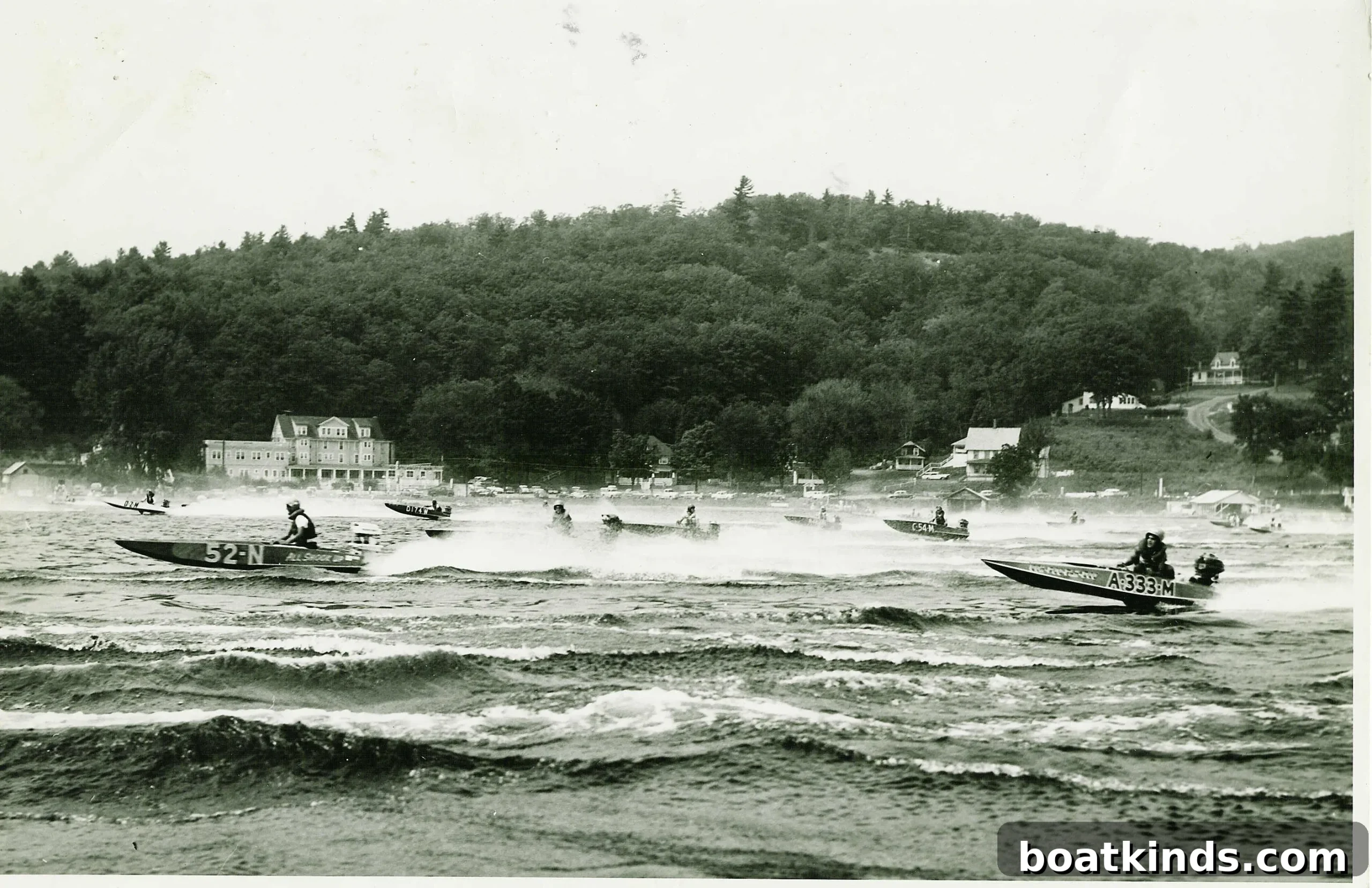
To boost tourism and bring back the excitement to Lake George, Kuenzel’s father and other local business owners organized a renewed series of races. The first official postwar race was held in 1954. Participation climbed quickly: 62 boats in 1955, 109 the year after, and a peak of 143 boats in 1957. The circuit continued until 1964.
The boats themselves were small and light, designed for speed rather than comfort. The largest class—referred to locally as the “big boat”—measured 13 feet, 9 inches and ran on a 40-horsepower outboard. Smaller boats were around 12 feet with 7.5-horsepower engines. “You’ve got about a quarter inch of plywood between you and the water,” Kuenzel says. “All of them felt like they were flying.”
Decades after the races faded, Kuenzel received a trove of primary materials that helped shape her book. When a friend of her father’s—who had served as publicity chairman during the racing years—passed away, his widow entrusted Kuenzel with original press photos, race programs, letters from sponsors and other memorabilia. Those artifacts, together with interviews and Kuenzel’s own memories, became the foundation of The Buzz on Lake George.
The book has been shared at local historical societies and in lectures around the lake, where former racers and longtime residents have responded warmly. “They’re in their late 70s and 80s now. They were so happy to talk about these times,” Kuenzel says. At one event, a man asked her to sign his copy and mentioned, “By the way, I raced in that event in 1958. It was great.”
Kuenzel interviewed numerous participants who described how racing and boating tied generations together. One interviewee described how trips to Lake George became a way to teach his children about sportsmanship and perseverance—using boating as a medium for life lessons.
The book also tells the personal story of the 13-foot, 9-inch boat Gingerly, which Kuenzel’s father campaigned. The family believes the hull was a custom design by Marcel Raveau, whose creations were known for speed in Hudson River races. Kuenzel remembers being proud to have a boat named after her—she was 7 years old when her father acquired Gingerly in 1956.
In 2023 the family celebrated the relaunch of the fully restored Gingerly, with many former racers and enthusiasts cheering its return to the water. Among those at the event was Bob Walwork, an apprentice of Raveau’s who has spent years restoring Raveau-built boats. “There’s a big community around this,” Kuenzel says, reflecting on the bonds created by decades of racing.
This article was originally published in the September 2024 issue.