
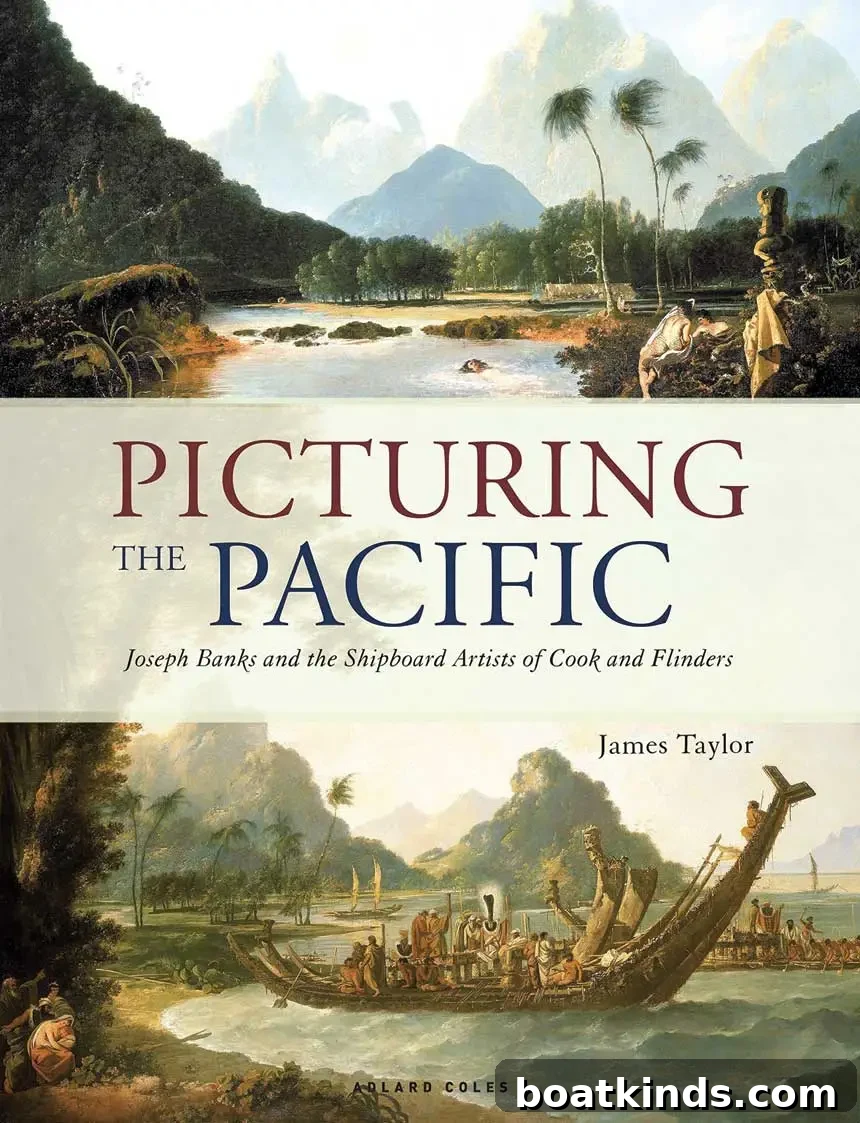
Picturing the Pacific: Art, Exploration, and the Making of a New World Image
Between the 1760s and the early 1800s, voyages from Europe to the Pacific brought not only maps and specimens but also a visual record of distant landscapes, peoples, flora and fauna. These records—oil paintings, watercolors and drawings—provided many Europeans with their first sustained impressions of places far beyond familiar coasts. James Taylor’s book, Picturing the Pacific, collects and examines this visual legacy, drawing together images from private and public collections and placing them in historical context.
The book emphasizes the important role played by Sir Joseph Banks, the influential president of the Royal Society, who promoted the practice of including professional artists on British voyages of discovery. By encouraging trained artists to accompany naturalists and navigators, Banks helped ensure that encounters in the Pacific were documented with both artistic skill and observational precision. The painters and draftsmen of these voyages recorded botanical specimens, animal life, coastal views and portraits of indigenous men and women—images that served both scientific and popular purposes.
These artistic records performed a dual function. On one hand, they became resources for naturalists and scholars, offering visual evidence that complemented collected specimens and written accounts. On the other hand, the images were powerful tools of persuasion: they shaped European perceptions of the Pacific as a place of abundance and possibility. Paintings of lush vegetation, unfamiliar animals and dignified portraits of local people helped to promote the idea of the New World as both scientifically intriguing and attractive for settlement or trade.
Picturing the Pacific spans 256 pages of artwork, including oil paintings, watercolors, drawings and prints, supported by historical documents that illuminate the circumstances of their creation. By bringing together material from a range of collections, the book allows readers to trace recurring themes—such as botanical illustration, coastal vistas, and ethnographic portraiture—and to see how artists balanced aesthetic concerns with documentary aims. The selection also highlights differences in style and purpose between individual artists and institutions, and shows how images circulated back in Europe, influencing public opinion and scholarly discourse.
Taylor’s approach situates the images within broader currents of exploration and scientific inquiry. The artworks are shown not simply as isolated curiosities but as part of practices of observation and representation that shaped knowledge about distant regions. The book discusses how artists and naturalists collaborated in the field, how artistic conventions affected the depiction of people and places, and how collectors and institutions curated these visual records once voyages returned home.
For contemporary readers interested in maritime history, natural history illustration, colonial encounters and the history of visual culture, the collection offers a useful synthesis. It sheds light on how visual materials contributed to imperial knowledge-making and how aesthetic choices influenced the meanings that these images carried. The artworks are valuable not only for their beauty but also for what they reveal about the relationships between explorers, indigenous societies, and the institutions that financed and disseminated accounts of the voyages.
The book’s compact format and richly illustrated pages make it accessible to scholars and general readers alike. Its reliance on both private and public collections underscores the dispersed nature of these historical images and the importance of bringing them together for comparative study. In doing so, the volume invites readers to consider the ethical and interpretive challenges involved in using historical imagery to reconstruct past encounters and to reflect on the enduring power of images to shape how distant worlds are imagined.
($25, Adlard Coles)
This article originally appeared in the February 2019 issue.