
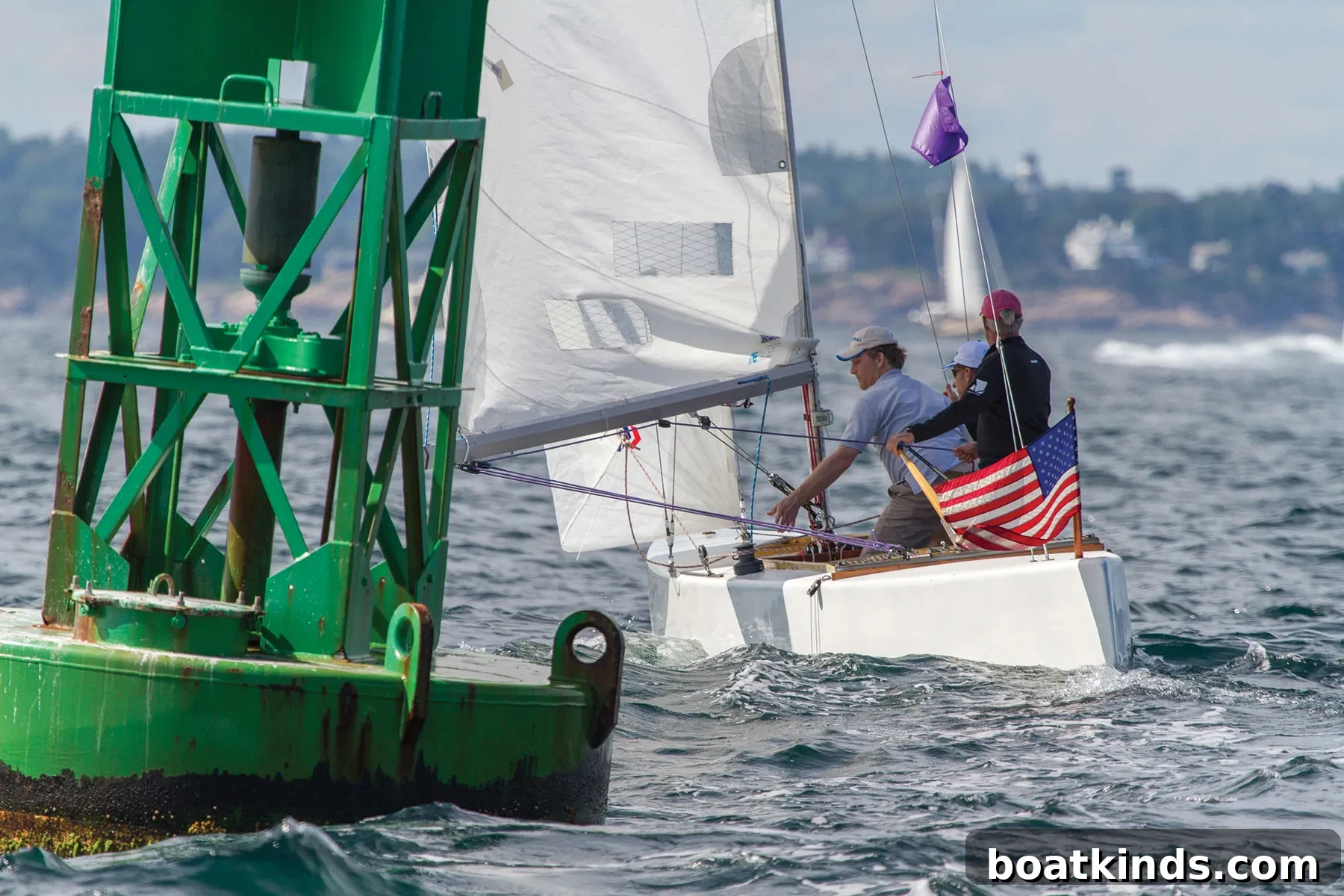
The used-boat market can yield unexpected treasures. Ted Boynton discovered one such find: a neglected racing sloop that became the centerpiece of a restoration project and later a winner at a major East Coast classic yacht regatta.
Boynton’s 36-foot sloop, Dagger, is one of several prototype racing boats drawn by designer Ray Hunt in the mid-1930s that led to the creation of the International 110—one of America’s longest-lived one-design sailboats. At the time Hunt and collaborators Bror Tamm and Gordon Munro developed the design, yacht racing was a widely followed sport. Their goal was to produce a competitive racing boat that remained affordable, built to exacting one-design rules: “a long boat with a small sail area,” as Hunt described it.
Constructed by George Lawley and Sons in Neponset, Massachusetts, these 36-foot plywood prototypes were radical for their era. The hulls were long and narrow, with nearly flat bottoms, double-ended sterns and slab-sided profiles—features that carried over into the International 110. “They shrank this design down to 24 feet using the same proportions, and that’s the International 110,” Boynton notes. “Dagger is a 110 on steroids.”
The new racing design debuted at the 1939 Marblehead Race Week, helmed by Hunt himself. It outperformed the larger fleet boats in many matchups, aside from the International One Designs. Priced at just $480—affordable for the time—more than 400 hulls were built in two years, a testimony to the design’s appeal and performance.
Boynton located Dagger through Soundings and purchased the boat for about $5,000. Parked at the Museum of Yachting and later circulating in Newport, Dagger arrived with an aging J/24 mast and a set of used sails. Boynton, who runs Sound Boat Works in Westbrook, Connecticut, saw a relatively economical path into classic yacht racing and a chance to restore something special.
Raised in Riverside, Connecticut, Boynton sailed a range of small wooden boats—Luders 16s, Quincy Adams 17s, Lightnings and International 110s—and developed a lifelong affinity for wooden craft. He also owns a Chris-Craft runabout. On Dagger’s first outing in Newport, the boat’s potential was clear even though the rig and sails were not original; Boynton and his team knew the hull had promise.
The project replaced the J/24 rig with an Etchells rig that closely matched the original sail plan. The Etchells mast is nearly identical in length to the original, and sailmaker Kevin Farrar built a new jib followed by a new mainsail. The performance improvement was immediate and significant—Dagger began to sail much closer to its historic potential.
Structural work was required to address age-related weaknesses. The floor timbers needed reinforcement and the keel showed movement in heavier wind. The restoration team sistered frames and built a keel grid to stiffen the structure. Crew member Brian Lenihan crafted a new rudder with the original foil shape and installed it on a new rudder post. These repairs preserved the boat’s character while improving safety and handling.
The restoration culminated at the 2014 Museum of Yachting Classic Yacht Regatta in Newport, where Dagger won the non-spinnaker class and took the Overall Winner title in the Grand Prix Class. That weekend validated the work done on the hull, rig and sails.
Boynton says Dagger performs best in 12 to 18 knots with a crew of three or four. In those conditions the boat feels like a racehorse—responsive and fast. In winds above 20 knots, the open cockpit and hull form allow a lot of water aboard, turning management into a priority. With the new rig and sails, Dagger also handles light air well; in one Long Island Sound race she rounded the first mark ahead of the class that started earlier.
Since the Newport victory, Boynton has campaigned Dagger at a number of classic regattas including Eggemoggin Reach, Marblehead, Greenport, Indian Harbor and Race Rock on Long Island Sound. The pandemic paused racing plans for a season, but Boynton expected to return to the circuit, beginning with the New York Yacht Club’s Tiedemann Regatta in Newport. “It’s been a fun boat,” he says. “A blast for the buck.”
WALKTHROUGH
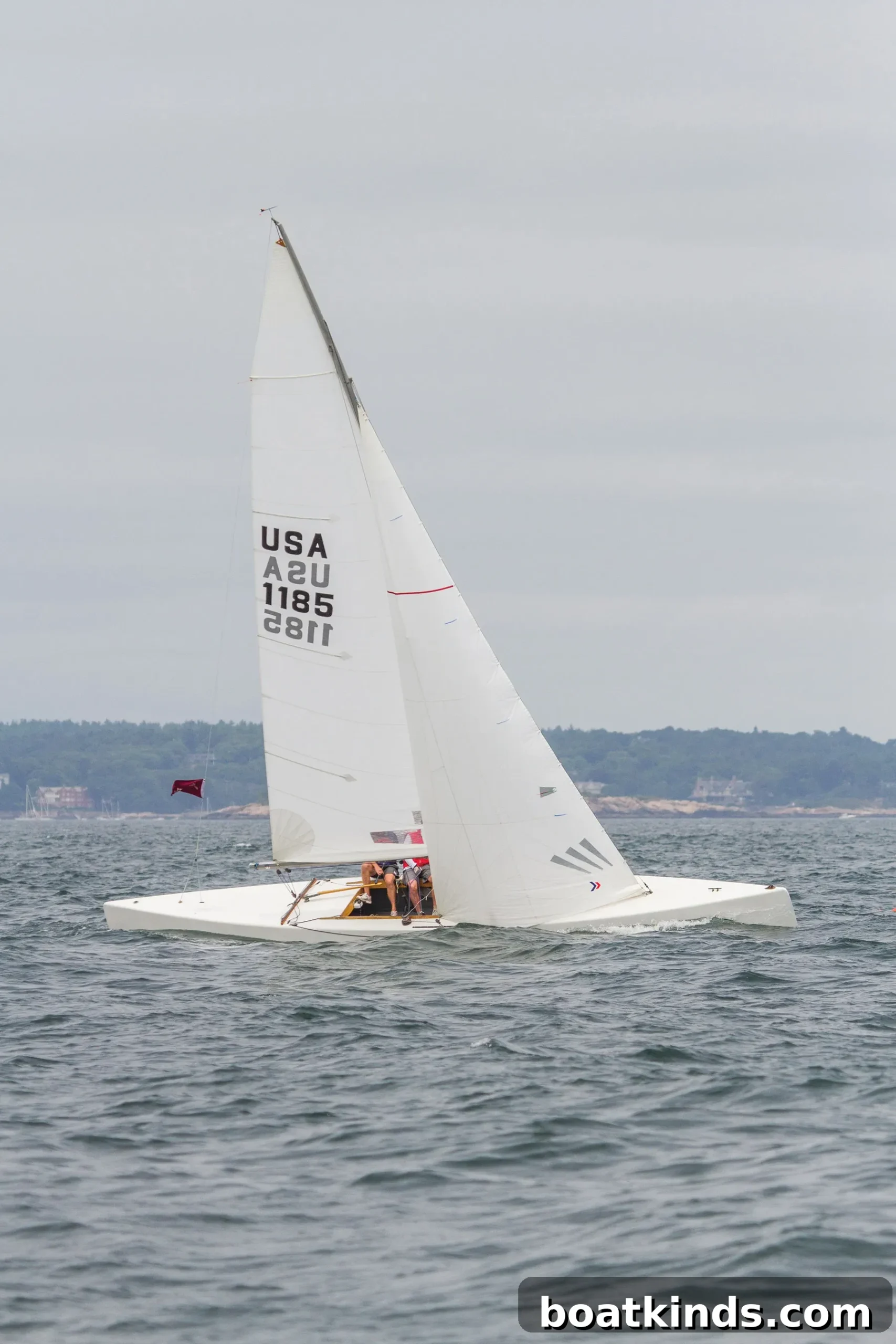
Dagger measures 35 feet 6 inches overall with a very narrow 5-foot 11-inch beam. The 6:1 length-to-beam ratio contributed to the International 110’s nickname of “flying splinters” when the design was scaled down. The hull is double-ended with a nearly flat bottom that has a slight rocker; both bow and stern are nearly plumb. Under the right conditions the shape allows the boat to plane on downwind legs. The small center cockpit sits just forward of the rudder post. The original sail plan called for a high-aspect mainsail and a fractional jib totaling roughly 225 square feet of sail area. A long, slim hull carried a deep fin keel with about 1,000 pounds of ballast and a draft near 5 feet.
Hunt’s prototypes used then-new waterproof plywood coverings—Harborite or Weldwood—over a box-like spruce and oak framework rather than traditional plank-on-frame construction. Stringers and chines were fir, and spars were typically spruce, with Duralumin and bronze fittings. The resulting boat was light, stiff and fast for its era.
Specifications
LOA: 35’11”
Beam: 5’11”
Draft (approx.): 5’0”
Keel: Fin w/bulb
Ballast (approx.): 1,000 lbs.
Sail Area (approx.): 225 sq. ft.
BACKGROUND
Ray Hunt began his career as an accomplished helmsman and Olympic-class sailor and grew into an innovative designer whose work ranges from the Concordia yawl to production and powerboat designs. Historian Stan Grayson called Hunt an idea man who saw and drew what few of his contemporaries imagined. The influence of his prototype designs endures today in the International 110, which remains an active one-design class and a touchstone of American small-boat racing.
This article was originally published in the August 2021 issue.