
A barracuda glides past our catamaran as we lie at anchor. It’s a blistering day in Bimini, and the fish seems to be seeking shade between the Leopard 53 Powercat’s two hulls. In the distance, a lone sea turtle breaks the surface in intermittent breaths. The water is so clear that every movement is visible, especially from the panoramic vantage of the Leopard’s flybridge—the newest model from the South African builder.
“This boat so far has exceeded expectations,” says Katie Baker, marketing manager for Leopard Catamarans. The 53 had just premiered at the Miami International Boat Show a month earlier, where the company sold five of the new cruising catamarans. After a day aboard, it’s easy to understand why.
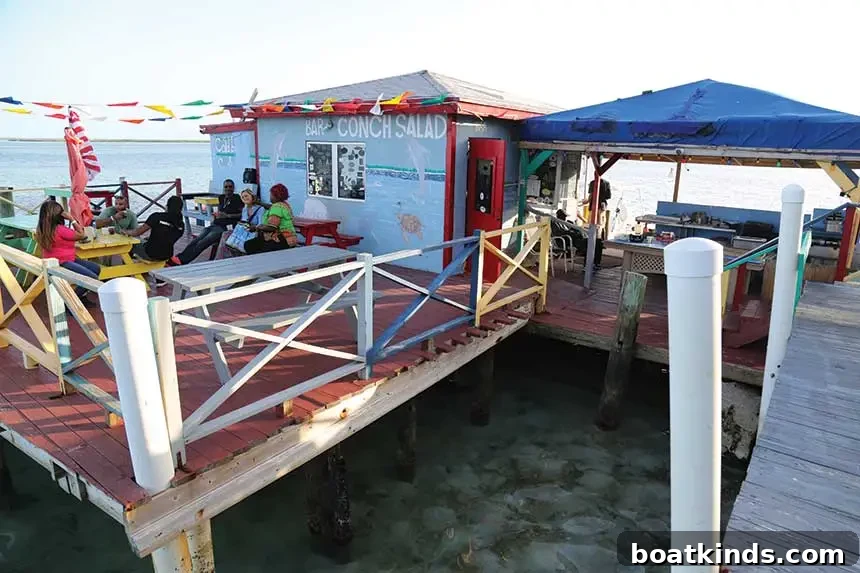
We departed The Bimini Big Game Club on North Bimini in the morning and cruised through the Bahamas’ famed turquoise water toward Cat Cay—two small private islands in the Bimini chain. Access to the shore is restricted, and those rules have helped preserve some of the cleanest water in the Bahamas. When we arrive there’s not a breath of wind, no ripples to disturb the remarkable clarity. Visibility extends for miles, and the waterfront is dotted with elegant homes.
Located at the western edge of the Bahamas, Bimini is only about 50 miles across the Gulf Stream from Miami, but the difference in atmosphere is immediate. Once a rum-smuggling point during the 1920s, Bimini became a mecca for big-game fishing after Prohibition, attracting famous anglers and earning the nickname Big Game Fishing Capital of the World. Writers and fishermen like Zane Grey and Ernest Hemingway trolled these waters—Hemingway arrived aboard Pilar in 1935 and lived on North Bimini until 1937. His grandson, John Patrick Hemingway, remembers the author’s fascination with the power and speed of the billfish and bluefin found off the coast. Sharks, which often chewed catches before they could be hoisted aboard, inspired elements of Hemingway’s The Old Man and the Sea, and Bimini provided the setting for his story Islands in the Stream.
Today anglers still come to Bimini for big-game action, but the island also draws visitors seeking a slower pace. Arriving here is like stepping off a fast-moving train: the urgency of the city falls away and Island Time settles in.
A catamaran is the ideal platform for that relaxed lifestyle, and the Leopard 53 feels larger than its 53-foot length suggests. Even with five aboard, the layout never feels crowded. We don’t have a beach house on Cat Cay, but aboard the Leopard we enjoy a private, mobile island of our own.
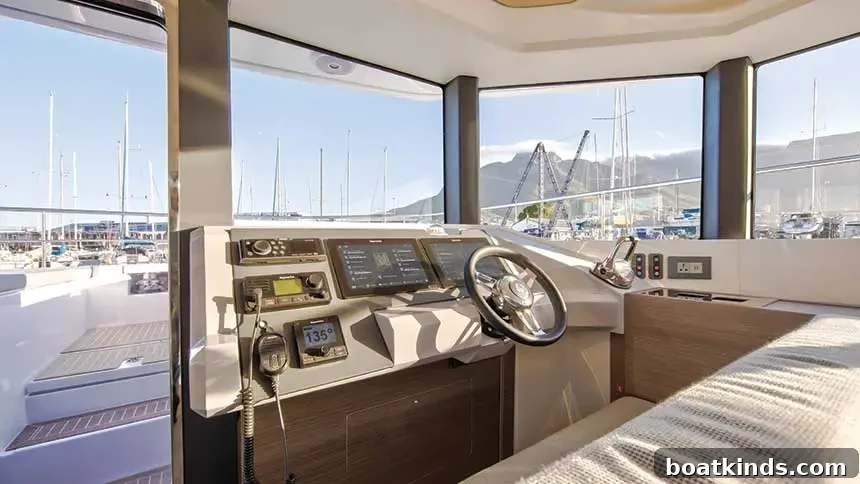
The Leopard is as seaworthy as it is comfortable. That was proven on our Gulf Stream crossing from Fort Lauderdale the day before. Winds picked up as we left port and we encountered quartering 4- to 5-foot seas for much of the passage. Averaging 9 to 10 knots, the boat rode through the swell calmly; the flybridge stayed dry until a squall forced the crew down into the salon, where Captain Calvyn McEvoy used the optional indoor helm. The conditions remained consistent for the roughly five-hour trip, and the 53 handled them with composure.
For McEvoy, the rougher seas were just another day at work. He’s a delivery captain with 14 years of experience and has completed 22 ocean crossings on Leopard sail and power cats, including a South Africa–to–Antigua delivery on a Leopard 37 Powercat. He’s taken these boats across oceans and varied weather on 45-day offshore passages, so his assessment of their capabilities carries weight.
On trial runs he pushed the cat to a top speed of 25 knots at 3,660 rpm, where twin 370-hp Yanmar diesels consumed about 32.3 gph. At a faster cruising speed of 17 knots the reported fuel burn is roughly 19 gph, yielding a range around 463 nautical miles, while maximum range is about 1,330 nm at a more economical 7.9 knots. Even at top speed, the boat ran quietly enough for easy conversation on the flybridge.
Heading back to The Big Game Club, we encounter scenes that underscore how different Bimini is from Miami: a snorkeler clinging to a small outboard boat’s rail, an overloaded water taxi bumping through the channel, and a seemingly derelict sportfisher listlessly settling into the water. This is a place where the pace—and the problems—are very local.
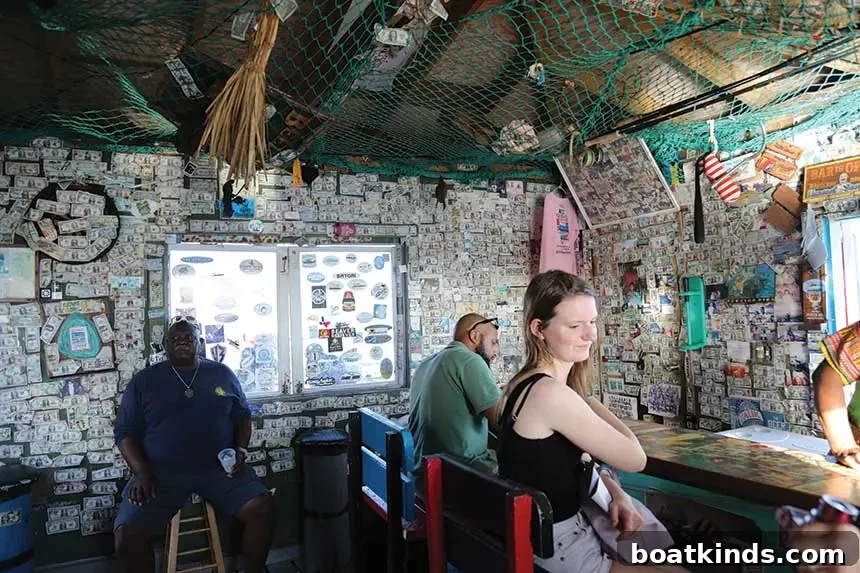
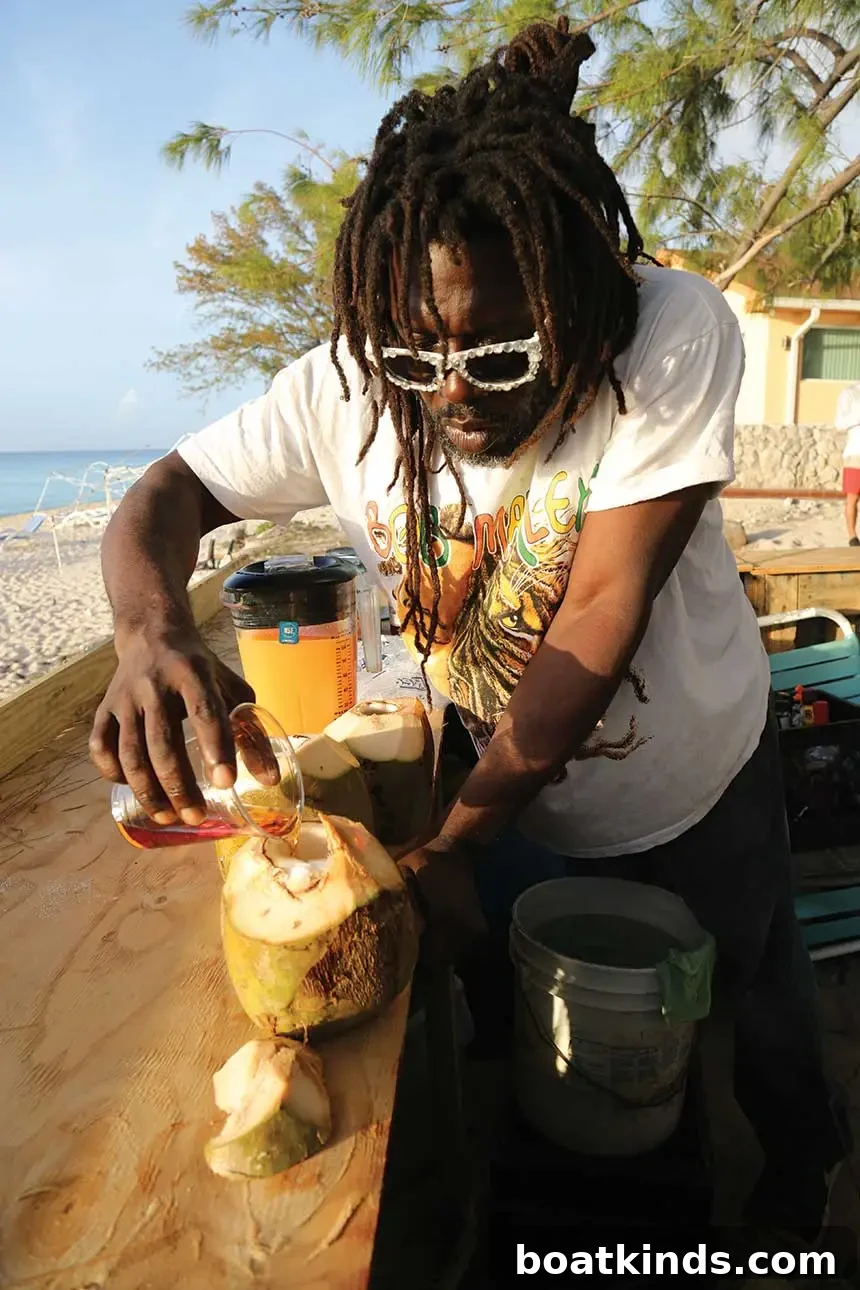
After tying up, we take a six-person golf cart along narrow roads lined with conch shell piles and colorful buildings painted with marine scenes. We pass spring-break crowd-filled carts and oversized vehicles, then stop at Ebbie’s and Pat’s Bonefish Club, a waterfront bar plastered with dollar bills. On the island’s slim strip of sand we meet “Coconut Brian,” a man known for serving coconuts filled with rum from a small wooden shack on the beach. With coconuts in hand we watch the sun sink and then return to the club.
The historic Bimini Big Game Club, founded in 1936 and settled at its present site since 1954, helped put Alice Town on the map as a fishing destination. A Marine Protected Area off North Bimini has helped revive bonefish populations and kept sportfishing strong, even though the biggest schools of marlin have shifted elsewhere. The charter scene has shifted toward recreational anglers, and boats from states as distant as Maryland, Texas and Colorado show up for the island lifestyle. Our immediate neighbors harbor a sail cat, a power cat and an outboard-powered cat—each carrying crews drawn to relaxed cruising and fishing.
We end the day with cocktails and dinner cooked on the optional grill and wet bar on the flybridge. The wraparound seating and table easily accommodate the five of us. As night cools the air, we’re grateful for the Leopard’s inviting accommodations. Hull No. 1 is laid out with three staterooms and three heads, the owner’s suite taking the entire starboard hull; an alternate four-stateroom layout replaces the owner’s suite and adds a single crew berth in the bow. Cabins are roomy for hull berths, easily fitting queen-sized beds, with abundant storage in bed platforms, a walk-in closet and a double vanity in the owner’s cabin.
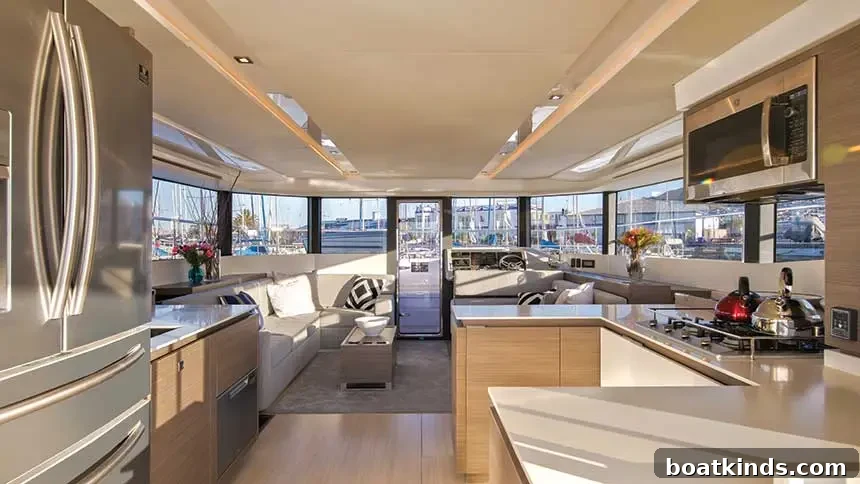
Everything aboard the 53 feels spacious. The salon is wide and light-filled, and the galley is large enough for several people to cook together. Outdoor spaces are especially important for Bahamas island-hopping: the shaded aft deck and dining area, a hydraulic swim platform for easy water access, a forward sunpad with storage underneath (we stowed two inflatable standup paddleboards there) and an additional sunpad aft on the flybridge.
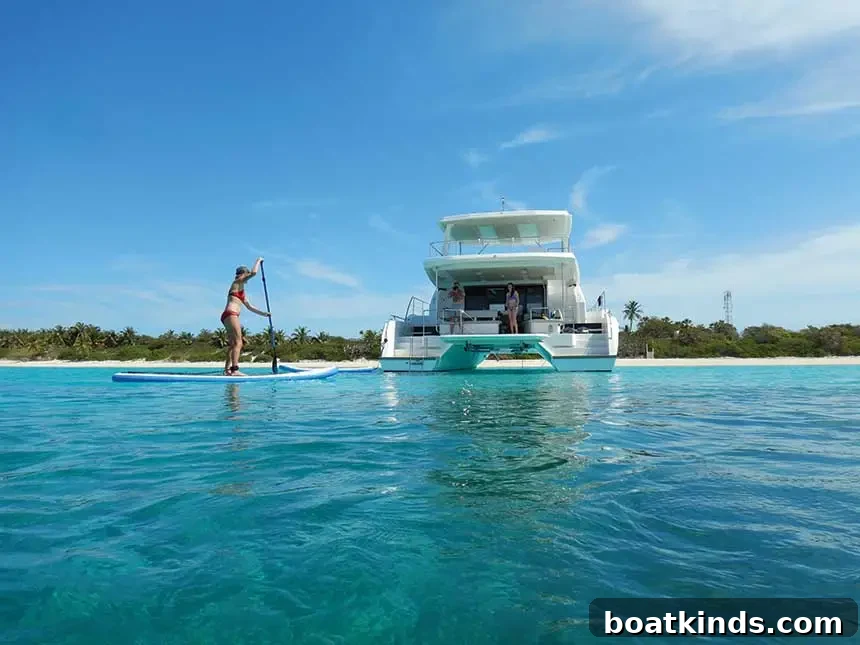
My stateroom window looks out over the channel and I wake to sunrise and a flurry of boats already heading out to fish or dive. The trap of Island Time is real—especially when your floating home is as comfortable and capable as the Leopard 53. It combines catamaran space and liveaboard comfort with the performance of a motoryacht, making spontaneous Bahamas trips entirely feasible. On the run back to Florida I stretch out on the flybridge sunpad and watch flying fish scatter from the hull as the islands fade behind us.
Specifications
LOA (w/platform): 53’1”
Beam: 25’2”
Draft (half load): 3’2”
Displ.: 41,070 lbs.
Water: 185 gals.
Fuel: 562 gals.
Power: (2) 370-hp Yanmar 8LV370 diesels
Base Price: $969,000
This article originally appeared in the July 2020 issue.