
Rules of the Road is an in-depth course that explores the navigational rules that govern safe boating. Instructor Robert Reeder walks through each rule, noting inland and international distinctions, and explains how to operate recreational and commercial vessels safely in U.S. and international waters. These principles apply to everything from a small dinghy to the largest superyacht.
Sign up today and use the coupon code: SOUNDINGS for 15% off.
How well do you know the Rules of the Road? Consider this common scenario: you are navigating a narrow East Coast river in daylight with clear visibility. From a distance you see the top of a tug’s wheelhouse rounding a bend. What should you do?
Your equipment is functioning, and experience has taught you to plan ahead and use every available tool. AIS shows the tug’s identity, and you hail it on VHF. The tug replies immediately: “Hi captain, I see you. I’m pushing a deep-draft barge, and I’m gonna need plenty of room. Can you hold back and I’ll meet you on two whistles after I make the bend?”
Do you understand what the tug is communicating and what the Rules of the Road require? The tug has informed you of its limitations and special circumstances—specifically that it is constrained by draft while transiting a narrow channel. Under the navigation rules, you must take early and decisive action. You should reduce speed or take off all way so as not to impede the safe passage of a vessel constrained by its draft in a narrow channel.
When the tug skipper says, “I’ll meet you on two whistles,” that is established commercial practice meaning, “I intend to keep you on my starboard side” (starboard-to-starboard passing). You should acknowledge the tug on VHF, stop your vessel before the bend and allow the tug and its barge to pass, keeping to the agreed arrangement.
All skippers should have a solid working knowledge of the Rules of the Road, which are summarized in the U.S. Coast Guard’s Navigation Rules and Regulations handbook and include the International Regulations for Preventing Collisions at Sea (COLREGS). That handbook covers the conduct required in both inland and international waters and should be carried on board in an updated copy; it is also available from the U.S. Coast Guard Navigation Center.
Even seasoned boaters benefit from refreshing their knowledge of the COLREGS. Habits can drift over time, and a clear understanding of the rules will help you know where your vessel fits in the hierarchy of responsibilities: Is your vessel power driven? Is the other vessel sailing, fishing, not under command, or restricted in its ability to maneuver? Are you the stand-on (privileged) vessel or the give-way (burdened) vessel?
In brief, here are key points to remember:
- Crossing: When two power-driven vessels are crossing, the vessel that has the other on her starboard side must keep out of the way. A practical nighttime mnemonic is “red means stop” for the port side light.
- Overtaking: Any power-driven vessel overtaking another must keep clear of the vessel being overtaken. At night, if you can see the other vessel’s side lights, you are not overtaking.
- Head-on meetings: When two power-driven vessels meet head-on, each should alter course to starboard so they pass port-to-port. At night, meeting vessels should sight each other’s masthead lights in line along with the red and green side lights.
- Early, decisive action: Whether under power or sail, make course changes early and make them large enough to be clearly understood. Avoid a series of small, ambiguous adjustments. If necessary, take way off completely to avoid collision.
- Lights and visibility: Display required navigation lights and ensure they are visible. Don’t block lights with dinghies, deck gear or passengers, and don’t obscure their meaning with decorative LEDs.
The rules also require keeping a proper lookout “by sight and hearing as well as by all available means appropriate in the prevailing circumstances and conditions” so you can fully assess collision risk. That means radar and automatic aids complement—but do not replace—eyes and ears.
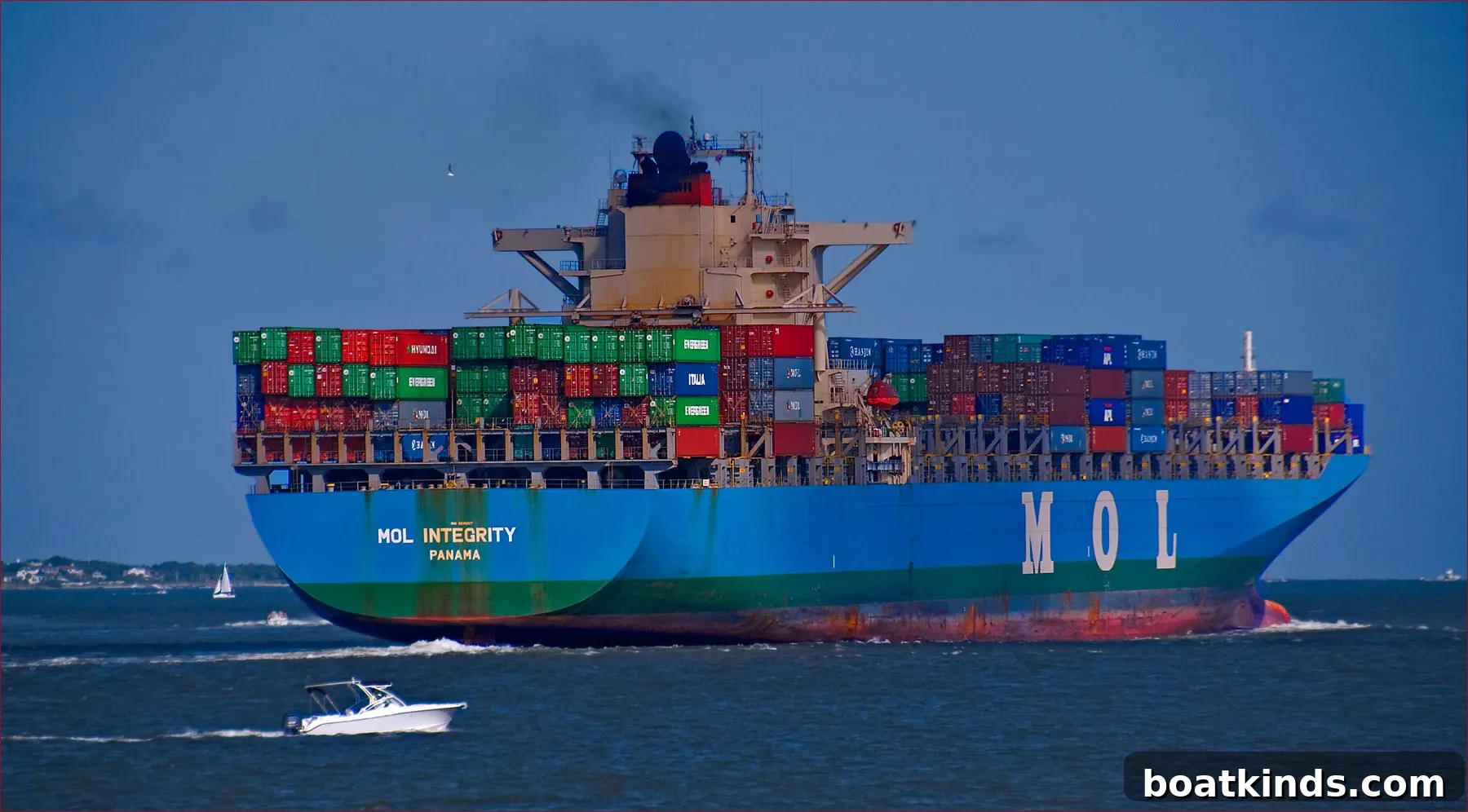
Large ships present special challenges. There is no “rule of tonnage,” but because of their size and blind sectors, big ships can have difficulty detecting small craft and maneuvering quickly. A ship’s bridge may be more than 100 feet above the water and its forward deck can create a blind spot dead ahead. If you find yourself in that sector, the ship may not see you.
Remain vigilant and act early around commercial vessels. A ship traveling 17 knots covers roughly 1.7 miles in six minutes—closing distance can disappear fast. Likewise, a large loaded tanker requires a long distance to alter course; a full, sharp rudder over may still take a ship a significant distance to achieve large course changes.
When calling a ship’s bridge, identify yourself precisely. Saying “the white sailboat on your starboard bow” can be ambiguous when there are many similar craft nearby. Give a GPS position or a bearing and range so the bridge team can positively identify your vessel before any maneuvering agreements are made.
“Know before you go” is sound advice. Understand where you fit in the rules hierarchy and how you are expected to operate. Act prudently and early, avoid small course changes that other vessels may misinterpret, and use all available means—your eyes, ears and electronic aids—to maintain situational awareness. Ensure navigation lights are displayed and not obscured. Above all, give large commercial vessels plenty of room; your passengers depend on your sound judgment and seamanship.
Pat Mundus is a retired merchant ship deck officer who cruises her ketch, Surprise, in the Bahamas and the Caribbean.
This article originally appeared in the October 2017 issue.