
More Women Are Becoming Commodores as Yacht Clubs Modernize

Across the country, yacht clubs are seeing a steady rise in the number of women elected to the role of commodore. Many of these new leaders say the increase reflects important, overdue structural changes in how clubs operate — adjustments that have opened the door for broader participation and leadership by women.
“I can’t tell you how many men have come up to me and said, ‘It’s about time,’” says Lisa Curcio Gaston, the first woman to serve as commodore in the Chicago Yacht Club’s 148-year history. “I think it goes to the fact that the culture of our club has changed a lot, in a good way.”
These milestones are not isolated. Over the past few decades, clubs around the United States have gradually broken down longstanding barriers. Examples include Carolyn Nelson Hardy, the first female commodore of Bahia Corinthian Yacht Club in Corona Del Mar (1993); Sanderson Carney, who led Ida Lewis Yacht Club in Newport, Rhode Island (2004); Sheila McCurdy at the Cruising Club of America (2009); Helen Salogub of the Midget Squadron Yacht Club in Brooklyn (2016); and Lynn Wingard, who became the Seattle Yacht Club’s first female commodore after 125 years (2017).
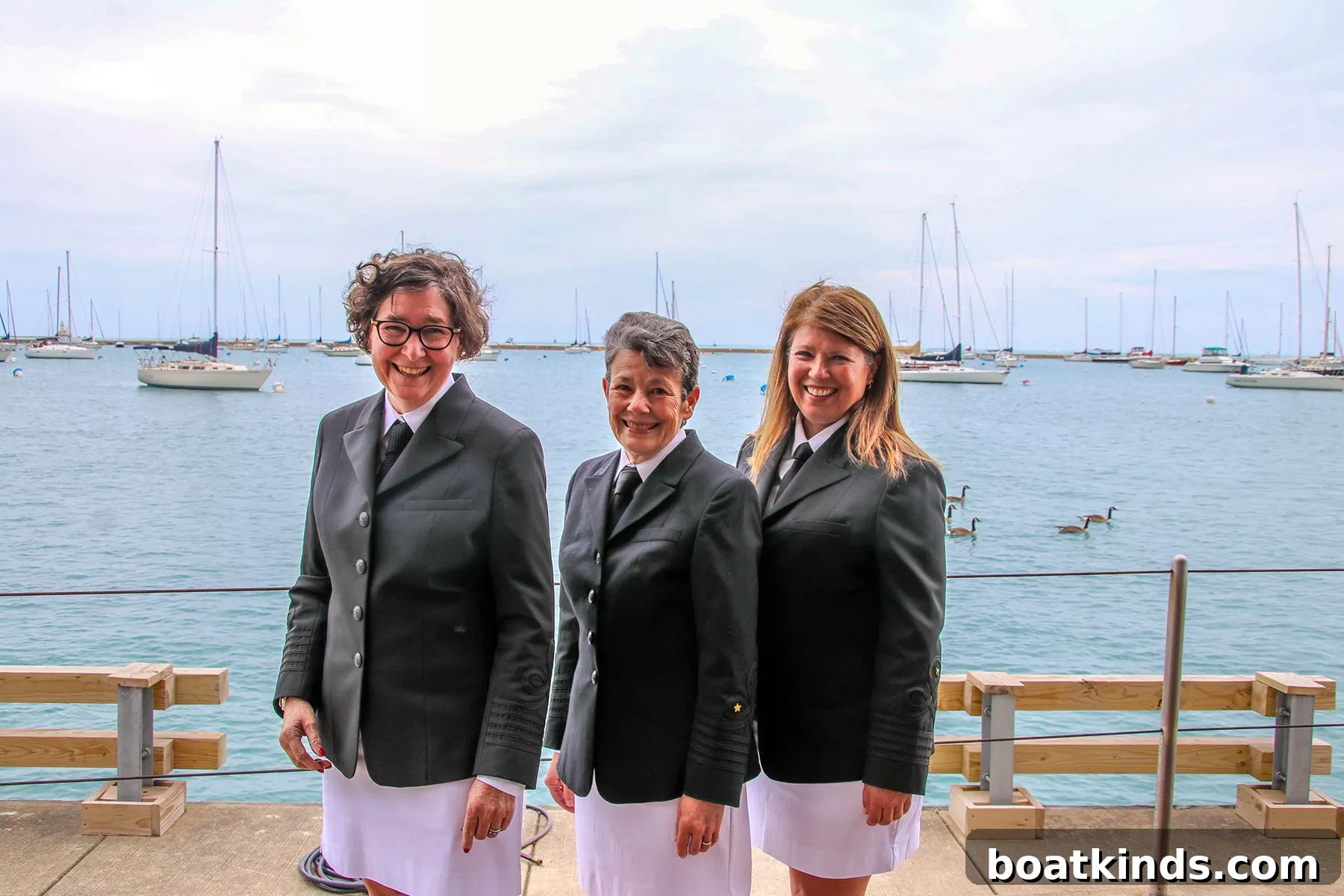
Today, stories of first-time female commodores appear with greater frequency. On New York’s North Fork, four of the region’s five yacht clubs — Shelter Island Yacht Club, Orient Yacht Club, Old Cove Yacht Club and Mattituck Yacht Club — are currently led by women. Lynn Kotwicki recently completed her term as the first female commodore at Detroit’s Bayview Yacht Club, founded in 1915. The Poplar Island Yacht Club on the Chesapeake Bay elected Missy Warfield as its first woman commodore in late 2021.
“We’re kind of doing it as a society,” says Lynn Reich, current commodore at Shelter Island Yacht Club. “The fact that this is happening all across the United States — it’s a really exciting time to be around and see these changes.”
What sets the current wave apart is that many of these women highlight specific institutional changes that made their leadership possible. Curcio Gaston and Reich say clubs had to rethink membership rules, committee structures and traditional expectations tied to gender in order to create genuine opportunities for women.
At the Chicago Yacht Club, for instance, membership historically favored men, with their spouses participating informally. The club revised that policy to allow couples to hold regular membership, and to recognize civil unions. Now, either partner in a couple may serve as a voting member, an officer, or a board member — though not simultaneously in the same role — and they may alternate positions year to year. According to Curcio Gaston, that change significantly expanded the pool of potential female leaders.
The club also reimagined the Women’s Committee, once led by the commodore’s wife and focused on social functions. An ophthalmologist who previously held that informal role redirected the committee’s focus toward women’s leadership and active participation on the water. The committee was later renamed Women on the Water, and is now chaired by a female member: an active sailor in her late 30s or early 40s who works outside the home and has a child. “So now, it is run by a female member,” Curcio Gaston says — a development that shifts authority and visibility to women within the club.
Reich describes a similar evolution at Shelter Island Yacht Club. “Years back, the women at our club weren’t even considered members. The men were the members,” she recalls. It was only a generation ago that a member pushed for equal recognition, saying, “This isn’t right. The women do half the work around here.”
That shift included ending the practice of automatically assigning certain committee leadership to a flag officer’s spouse. Today the club actively recruits female members for leadership positions and seeks gender balance on committees. Reich explains that practical committees — such as those overseeing docks, waterfront operations and the club’s fleet — used to be male-dominated. Now the club reaches out to ensure women with experience and knowledge are included and heard.
Curcio Gaston noticed this cultural change during the Chicago club’s annual ladies’ luncheon. “Back in the day — not many days back — it was a fashion show,” she says. This year, as the first female commodore, she was invited to speak. “I didn’t think I said anything all that exciting, and I can’t tell you how many women came up to me and said they came because they knew I would be speaking. They used the word inspirational.” Her presence at the helm is having a visible impact on other women’s sense of possibility within the club.
Both women emphasize that progress is about more than gender alone. “It’s not just about women; it’s about diversity and inclusion,” Reich says. “We need to get more people to enjoy the sport that we love. More people on the water means more ideas, more variety and background. It only makes us better.”
— Kim Kavin
This article was originally published in the July 2023 issue.