
Cruising to Vero Beach along the Intracoastal Waterway, you travel through North America’s most biologically diverse and second-largest estuary system: the 156-mile-long Indian River Lagoon. Stretching from Ponce de Leon Inlet south to Jupiter Inlet, the lagoon sits at the transition between temperate and subtropical climate zones, creating a unique mix of habitats and species.
Locally known as the Indian River, this waterbody is not a true river but an estuary — a lagoon where fresh water from rainfall, streams and runoff blends with salt water that moves in and out through five ocean inlets. The lagoon’s separation from the Atlantic by barrier islands limits saltwater exchange, and tidal flow is strongest near those inlets, which gives the Indian River the character of a lagoon rather than a flowing river.
When winds are favorable, the dredged Intracoastal Waterway channel provides relatively calm and protected passage for boaters. The lagoon’s shallow waters, a mixture of salt and fresh, become progressively warmer moving southward and cooler to the north, supporting both temperate and tropical species. These conditions create excellent spawning grounds and nurseries. Tidal salt marshes, shoreline-protecting mangroves, and extensive seagrass meadows that carpet much of the bottom all combine to feed and shelter a wide array of lagoon and ocean wildlife. Smithsonian Institution scientists have valued an acre of this “underwater rain forest” of seagrass at $20,500. The lagoon covers approximately 353 square miles, making those habitats both extensive and ecologically significant.
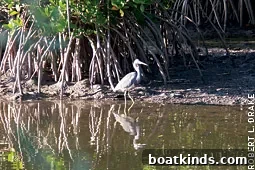
Early dredging for navigation created more than 200 spoil islands, many of which have since become heavily vegetated and now serve as important refuges for birds and other wildlife. Cruising through what has been called the “Nursery of the Atlantic,” it’s common to see dolphins, manatees, pelicans and osprey, and you may also encounter sea turtles, wood storks and frigate birds. Scientists have recorded a remarkable diversity here: 1,350 plant species and 2,765 animal species, including 685 species of fish and 310 species of birds — more species than anywhere else in North America. More than 50 of those species are listed as endangered or threatened, and some of them are found nowhere else.
Recreational fishing is a major local activity. Officials report that roughly 190,000 anglers target species such as redfish, spotted sea trout, snook and the formidable tarpon, among others. That fishing activity contributes more than $140 million each year to the local economy. Beyond sportfishing, the lagoon supports commercial, recreational and cultural values for surrounding communities.
Recognizing its importance, the Environmental Protection Agency designated the Indian River Lagoon an “estuary of national significance” in 1990. Yet beneath the surface beauty lie serious, ongoing threats: habitat loss from coastal development; pollution from stormwater runoff and nutrient overload; sediment quality degradation; invasive species; and fragmentation of management across federal, five county and 42 local governing authorities along the shoreline. The lagoon’s estimated contribution of about $730 million annually to surrounding communities has helped spur collaboration among government agencies, nonprofit organizations and local stakeholders to protect and restore these waters.
Boaters and visitors have a direct role to play in protecting the lagoon. Simple, practical actions make a measurable difference: properly dispose of trash and fishing line on shore rather than discarding them in the water; avoid boating directly over seagrass meadows to prevent scarring and loss of habitat; observe wildlife from a respectful distance and never feed or harass manatees, dolphins, nesting birds or sea turtles; and obey posted manatee zone speed limits. Minimizing wake damage in shallow areas, following responsible anchoring practices, and reducing nutrient inputs from shoreline properties and vessels also help maintain water quality and habitat health.
Enjoying the Indian River Lagoon means appreciating its remarkable diversity while taking steps to reduce our impact. By combining responsible boating habits with ongoing conservation efforts, communities and visitors can help protect this vital estuarine ecosystem for future generations.
This article originally appeared in the February 2009 issue.