
Porsche’s Type 729: The Air-Cooled Marine Engine and Its Legacy
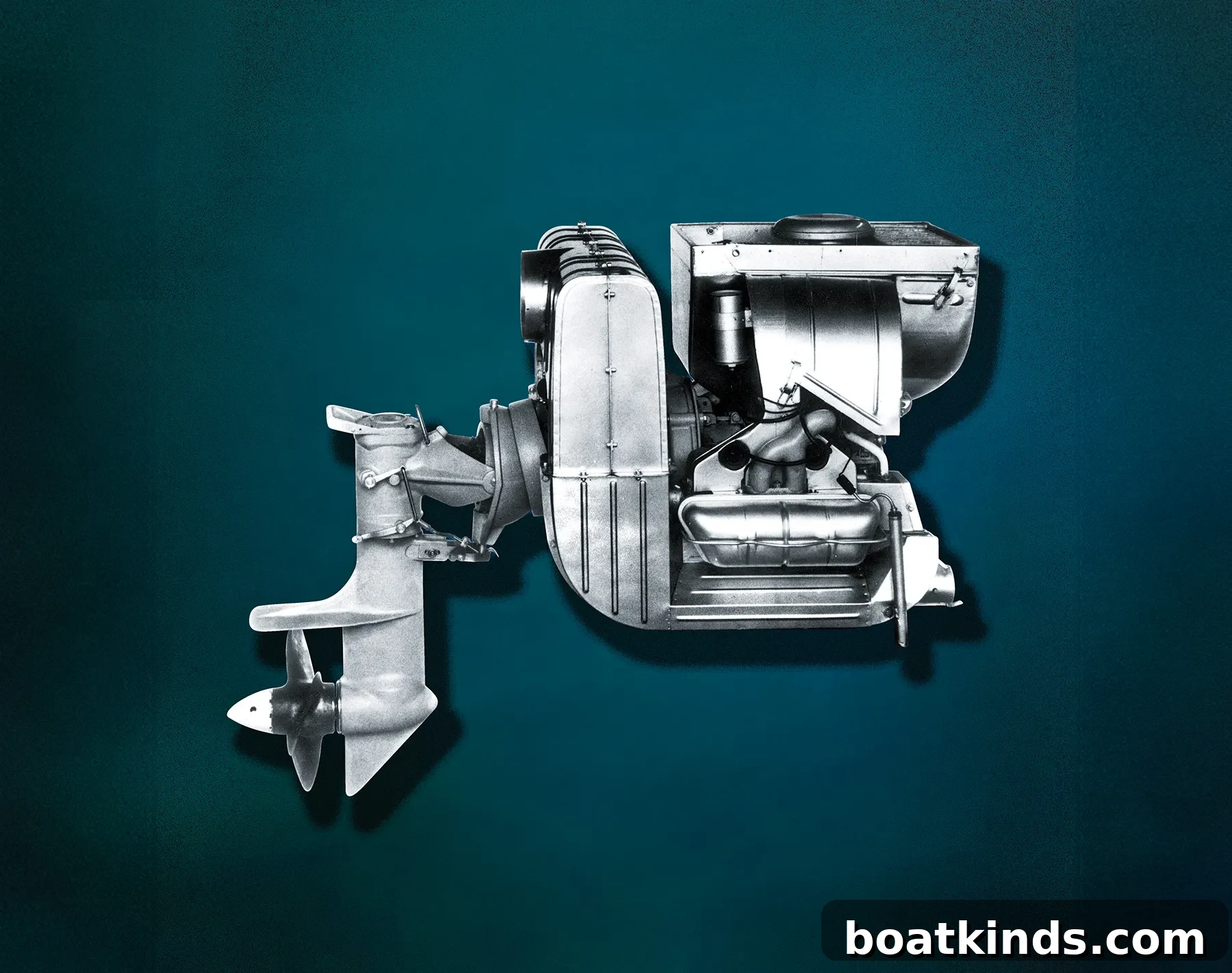
When the name Porsche is mentioned, most people picture sports cars, not boat engines. Yet in 1959 Porsche introduced a distinctive marine propulsion option to the U.S. market: the Type 729 air-cooled marine engine. Derived from the 1.6-liter, four-cylinder boxer unit used in the Porsche 356 A, the Type 729 weighed just 285 pounds and was promoted as a “light engine for lightweight boats.” Porsche marketed it as a compact, powerful alternative to conventional marine powerplants of the era.
The Type 729 produced 52 horsepower at 3,600 rpm and was initially offered as a transom drive, with plans for a traditional inboard version to follow. Ferry Porsche, son of company founder Ferdinand Porsche Sr., personally fitted one of the first units to his motorboat and put it through trials on Wörthersee Lake in Austria. Those early demonstrations aimed to show not only performance but also the practical benefits of air-cooling in a marine environment.
Porsche emphasized several advantages of air-cooled design for boats. Without a water-based cooling system, operators avoided issues tied to cooling-water corrosion, saltwater damage, and the need for filters or antifreeze. Air-cooling simplified maintenance by eliminating coolant checks and reducing the risk of sludge and corrosion inside the engine’s cooling system. A forced-air fan fed fresh air to the engine to maintain optimal temperatures, and the company also highlighted the engine’s quick warm-up and potential use in providing cabin heat. To further resist marine conditions, Porsche applied a corrosion-resistant coating to the crankcase.
Those selling points appealed to a variety of users. By 1959 the Type 729 found applications in search and rescue boats, where light weight and reliability were particularly valuable, and by 1960 it had even been adapted for use in some narrow-gauge locomotives. Despite these niche deployments, the air-cooled marine engine did not achieve the widespread recognition or market penetration of Porsche’s automobile engines. The marine propulsion market remained dominated by established manufacturers and technologies that continued to evolve alongside boating demands.
Over the decades, most recreational and commercial boaters have turned to well-known marine engine brands such as Mercury, Yamaha and Volvo Penta for outboard and inboard power. These companies developed extensive dealer networks, marine-specific engineering, and product lines tailored to a wide range of boat types and uses. Porsche’s marine efforts, while innovative, never displaced the market leaders in the same way as its automotive successes.
Still, Porsche has not entirely left the world of marine propulsion. In recent years the company has shifted focus from internal combustion marine units to electrified solutions. Porsche is leveraging electric driveline technology used in models like the Macan and collaborating with Frauscher, an Austrian boatbuilder, to develop a contemporary electric boat: the Frauscher x Porsche 850 Fantom Air. This partnership reflects broader industry trends toward quieter, cleaner, and more efficient marine propulsion systems, while drawing on Porsche’s expertise in performance engineering and electric powertrains.
The story of the Type 729 remains an intriguing chapter in Porsche’s history—an example of automotive technology applied to maritime needs, and an early experiment in alternatives to conventional marine cooling and propulsion. Although the air-cooled engine did not become a dominant force on the water, it demonstrated advantages that anticipated later concerns about simplicity, reliability, and corrosion resistance. The company’s renewed interest in electric boating signals a continuation of that spirit: applying high-performance engineering to evolving marine technologies and responding to modern priorities such as sustainability and reduced emissions.
This article was originally published in the January 2024 issue.