
A Life In Boats
When I was a child, most small craft were wooden, and rowing was how you reached your mooring. Today, inflatables have replaced nearly every oar-powered pram, dinghy and dory, changing the humble routines of generations of boaters.

In our family, the progression for youngsters was consistent for all seven of us: learn to swim before you learned to row, learn to row before you learned to sail, and learn to sail before you handled a powerboat. That gradual path taught skills, respect for the water, and a quiet confidence that only time spent on small boats can provide.
My sister Gen and her friend Carol were tireless rowers. They would set off from the Sauga Point peninsula in North Kingstown, R.I., and row a mile to the town library at Wickford, which conveniently had its own dock. With books and a picnic, they’d continue up Mill Cove to a tiny island—really just a large rock—that became their outdoor reading room for finishing the summer reading list.
I’ve always loved rowing. So when Dan Cushman kindly offered me the chance to take his 20-foot Whitehall skiff around Wickford Harbor, I eagerly accepted. Years earlier I’d rowed a Whitehall with my small children at the Mystic Seaport Museum in Connecticut and remembered the pleasure of that motion and balance.
My wife, Abby, and I packed a few snacks and pushed off. After a few strokes to overcome inertia, the hull slipped into motion. With its gentle entry and long skeg, the boat glided through the water and tracked beautifully. Passing boaters called out to ask what we were rowing; some tooted horns, others gave us a thumbs-up. A Whitehall is undeniably elegant—the graceful lines and wine-glass transom draw attention much like a smartly dressed relative at a community gathering.
Whitehalls trace their origins to Whitehall Street in Manhattan shortly after the War of 1812, according to Wickford boatwright George Zachorne, who has restored numerous examples. These boats earned a reputation as the “bicycles of the sea” because they could move people and goods quickly and efficiently around harbors. Their speed and handling made them indispensable in busy ports.
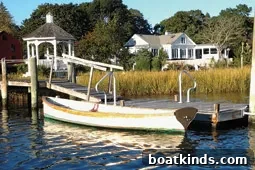
Pilots used Whitehalls to reach incoming vessels first and secure the piloting fee. Merchants used them to broach cargo or deliver provisions to ships. Being first to greet a ship as it entered a busy harbor could mean a tidy profit, and that competitive edge demanded boats capable of being rowed quickly—often by crews of motivated oarsmen using multiple oars.
Typically ranging from 14 to 22 feet, Whitehalls usually require two or three rowers. They are commonly carvel-planked rather than lapstrake, and older examples often include structural “knees” cut from fruit trees or hackmatack roots prized for their resistance to rot. In the 18-foot range these boats feel remarkably stable, though shorter versions can be tippier. Still, as small-boat master John Gardner observed, even a 12- or 13-foot Whitehall rows far better than many modern rowboats. While some Whitehalls have been adapted to sail, boatwrights like Zachorne note they generally sail best off the wind.
Dan Cushman’s Whitehall has its own story. His son Jeff first noticed an advertisement in Soundings while stationed in Iraq. For troops far from home, small signs of everyday life back on the coast can carry great meaning. The Cushmans went to Bayshore, N.Y., in 2004 to see the boat and discovered a true cedar-on-oak Whitehall, faithful to early 19th-century construction, built by Walter Stein with consultation from John Gardner. Stein invested roughly 20 years in the project, and the result is so authentic that a waterman from the 1850s would likely mistake it for a contemporary working boat.
Anyone who grew up near boats knows how restorative time on the water can be. Tasks like trimming sails, steering a course, assessing wind and tide, and the rhythm of rowing absorb your attention and quiet other worries. When Dan’s son returned home—bearing honors and scars from service—the Whitehall stood ready to help in that slow, steady way only a boat can: by offering focus, calm, and the simple joy of moving through water.
Greg Coppa is a freelance writer and lifelong boater whose short story “November Christmas” was adapted for a Hallmark Hall of Fame movie. His collection, “November Christmas and Other Short Stories,” is available in print and ebook formats.
June 2014 issue