
Hardware and software makers are expanding their toolbox, pushing marine electronics into new frontiers.
As trends multiply, so do the solutions. At the larger scale, stand-alone multifunction displays are taking up more real estate at the helm. At the smaller scale, smartphones and tablets have become central navigational and entertainment devices. Manufacturers are responding by offering black-box processors, app-driven systems and hybrid approaches that bring navigation, safety and entertainment together.
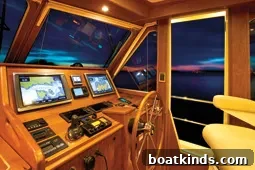
Furuno’s black-box approach
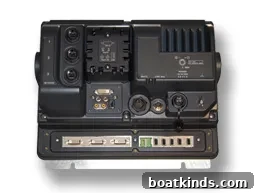
The term “black box” — sometimes called a “box of tricks” — dates back to wartime jargon for compact, non-reflective electronic modules. Furuno pioneered this approach in the marine sector in 1999 and has renewed that concept with its TZTBB processor. The TZTBB is a slim-line black-box unit designed to power dual-touch multifunction displays supplied by the customer, offering two DVI outputs and a built-in scaler to accommodate both widescreen and standard displays.
The TZTBB can run two displays in clone mode from a single unit, a practical solution for vessels with duplicated helms such as a flybridge and lower station. All TZtouch functionality is preserved in the black-box version except for the physical RotoKey knob, which Furuno replaces with intuitive on-screen “smart-touch menus.” Pricing was not available at press time. www.furunousa.com
Raymarine LightHouse v5 software
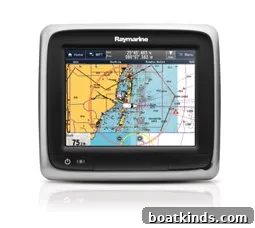
Often the difference between systems is software, and Raymarine’s LightHouse v5 demonstrates that. Available for c-Series, e-Series and a-Series MFDs, LightHouse v5 introduces fuel-management tools that let users calibrate tank levels, monitor consumption, receive low-fuel alerts and display a dynamic fuel-range ring on the chartplotter showing estimated range based on real-time fuel use.
LightHouse v5 also adds FLIR-based “slew-to-cue” camera tracking for thermal cameras, so thermal imaging can follow cued targets from AIS, radar MARPA targets or selected objects — even a person in the water. The software is free for compatible Raymarine displays. www.raymarine.com
Bluetooth audio and onboard convenience
Many boaters now rely on playlists on smartphones rather than FM radio, especially when cruising. Bluetooth has become the simplest way to control music from the helm, salon or cabin without running back to a central stereo. Black-box head units and compact marine stereos bring Bluetooth control, USB inputs and multiple preouts to integrate with onboard amplifiers and subwoofers.
For example, ProSpec’s JBL MBB 2020 black-box stereo includes a 4 x 50W internal amplifier, auxiliary inputs, three pairs of preouts, a subwoofer output and USB ports. Its compact faceplate provides basic controls and a digital display at the unit, while Bluetooth lets users control music remotely from phones or tablets. The unit retails at about $300. www.prospecelectronics.com
AIS on smart devices: Vesper Marine XB-8000
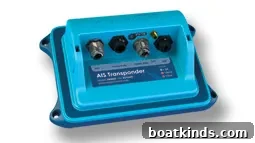
Vesper Marine’s AIS XB-8000 is a Class B AIS transponder without an integrated display, designed to be controlled and monitored via smartphones, tablets, laptops or by integrating with other marine electronics. The XB-8000 streams AIS data wirelessly, allowing navigation apps such as iNavX to display real-time target information and enabling remote configuration via a free app for iOS devices. The XB-8000’s suggested retail price is around $799. www.vespermarine.com
Lowrance Link-8: VHF and AIS combined
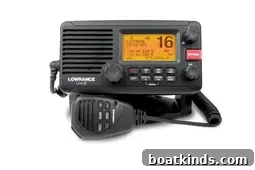
To make collision-avoidance information affordable, Lowrance offers the Link-8, a compact VHF radio with an integrated AIS receiver. The unit displays basic AIS targets and vessel data on its small screen and can share detailed AIS information with connected Lowrance multifunction displays over NMEA 2000.
The Link-8 supports a “track your buddy” feature for up to three boats via polling, and the VHF itself includes dedicated controls for Channel 16, weather, dual and TriWatch monitoring, DSC functions, distress logging and loud-hailer output. Retail price is approximately $299. www.lowrance.com
AIS for life rafts: McMurdo SmartFind S5
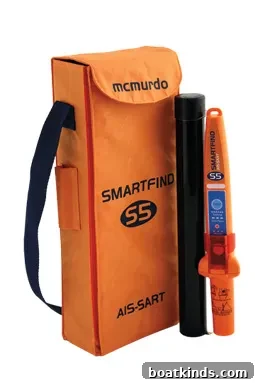
McMurdo’s SmartFind S5 brings AIS rescue capability to survival craft and life rafts. When manually activated, the S5 transmits GPS position and a unique identifier via AIS, making the life raft visible on standard shipborne AIS receivers. The unit offers an extended pole to elevate the antenna for improved line-of-sight transmission and a 96-hour operational battery life. The SmartFind S5 lists at about $965. www.mcmurdomarine.com
Simrad RS35 and HS35 wireless VHF
Simrad’s RS35 fixed-mount VHF reduces cable clutter by pairing with optional HS35 wireless handsets. The radio can support up to two HS35 handsets at ranges up to roughly 100 meters and integrates dual-channel AIS reception so AIS targets can be viewed while using VHF functions via a single antenna.
The HS35 handset has a high-resolution LCD, a dedicated AIS function, induction charging and up to eight hours of talk time. It includes an intercom for communications between handsets or to the base station, a headphone jack and a belt clip. The RS35 base and HS35 handset retail near $399 and $169, respectively. www.simrad-yachting.com
Onboard Wi‑Fi and NMEA over wireless: Digital Yacht iNAVHub
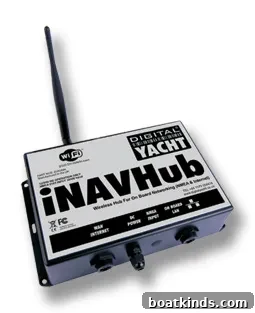
Digital Yacht’s iNAVHub creates a secure Wi‑Fi network aboard larger boats and shares NMEA data — GPS, instruments and AIS — to multiple devices running navigation and data-viewing apps. The iNAVHub supports WAN connections for shore Wi‑Fi, 3G or satellite via an ethernet interface, a local wired LAN port for PCs and pairs with Digital Yacht’s long-range WL510 Wi‑Fi adapter to extend connectivity up to several nautical miles. iNavHub retails around $500. www.digitalyachtamerica.com
KVH TracPhone V7 with IP controller
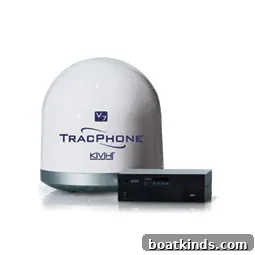
IP-enabled satellite systems are simplifying onboard connectivity. KVH’s TracPhone V7 adds an IP-capable controller (CommBox-ACU) to provide reliable internet over a 24-inch dome antenna, aimed at vessels larger than about 40 feet. TracPhone V7 IP supports download speeds up to about 2 Mbps and uploads up to roughly 512 Kbps. Hardware pricing is in the premium range, while monthly mini-VSAT plans start at modest data tiers. KVH also offers the smaller TracPhone V3 with a 15-inch dome for smaller boats. www.kvh.com
Digital Yacht Aqua 200 Series PC
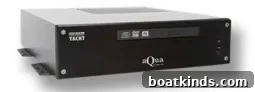
Digital Yacht’s Aqua 200 Series marine PC targets budget-minded owners who still want robust performance. The fanless unit runs on 12V DC, has no moving parts, and draws under an amp. It uses an Intel N2800 dual-core processor with Intel HD graphics, supports 1080p resolution, includes 4GB RAM and a 64 GB SSD, and offers VGA and HDMI outputs for dual-monitor setups. Windows 7 Home Premium 64-bit ships as standard, and the system includes dual NMEA 0183 inputs with optional NMEA 2000, Bluetooth and high-power Wi‑Fi. The Aqua 200 typically retails near $1,150. www.digitalyachtamerica.com
Bad Elf GPS for iOS devices
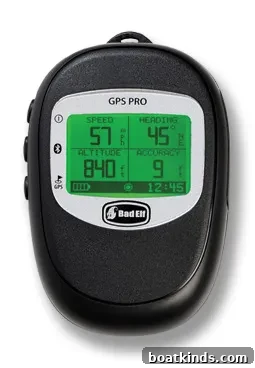
Bad Elf’s external GPS receivers provide direct satellite positioning to Apple iOS devices without relying on cell towers, allowing accurate positioning outside cellular coverage. Models include a 30-pin connector unit for older iOS devices and a compact Bluetooth-enabled Bad Elf GPS Pro that can share position data with up to five users and update as frequently as 10Hz. Accuracy is typically within a few meters. Prices start near $129.99. www.bad-elf.com
FLIR First Mate II: smarter thermal spotting
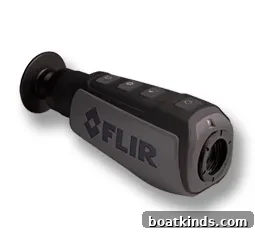
FLIR’s second-generation First Mate handheld thermal imagers add InstAlert, an automated processor that highlights the strongest heat signatures in red, making it faster to spot people in the water or other hazards. These lightweight handhelds are available in multiple resolutions and lens options and are valuable tools for search and safety operations. Retail price is about $1,999. www.flir.com
Furuno Fantum Feedback for outboards
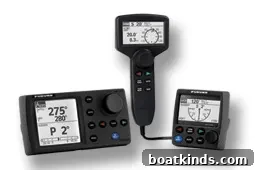
Outboard-powered boats have historically been tricky for autopilots because of exposed rudder-feedback sensors. Furuno’s Fantum Feedback software replaces the physical feedback assembly with a time-based rudder gain process that emulates the information an autopilot needs. Designed for planing and semi-displacement outboard boats, NavPilot systems equipped with Fantum Feedback start in the mid-thousands. www.furunousa.com
See related articles:
– A resolution to require emergency locator beacons
– The push to mandate locator beacons offshore
– Rescues aren’t cheap
February 2013 issue