
In his recently released book, Nick Schuyler recounts the tragedy that claimed the lives of his three friends
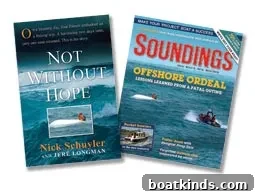
Nick Schuyler, the lone survivor of the widely publicized February 2009 boating accident in the Gulf of Mexico, has written a detailed account of the ordeal. In Not Without Hope, co-written with New York Times sportswriter Jere Longman, Schuyler provides an hour-by-hour narrative of the hours he spent in the water and the deaths of his three companions.
In the book’s prologue Schuyler asks a question that haunts him: “Four of us went into the water, and I was the only one who came out. Why me?” He describes his friends—Marquis Cooper and Corey Smith, both NFL players, and Will Bleakley, his college teammate—and the shock of surviving when they did not.
The group’s fishing trip went disastrously wrong after they attempted to free a fouled anchor by tying the anchor rode to the stern of their 20-foot, 9-inch Everglades center-console and using the 200-hp Yamaha engine to pull it loose. More than 50 miles off Clearwater, Florida, on the afternoon of February 28, 2009, the maneuver pulled the stern down, flooded the cockpit and capsized the deep-vee boat onto its port side. The men were in water whose temperature was in the low 60s and the boat carried no emergency position-indicating radio beacon (EPIRB).
Florida’s month-long investigation attributed the accident to improper anchoring, operator inexperience and careless or reckless operation. In Not Without Hope, Schuyler disputes several early rumors—such as claims that Cooper deliberately removed his life jacket and drowned or that Bleakley swam toward a light he thought was land—offering instead his firsthand observations of what happened during those final hours.
Schuyler writes that Cooper repeatedly apologized after they entered the water. “I’m so sorry, you guys,” Marquis said repeatedly, Schuyler recalls, suggesting the captain felt responsible because he was in charge of the boat. Bleakley also expressed remorse for suggesting the stern-towing plan, saying, “I’m so stupid. I can’t believe I did that.”
Through Coast Guard Capt. Timothy Close, commanding officer of Sector St. Petersburg, the book highlights how a functioning EPIRB could have changed the outcome: “If they had one, there wouldn’t have been search, there would have been rescue,” Close is quoted as saying. He adds that these were intelligent, college-educated men who were simply inexperienced boaters unprepared for rapidly worsening conditions.
Most of the book focuses on Schuyler’s struggle to survive and on how he watched each friend succumb, describing Cooper’s confusion and eventual loss of consciousness as hypothermia took hold. “Marquis was just laying across me, not moving,” Schuyler writes. Will checked for a pulse and could not find one.
Corey Smith’s behavior deteriorated as hypothermia set in. Schuyler recalls Smith becoming agitated and profane, at one point threatening him in a way that was uncharacteristic. Minutes after Schuyler released Cooper’s body, Smith removed his life jacket, dove away from the overturned boat and did not resurface. Schuyler’s description captures the horror and helplessness of watching a friend sink beneath the waves.
Bleakley clung to life into the next day. He managed to dive beneath the hull several times and retrieve a bottle of Gatorade and some pretzels, but Schuyler watched him grow weaker and begin to deteriorate. Bleakley told Schuyler he would not survive another night. Schuyler holds to the painful memory of holding Bleakley chest to chest as hypothermia claimed him.
Schuyler reflects on why he may have survived when the others did not. He notes that during the ride out he felt seasick and put on extra clothing—a sweatshirt, an orange jacket, sweatpants, a skull cap and gloves—and kept them on. Cooper and Bleakley had changed clothes to swim under the boat, and Bleakley was left in just a T-shirt and trunks. Those differences in insulation and exhaustion likely influenced who succumbed to hypothermia.
Grappling with survivor’s guilt, Schuyler openly questions whether he could have done more to help his friends—whether he should have shared clothing or assisted them under the hull. He refuses the label of “hero,” insisting he did not save anyone, but his account also demonstrates endurance, resourcefulness and the raw reality of survival under extreme conditions.
The book prompted media appearances as Schuyler tried to correct the record, including interviews on Oprah, Larry King Live and The Today Show. Not all responses have been positive. Rebekah Cooper, Marquis’s widow, criticized the book’s portrayal of her husband as inexperienced, saying Schuyler exaggerated his relationship with the family and profited from their loss.
Not Without Hope is a 237-page, first-person account that documents a tragic Gulf of Mexico boating accident and the human consequences of a split-second decision made far offshore. It is an unflinching chronicle of survival, loss and the long aftermath for the one man who returned.
This article originally appeared in the May 2010 issue.