
When Grady-White introduced the 251 Coastal Explorer in 2014, it stood out from the builder’s traditional lineup as the company’s first hybrid center console—designed to serve both anglers and families who wanted a versatile boat for inshore and nearshore adventures. With lower gunwales than typical Grady models, dual casting platforms and a hull that combined a deep-V forward with a shallow aft draft, the 251 CE blended traits of a bay boat and a coastal sportfish. It quickly attracted a loyal following for its adaptability.
Demand for hybrid designs has continued to grow, especially among younger families and day-boat buyers who value a single craft that handles a variety of activities and water depths. To meet that demand, Grady-White expanded its Coastal Series with the new 281. With a centerline length of 27 feet 7 inches, the 281 is sized for offshore confidence while remaining shallow enough—19 inches of hull draft—to spend an afternoon at a sandbar or anchored in skinny water. Built to Grady-White’s rigorous construction standards and traditional lines, the 281 also delivers a polished, upscale presence at any marina or dockside restaurant.
I saw the 281 at the Miami International Boat Show, moored on a less-trafficked dock, yet it still drew attention—proof of the brand’s strong reputation. Bruce Richter, Grady-White’s senior design engineer, was aboard to walk visitors through the design. He described the 281 as slightly too large to be a pure bay boat, yet perfectly sized for family fishing days that may include offshore runs, particularly with twin engines for added reliability.
At the core of the design is Grady-White’s SeaV2 hull. The 281’s aft deadrise is a shallower 16 degrees versus the 19–20 degrees found on the builder’s full offshore models, which makes the boat livelier in shallow water while still able to handle rougher seas—though it’s not intended for extreme offshore canyon running.
The boat on display wore twin 300-hp Yamaha outboards, the upper end of available power, delivering a top speed near 49.8 knots and a cruise speed around 25.3 knots with a reported fuel economy of 2.37 mpg at that pace. The standard setup is a single 425-hp Yamaha, which produces a 43.4-knot top end and cruises at about 25.8 knots with a fuel burn of roughly 2.19 mpg. These figures underscore the 281’s range of performance choices depending on how owners plan to use the boat.
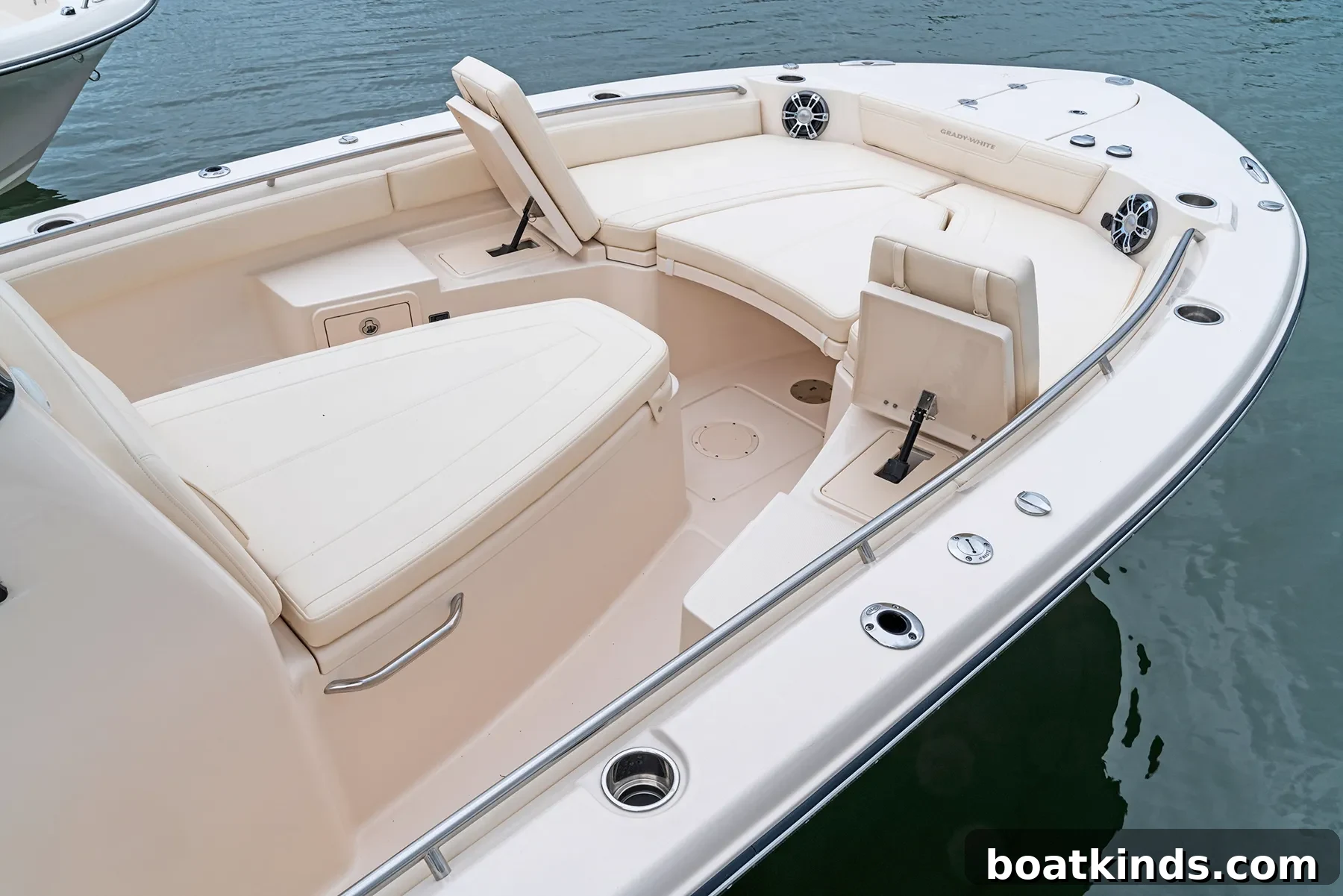
The bow area is thoughtfully detailed for both comfort and fishing. Cushioned lounges run port and starboard with a center section that converts into a table; an additional cushion inserts aft to create a large sun lounge. Remove the cushions and stow them in the console, and the space converts into a roomy casting deck capable of accommodating two—possibly three—anglers.
Richter pointed out the engineering challenges in creating the modular bow layout. “It’s complicated for an engineering team to put this type of section together, with so many pieces,” he said. Precision down to the centimeter is required so lids align, cushions fit snugly and everything operates smoothly without rubbing.
Practical technology in the bow includes electric backrests for the lounges, and a large insulated coffin box that doubles as either storage or a fish box. The boat is also pre-rigged for a bow-mounted trolling motor, making it straightforward to add quiet, precise control for inshore fishing or precise positioning near structure.
The helm is designed for excellent visibility and driver comfort. A full windshield extends to the T-top and is made from an acrylic material Richter noted was tested for durability—resistant to scratches even under harsh conditions. T-top supports are deliberately positioned to stay out of the driver’s sightlines and are constructed from heavy-gauge aluminum finished with a durable automotive-grade paint designed to resist scuffs and wear.
The dash accepts dual 16-inch displays and accommodates gauges and controls for Yamaha Helm Master; breakers are located nearby. The helm configuration on the show boat featured adjustable bucket seats, while a bench seat is standard. Switches for T-top and spreader lights, cockpit floor lighting and optional underwater transom lights were present, illustrating a balanced approach to equipment—functional and well-considered without unnecessary flash.
Fishing conveniences include dedicated tackle storage, a bait-rigging station at the leaning post, two live wells, rod holders and rocket launcher rod storage. For days away from the rod, options include a ski arch or pylon for towing towables, and a SureShade cockpit shade. The console houses a private head for added comfort and convenience on extended outings.
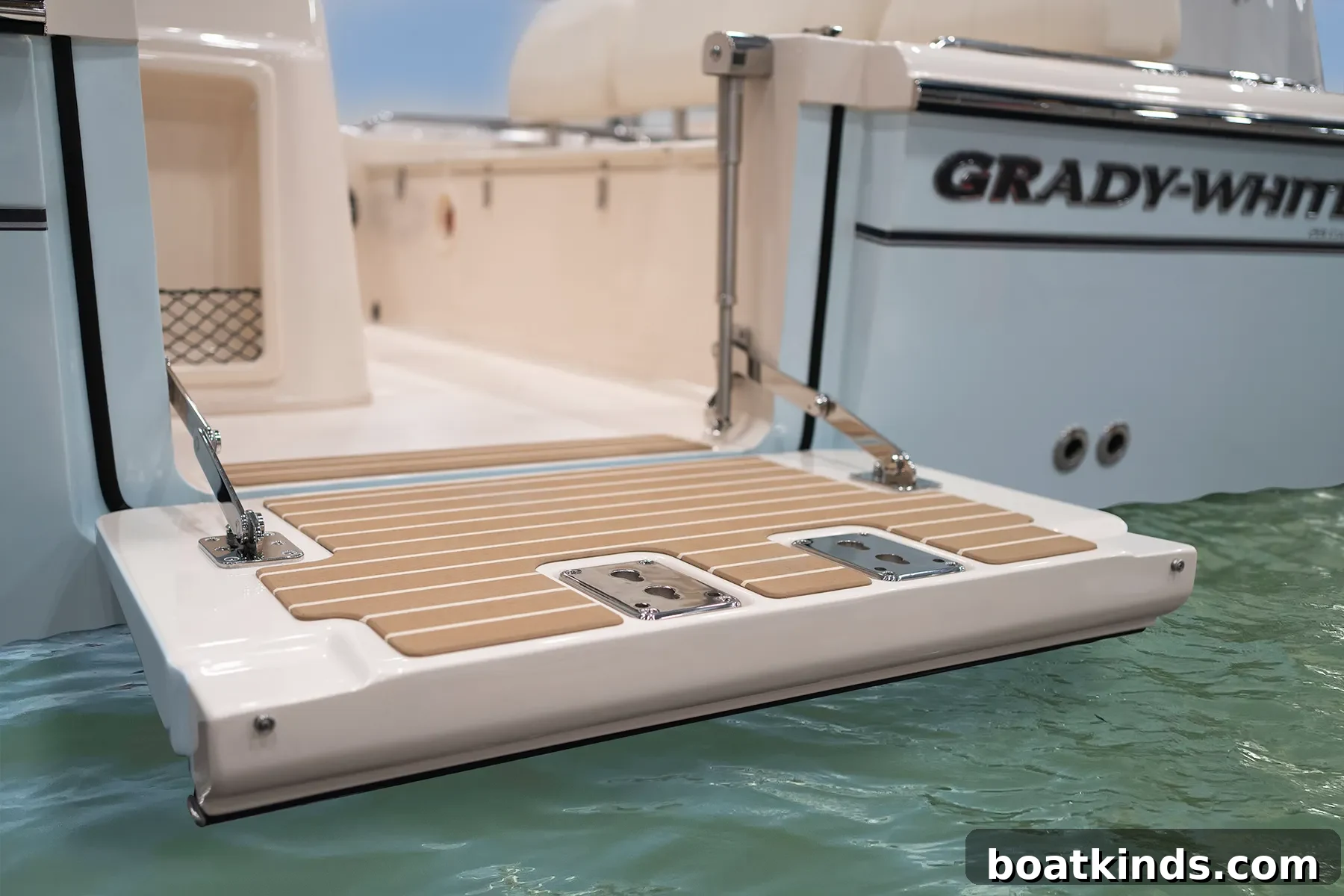
A standout feature is the port-side “sport deck”—an electrically operated door that folds down into a mini swim platform, making boarding and reboarding significantly easier. The sport deck includes a removable ladder for easy water access, an owner-friendly touch for families and swimmers.
The transom bench is another flexible element Richter took pride in. It conceals insulated storage and converts into a casting station. Seat backs rotate to create multiple configurations: opening a walkway to the swim platform, or rotating to form a coaming-style bolster to support an angler while fighting a fish. These small but thoughtful details reflect the iterative design and testing process Grady-White applies to enhance owner experience whether fishing offshore or staying inshore.
LOA (w/twin 300s): 30’3”
Beam: 9’4”
Bridge Clearance: 7’11”
Displacement (w/o power): 5,650 lbs.
Power: (2) 300-hp Yamaha outboards
Fuel: 160 gals.
This article originally appeared in the May 2023 issue.