
A simple, strong way to bond King Starboard: a real‑world test of Chem‑Set 6105

The talk around the docks has long been the same: bonding King Starboard—a popular marine-grade polyethylene sheet used by today’s boat builders and restorers—to itself or to other materials is difficult. Traditional approaches have required a sequence of demanding surface preparations: abrasion with medium‑grit sandpaper, thorough wiping with solvents such as acetone or alcohol, and even flame‑treating with a propane torch. That torch step must be performed precisely, risks scorching or discoloring the material, and forces you to bond the parts within a short window after treatment. Given that level of effort, many DIYers and weekend mechanics simply bolt or screw parts together rather than mess with adhesives.
Over the years there have been many attempts to solve King Starboard’s reputation as hard to bond. Until recently, most of those solutions came with caveats and elaborate prep. That made any promising product worth testing in a realistic setting before recommending it to other boat owners.
Last year a new option appeared: Chem‑Set 6105 from Chemical Concepts, a two‑part, 1:1 toughened acrylic adhesive formulated specifically to bond polypropylene and polyethylene without a primer or special surface treatments. Because the adhesive is designed for plastics that are typically difficult to glue, it attracted my attention and I decided to try it in a straightforward, practical way.
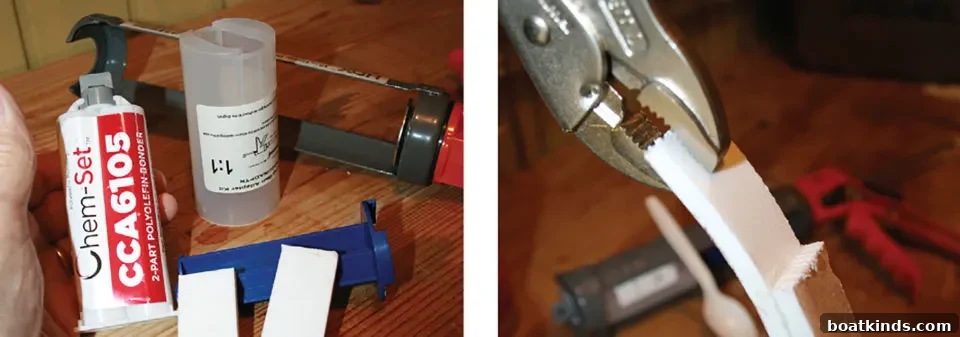
My test was intentionally simple and deliberately close to what a typical home builder might do. I cut two small strips of quarter‑inch King Starboard, each roughly three inches by one inch. I mixed a small quantity of the two‑part Chem‑Set at the recommended 1:1 ratio and applied a thin bead of the gelatinous adhesive to one strip using a plastic spoon. Instead of using clamps or elaborate fixtures I pressed the two strips together with my fingers, just enough to form contact, and set the piece aside to cure.
At the encouragement of Rick Firrera, product manager at Chemical Concepts, I allowed the bonded test piece to cure for about two days before attempting to separate the parts. The cured bond exceeded my expectations. Even though I had applied adhesive only to one mating surface and used no clamping pressure, the joint resisted every attempt at separation. When I secured one end of the bonded construct in a vise and used Vice‑Grips to try to pry the pieces apart, the bond held so well that the Starboard itself bent and deformed before the adhesive joint failed. In short, the joint proved exceptionally robust under these practical conditions.
There are a few practical takeaways from the experience. First, Chem‑Set 6105 appears to eliminate the need for the tedious abrasion, solvent wipe and flame‑treat sequence that many other bonding methods require with polyethylene materials. Second, handling and application are straightforward: mix the two components at the specified ratio, apply evenly, mate the parts, and allow adequate cure time. Third, although the product tolerated casual application in my test, following manufacturer instructions for surface cleaning, mixing precision and cure time will yield the most reliable results for load‑bearing or structural joints.
As with any adhesive, basic safety and good practice are important. Work in a well‑ventilated area, wear nitrile gloves to avoid skin contact, and use eye protection. Keep excess material off finishes and use appropriate tools to spread the adhesive evenly. For critical structural applications or for bonding mixed materials (metal, fiberglass, wood), consult the manufacturer’s technical data sheet and, if needed, perform your own small test pieces to confirm fit and bond performance before committing to a large project.
Chem‑Set 6105 represents a practical, accessible option for boat owners and restorers who want to bond King Starboard without the elaborate prep routines that have historically made adhesives impractical for many hobbyists. The straightforward mixing, the elimination of flame treating and the strong cured joint make it a noteworthy addition to the toolbox for marine repairs and custom fabrication. For technical specifications, application guidance and safe handling recommendations, contact the manufacturer, Chemical Concepts, or review the product documentation provided by them.
This advice previously ran in Power & Motoryacht magazine.