
How to Avoid Using a Firearm While Cruising: Practical Advice from John Price
John Price, a retired Army National Guard colonel and longtime Episcopal priest who now serves as an FBI chaplain, has thought deeply about self-defense while cruising. A Houston resident who has spent much of his adult life sailing, Price shared practical guidance on avoiding conflicts at sea and, when necessary, responsibly preparing to defend yourself, your crew and your guests.
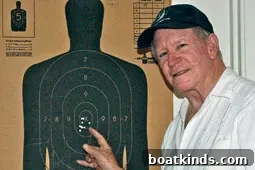
Soundings spoke with Price in mid-June while he was in St. Thomas, U.S. Virgin Islands, changing crews during a two-week sailing charter in the USVI and BVI on a 45-foot Jeanneau. He traces his familiarity with guns to his upbringing in Corpus Christi, Texas; his father, a World War I Army engineer and later an oil explorer, carried a .45-caliber Army surplus revolver that Price still keeps as a display piece.
Although licensed to carry a concealed weapon in Texas, Price says he does not routinely carry one. His approach is rooted in avoidance: he stays out of places where the risk of having to use a firearm is high. “There are places I won’t go because of the local situation,” he says. He finds the U.S. and British Virgin Islands among the safer cruising grounds but avoids the Windward Islands, where reports of attacks on cruisers have risen.
Price connects incidents of crime against boaters to underlying poverty and desperation in a region. He points out that environments with severe economic hardship tend to see more piracy and violent crime. For that reason he warns cruisers to research regional risks carefully and to consider how those risks affect their plans and behavior.
Mexico is a clear example he cites. With violent crime up in many areas due to drug trafficking and rival gangs, Price says the situation can be dangerous for travelers. He emphasizes that some places are simply not worth the risk and urges cruisers to educate themselves before setting course.
When it comes to defending a boat, Price says skippers must think seriously about responsible preparedness. Whether to carry a firearm depends on the local threat level, the legal rules for firearms in each country along the itinerary, and the practical consequences of using a weapon aboard a vessel. Many countries require that firearms be declared to customs and either secured in a locked gun cabinet under a customs seal or surrendered to authorities until departure.
Price has strong opinions about which firearms, if any, are appropriate aboard boats. He worries that semiautomatic rifles can cause excessive collateral damage — a stray bullet can easily penetrate a hull, sink a boat or injure nearby people. For those who choose to arm themselves, he prefers a pump-action 12-gauge shotgun with a short 18-inch barrel. He says the sound of chambering a shell can be a powerful deterrent, and the shotgun is effective at close range.
To limit collateral damage in tight quarters like marinas, Price recommends heavy birdshot rather than double-ought buckshot. His recommended tactic is defensive rather than aggressive: fall back to a secure position, fire a warning load into a non-critical area such as an unoccupied couch to frighten intruders, and be prepared to chamber another round if necessary. “He’ll run,” he says. Rushing an intruder, he warns, is a bad idea.
Price is skeptical of pistols as the default home- or boat-defense weapon for most people. Under stress and adrenaline, he says many shooters lose the ability to aim accurately. He mentions one unusual option — the “Judge’s Special,” a revolver with a cylinder configured to accept .410 shotgun shells or .45-caliber bullets and a short barrel suited to very close range — but notes that this is not a typical choice for most cruisers.
No matter what weapon you choose, practicing with it before taking it aboard is essential. “You don’t want to be learning as the guy is coming down the steps,” Price says. Training reduces the risk of accidental harm and increases confidence in a high-stress situation.
Price also urges perspective amid media-driven fear, such as the attention paid to Somali piracy. While piracy has increased in some areas, that does not mean every cruising ground is equally dangerous. He recalls a spike in home invasions in Houston that alarmed residents, only to find most incidents were gang-related or targeted specific communities, not random attacks on typical homeowners.
Ultimately, Price balances a serious approach to self-defense with a preference for prudence and avoidance. He emphasizes staying out of harm’s way, being informed about regional threats and legal requirements, and choosing defensive tactics that minimize risk to yourself and others. “I’ve never shot a gun in anger,” he says — a record he attributes to good judgment, preparation and a focus on safety.
This article originally appeared in the October 2009 issue.