
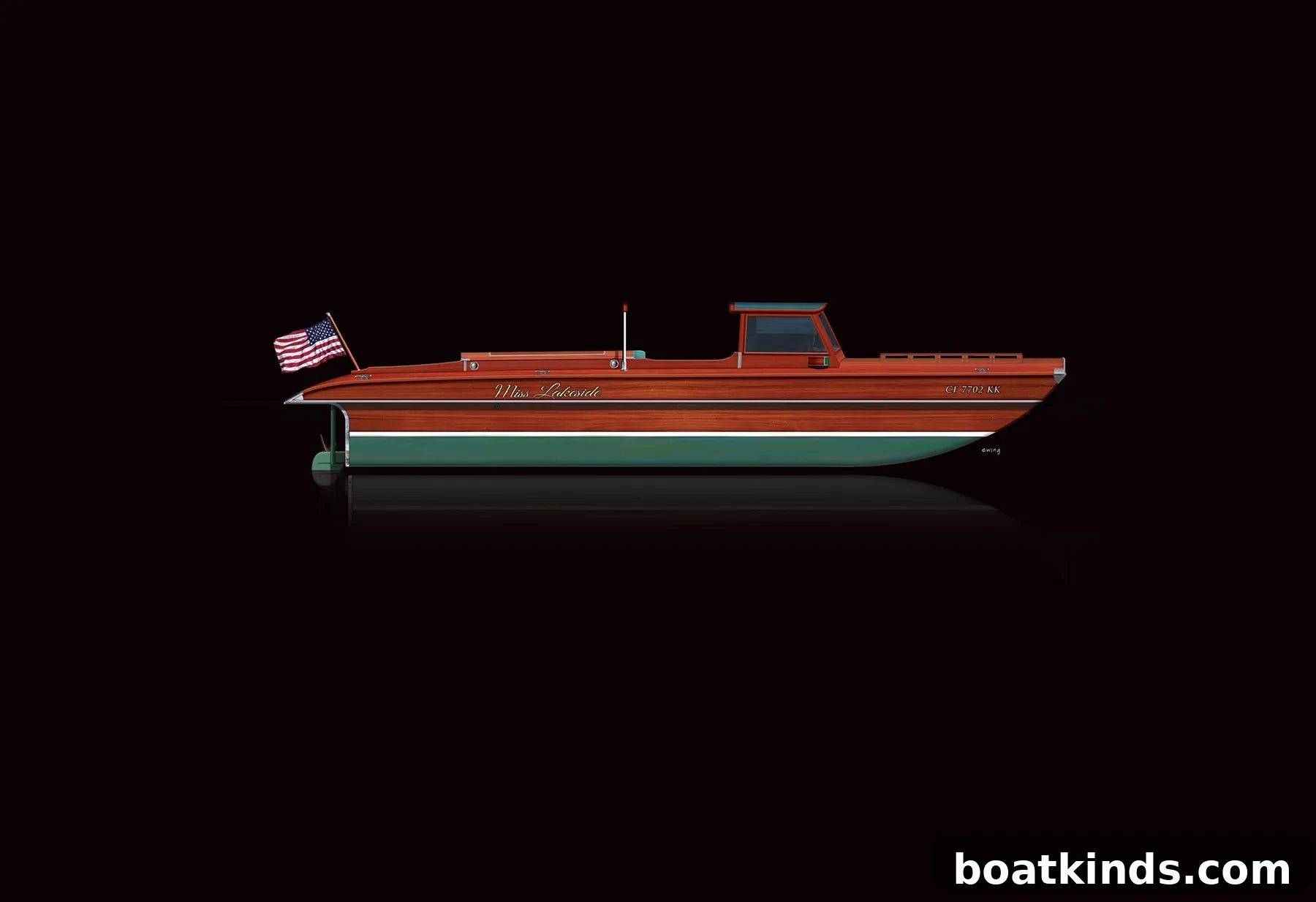
Miss Lakeside — The 1925 Sea Sled That Redefined Speed
Search images for “Miss Lakeside” and you’ll often see the dramatic starboard-aft view: a classic wooden speedboat punching a rooster tail across the wake. That view highlights her offshore performance, but the most revealing angle is forward of the cockpit. From a forward quarter you can clearly see the Sea Sled’s most unusual feature: two bows converging into an arched tunnel hull that sets this boat apart from conventional V‑bottom designs.
The Sea Sled hull was the invention of Canadian engineer Albert Hickman, who began building boats with an inverted‑V shape before World War I. Rather than slicing through waves like a traditional V hull, the Sea Sled funnels bow waves and trapped air beneath the hull. This stream of water and cushion of air reduces friction and allows the hull to plane more efficiently. The design tapers aft to a flattened transom with effectively zero degrees of deadrise, lowering the wetted surface in the way modern vents and steps do on many high‑performance monohulls.
Miss Lakeside was built in 1925 and measures 27 feet, 6 inches overall, with a 9‑foot beam and a shallow draft of roughly 1 foot. Her double‑planked mahogany hull rides on oak frames reinforced with steel, a common and robust construction method of the era. Power came from a 200‑horsepower straight‑six engine made by Hall‑Scott, an advanced powerplant for its day that used an overhead cam layout—an approach borrowed from aircraft and seen in high‑performance automobiles such as Duesenbergs.
Speed for the Sea Sled came from more than hull shape. Hickman also patented a surface‑piercing propeller arrangement: a straight, horizontal shaft running beneath the floorboards and exiting through the transom just above the planing surface. That configuration, combined with the tunneled hull form, promoted efficient high‑speed running. Steering on early Sea Sleds was distinctive as well. Hickman’s system used aft‑mounted side panels that swung out to deflect water and turn the bow, much like an aileron changes the lift on an airplane wing. The tradeoff was that Sea Sleds tended to turn more slowly than contemporary boats; Hickman remained committed to his original steering concept even as conventional rudders became the norm. Miss Lakeside today retains a single large three‑bladed bronze surface‑piercing propeller following Hickman’s design and is equipped with two teardrop rudders with exposed linkages for improved maneuverability.
At the time Sea Sleds were built, they ranked among the fastest small craft afloat. A 1914 account describes a 26‑foot Sea Sled averaging 30 knots and reaching 40 knots during a trip from Boston to Bar Harbor, Maine, in difficult conditions including fog, large seas, and gale‑force winds. Their combination of speed and seakeeping made Sea Sleds attractive not only to recreational owners but also to military organizations; the U.S. Navy and Army employed Sea Sleds during the Great War. The design’s speed also found more dubious users—rumrunners favored Sea Sleds, and reports from the era describe criminals using them to outrun authorities.
From 1925 through 1934, more than 6,000 Sea Sleds were built under license in West Mystic and Groton, Connecticut. The Great Depression hit the business hard and the original firm eventually failed; Hickman stepped in but could not restore the operation to its former level. He died in 1957, having spent much of his career refining a concept that influenced small‑craft thinking for decades. The Sea Sled experienced a brief revival in fiberglass with outboard power during the 1980s, but that effort did not persist.
Miss Lakeside’s story continued into the 21st century. During the pandemic she changed hands at auction for $71,000, a reminder of the lasting appeal and historic importance of Hickman’s design. Today she stands as a tangible example of early naval innovation, combining inventive hull engineering, advanced contemporary propulsion, and distinctive aesthetics that still capture attention on the water and in photographs.
This article was originally published in the March 2023 issue.