
Overnight Party-Boat Fishing and the Shipwrecks South of Nantucket
Anglers who board overnight party boats bound for the wreck-strewn grounds 30 to 75 miles south of Nantucket, Massachusetts, seek both sport and, often, a memorable seafood dinner. This fishery is commonly called the Lightship area — named for the Nantucket Lightship that once held station nearby and guided transatlantic ships on passages to and from New York. The lightship marked the busy inbound and outbound steamer lanes, and with so much traffic passing close to that spot over the years, many vessels never reached port. Collisions, enemy actions, storms and other causes left a carpet of wrecks that now attract fish and fishermen alike.

Once a ship settles on the bottom, marine growth quickly colonizes its surfaces. Barnacles, algae and other organisms draw small baitfish, which in turn attract larger predators such as cod and pollock. These concentrations of marine life make the wrecks prime targets for the overnight party-boat fleet, which must depart the previous evening — typically around 10 p.m. — to make the 100-plus-mile run and arrive near sunrise.
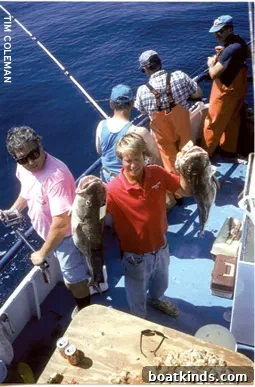
Passengers often sleep in bunks below or in the cabin during the transit, waking to coffee, breakfast and the horn that signals it’s time to fish. Most anglers use simple bottom rigs with one or two hooks baited with clam, lowered with a 12- to 16-ounce sinker. This method targets cod that patrol the seafloor and can range from small keepers to fish weighing 5 to 40 pounds. Others use an 8- to 12-ounce diamond jig tipped with a red tube, casting and letting it sink to the bottom before retrieving it back 20 to 50 feet above the wreck. Those faster-moving lures are frequently taken by pollock, which hunt higher in the water column than bottom-bound cod.
The trip typically runs until mid- to late afternoon, and captains often visit multiple wrecks to maximize anglers’ chances of a full cooler. Around 2 p.m. the fleet heads back to port; mates clean and ice fillets on the return so passengers disembark with ready-to-cook fish.
The Andrea Doria and Other Notable Wrecks
Among the most famous wrecks in this region is the Italian luxury liner Andrea Doria, a 630-foot ocean liner that sank after colliding with the 524-foot Swedish liner Stockholm on the night of July 25, 1956. Heavy fog and human error played central roles in the disaster. Both ships were visible on radar, but the captains misread each other’s intentions. The Doria attempted a port turn to achieve a starboard-to-starboard passing while the Stockholm turned starboard to try to create a port-to-port meeting. Instead, they steered toward one another. Visual contact came late, and despite last-minute evasive maneuvers, the Stockholm struck the Andrea Doria at about 11:10 p.m., leaving the great liner severely compromised and listing.
The Andrea Doria stayed afloat long enough for rescue efforts to save many aboard; ultimately 1,660 passengers and crew were rescued, while 46 people died. Film crews documented the sinking the next morning as the ship rolled and descended more than 40 miles south of Nantucket. Today she rests in roughly 240 feet of water and is often referred to as the “Titanic of New England” among wreck divers and historians.
Not all wrecks are identified. One reported site, known locally as the Oil Boat, lies in about 385 feet of water roughly 25 miles south of the Andrea Doria. Discovered by a Navy vessel during wartime sonar patrols, it reportedly rises some 40 feet off the bottom and still leaks oil. Beyond a brief report to the National Ocean Service noting its condition and charting its location, little else is publicly known.
World War I Losses and Other Historic Remains
Further south are five merchant ships sunk by the German submarine U-53 in October 1916. Although the United States and Germany were not yet at war, Germany sought to interdict supplies bound for Britain. In a single day the U-boat sank the Stephano, Blommersdijk, Christian Knudsen, Strathdene and West Point. These vessels lie roughly in a north–south line in 120 to 265 feet of water, 35 to 45 miles southeast of Nantucket’s Sankaty Head Light, and are regularly fished on overnight trips.
These named wrecks are only a portion of the sunken heritage offshore; many commercial fishing vessels and schooners also rest on the bottom, their timbers reduced over time to low profiles and scattered remains. Some losses involved heroic rescues, others tragic fatalities — stories that add to the area’s maritime lore.
For anglers, a day on the Lightship grounds offers more than the prospect of fresh fish. It’s a trip into history, where every bite comes from a place that once carried people, cargo and stories across the Atlantic. The ships no longer sail, but they continue to provide habitat, and they wait for fishermen to drop a line and see what pulls back.
This article originally appeared in the April 2012 issue.