
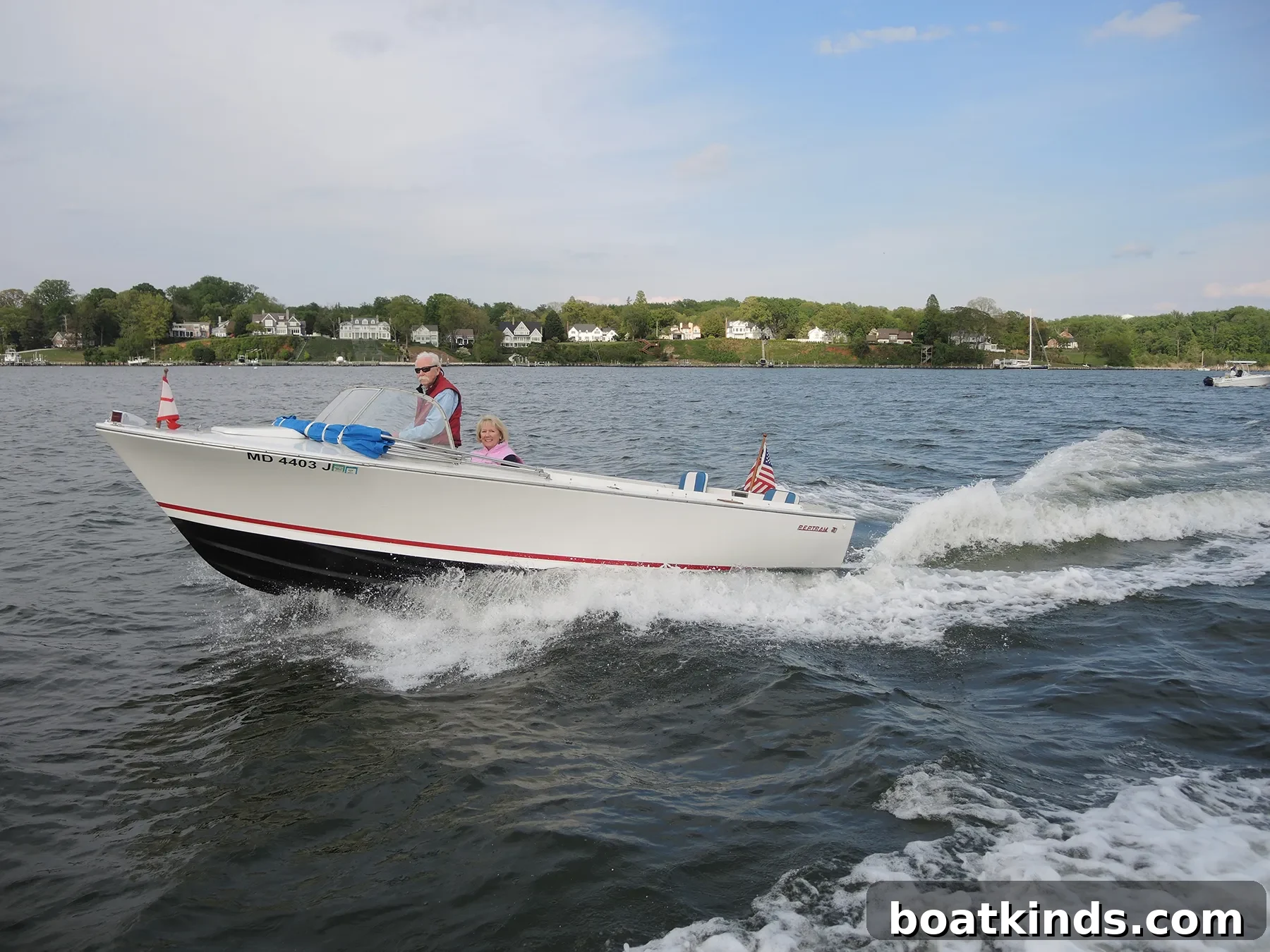
Charlie and Diane Ford came to boating by different paths but share a deep passion for being on the water. Diane’s interest began in childhood—her father was always afloat, and she grew up sailing Star-class sloops. Charlie discovered sailing later, after service in the Marine Corps and studies at the University of Maryland. A ride on a colleague’s Cal-25 hooked him, and he went on to buy his first J/24 in 1983, racing it competitively for decades, including two J/24 World Championship events.
Charlie’s first powerboat was a Correct Craft ski boat with a powerful engine and a fast planing hull, ideal for towing waterskiers on the broad rivers of the Chesapeake Bay. The couple’s connection to the iconic Bertram 20 Moppie came through a friend and neighbor, Bill Finagan, who kept his Bertram in the slip next to theirs during the 1990s. Finagan, a dentist who also flew a stunt plane, eventually offered the boat to Charlie, and the Fords purchased the 1965 Bertram 20—named Spirit—in 2000.
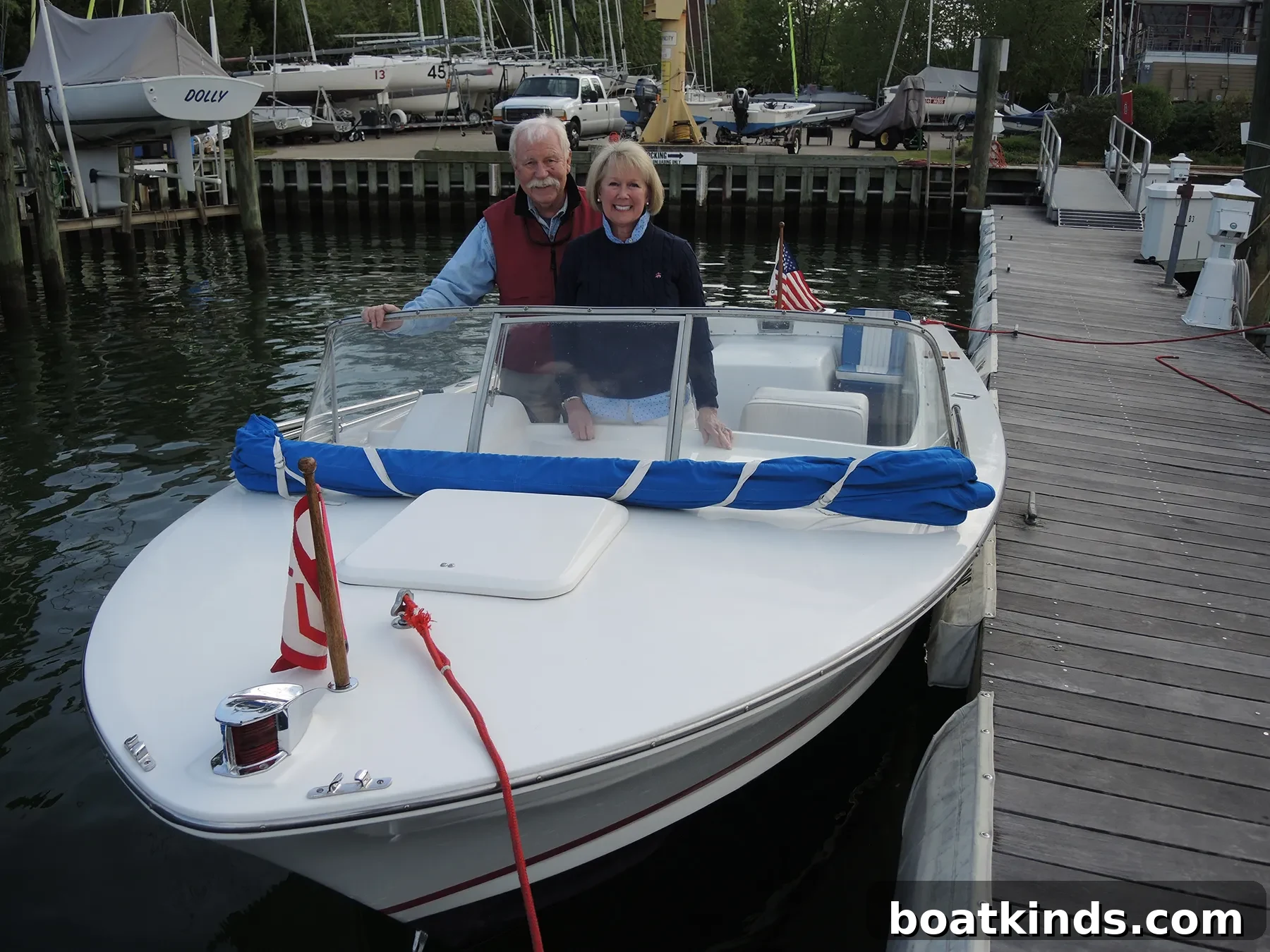
They were drawn to the Bertram 20’s distinctive lines and its pioneering hull design. Like many early Bertrams, the 20 Moppie employs a deep-V hull with a constant deadrise carried from just behind the stem to the transom. That hull form softens the ride when meeting waves at higher speeds—conditions that would otherwise produce harsh pounding in a flatter-bottomed boat. For a vessel of its size the Bertram 20 delivered an unusually smooth, confident ride and impressive performance, with top speeds that could exceed 35 knots at wide-open throttle.
Introduced in 1964, the Bertram 20 was produced in significant numbers—about 1,300 boats in a four-year span—and was offered in several layouts, including center-console, cuddy cabin, and an upscale dayboat powered by twin Baron engines. The Fords valued the model’s combination of speed, seaworthiness and classic styling, and set about restoring Spirit to preserve those qualities.
Originally kept at a marina near Annapolis, Spirit survived a major test in September 2003 when Hurricane Isabel drove an 8-foot storm surge through the Chesapeake Bay and swamped many boats, including theirs. A trusted mechanic rebuilt a replacement 165-hp MerCruiser engine from parts sourced from two engines recovered from an abandoned vessel. That rebuilt MerCruiser performed reliably for many years until a recent overhaul: the block was blueprinted, new alternator and pumps installed, and the Holley carburetor rebuilt, returning the motor to strong, dependable operation.
Choosing to honor the boat’s heritage, the Fords resisted modernizing Spirit with a higher-horsepower sterndrive or an outboard bracket. They preferred to retain the original MerCruiser power and the classic running attitude that make the Bertram 20 a true representative of its era. The boat still cruises comfortably and can reach the familiar 35-knot top end when pushed.
For hull and interior restoration the couple hired a skilled Eastern Shore craftsman. The restoration included soda-blasting decades of bottom paint back to the original gelcoat, repainting topsides and deck, restoring the instrument cluster, and replacing the analog gauges. The stainless-steel wheel now at the helm temporarily replaces the original thermoplastic wheel, which the Fords plan to restore to maintain historical accuracy. Ongoing work—canvas repairs, upholstery and cushions—keeps the restoration project active; even a 20-foot classic requires continual maintenance to remain shipshape.
With the MerCruiser ready for another season, the Fords plan relaxed cruises on local rivers, visits to Annapolis Harbor, and stops at preferred waterside restaurants with friends. When conditions turn choppy, they rely on Spirit’s deep-V hull and proven power to provide a safe, comfortable ride.
WALKTHROUGH
Boarding the Bertram 20 Moppie is straightforward thanks to its nearly full-length, gently flattish sheer—especially convenient from floating docks. The open cockpit is roomy enough for coolers, waterskis and other gear. The inner gunwale rises above the side deck, allowing snap-fit hardware for a cockpit tonneau, and storage beneath the gunwales keeps rods, paddles, dock lines and throwable cushions out of the way. A drained centerline locker in the cockpit sole provides additional stowage and drainage.
Seating is arranged to maximize open space in the cockpit: twin back-to-back seats forward and two removable seats at the stern that flank the engine hatch. Vinyl-covered cushions are practical and comfortable while maintaining a vintage appearance.
The windshield does not include an opening center panel, so access to the foredeck requires stepping over the relatively low screen. Behind it, the helm features a compact cluster of analog gauges, a single-binnacle throttle mounted to the right of the wheel, and trim-tab controls just forward. A glove box sits forward of the port seat in the dash, and a cutout beneath the foredeck provides legroom for both driver and passenger while also serving as convenient stowage for fenders and bulky items.
BACKGROUND
Bertram Yachts made a name for itself with the launch of the Bertram 31, its first production fiberglass model, debuting it at the 1961 New York Boat Show. That design drew heavily on Moppie, a custom wooden powerboat by naval architect C. Raymond Hunt that earned fame by winning the 1960 Miami–Nassau race. Bertram became known for rugged, well-engineered boats that handle offshore conditions confidently. Today the company continues to produce a range of models spanning several sizes, carrying forward a legacy of seaworthy design and solid construction.
This article was originally published in the July 2023 issue.