
International Folkboat (IF): History, Design and Enduring Appeal
The International Folkboat—commonly referred to as the IF—occupies a distinctive place in small-boat history. Often confused with the earlier Nordic Folkboat, the IF is a separate fiberglass adaptation created to capture the seaworthiness and beauty of the older clinker-built design while offering the advantages of modern materials and production techniques. Because of recurring misidentification, the IF’s clear identity is worth restating: it is neither the original Nordic Folkboat nor a regional variant; it is a deliberate, well-documented design born in the 1960s.
Origins and Development
In 1967 the Swedish shipyard Marieholms Bruk commissioned designer Tord Sundén to develop a fiberglass version of the Nordic Folkboat. Sundén was already respected for his role in shaping the Nordic Folkboat during World War II, when he consolidated the best features from a design competition into that now-classic boat. His work on the IF carried that legacy forward, translating the gentle overhangs and seaworthy hull shape into a form suitable for fiberglass construction. Although the Swedish Sailing Association required the name be changed for clarity in Europe, the boat quickly became known worldwide as the IF.
Design Characteristics
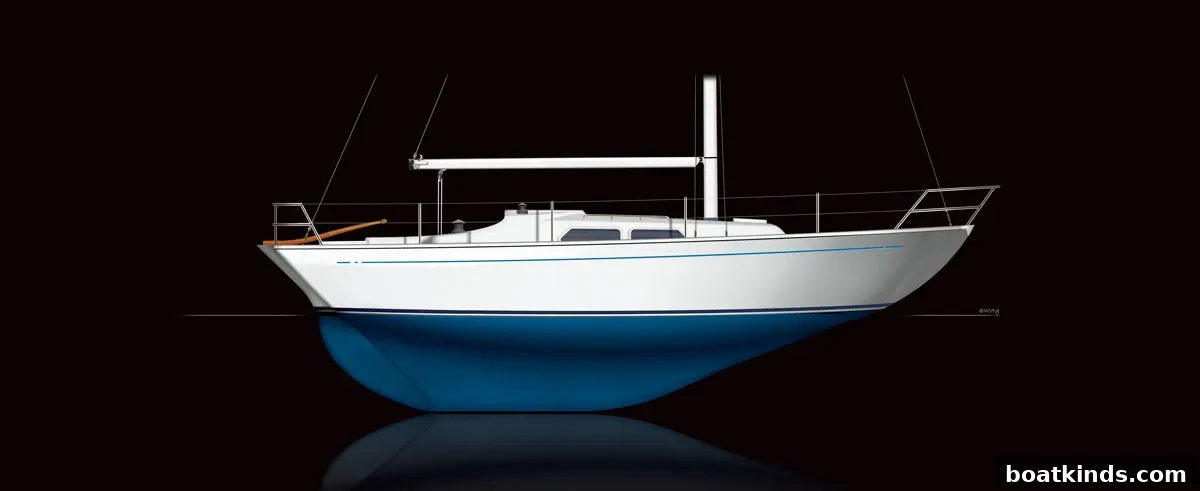
The IF is an all-purpose sloop featuring a full keel with a skeg-mounted rudder and a fractional rig. At 25 feet 10 inches overall, with a four-foot draft, the IF carries substantial ballast—about 2,750 pounds—equal to more than half of its nearly 5,000-pound displacement. Those proportions contribute to a steady, forgiving motion at sea, which made the boat a favorite among sailors who valued safety and predictability in challenging conditions.
Construction in fiberglass allowed for more consistent builds and lower maintenance compared with traditional lapstrake wooden craft, while keeping the graceful lines and overhangs that appealed to enthusiasts. Masts were typically extruded aluminum, steering was by tiller on all original boats, and propulsion came from either a small single-cylinder inboard engine or an outboard mounted on the transom or in a well. Practical features included a cockpit self-bailer and a compact, efficient interior layout.
Accommodation and Use
Belowdecks the IF offers two forward berths plus two settee-style berths in the main cabin. While headroom is limited—about 4 feet 8 inches—the arrangement provides modest overnighting capability, storage to both port and starboard, a stove and a marine head. Practical Sailor once quipped that the headroom was “ideal for those wonderful creatures of Scandinavian folklore: elves,” a humorous nod to the cozy accommodations. Despite the compact cabin, the IF proved versatile: owners used it as a racer, daysailer and for short coastal cruising.
Racing and Community
The IF achieved one-design class certification and attracted active racing fleets around the world. Its combination of seaworthiness and responsive performance made it competitive in a variety of conditions—able both to handle heavy weather and to move nimbly in lighter airs. Roughly 125 IFs were shipped to the United States, where the design found particular favor in places like San Francisco Bay, known for its strong winds and demanding conditions.
Legacy and Revival
Production of the IF was extensive: more than 3,400 boats were built in Sweden before production ended in the mid-1980s. Even after mass production ceased, the design’s reputation endured; as late as 2017 there were still around 1,800 IFs sailing in Sweden. The boat’s influence reached beyond its own class—some later designs, notably the Contessa 26, share clear hull lineage or stylistic kinship, and sailors such as Tanya Aebi famously sailed comparable boats on long voyages.
Interest in the IF has seen a resurgence in recent years. In 2018 a German builder, Seacamper, restarted production, responding to renewed appreciation for the IF’s combination of classic lines, solid sea manners and practical usability. Today the IF continues to attract sailors who want a small cruiser that balances tradition and practicality, offering a rewarding sailing experience without excessive complexity.
This article was originally published in the March 2022 issue.