
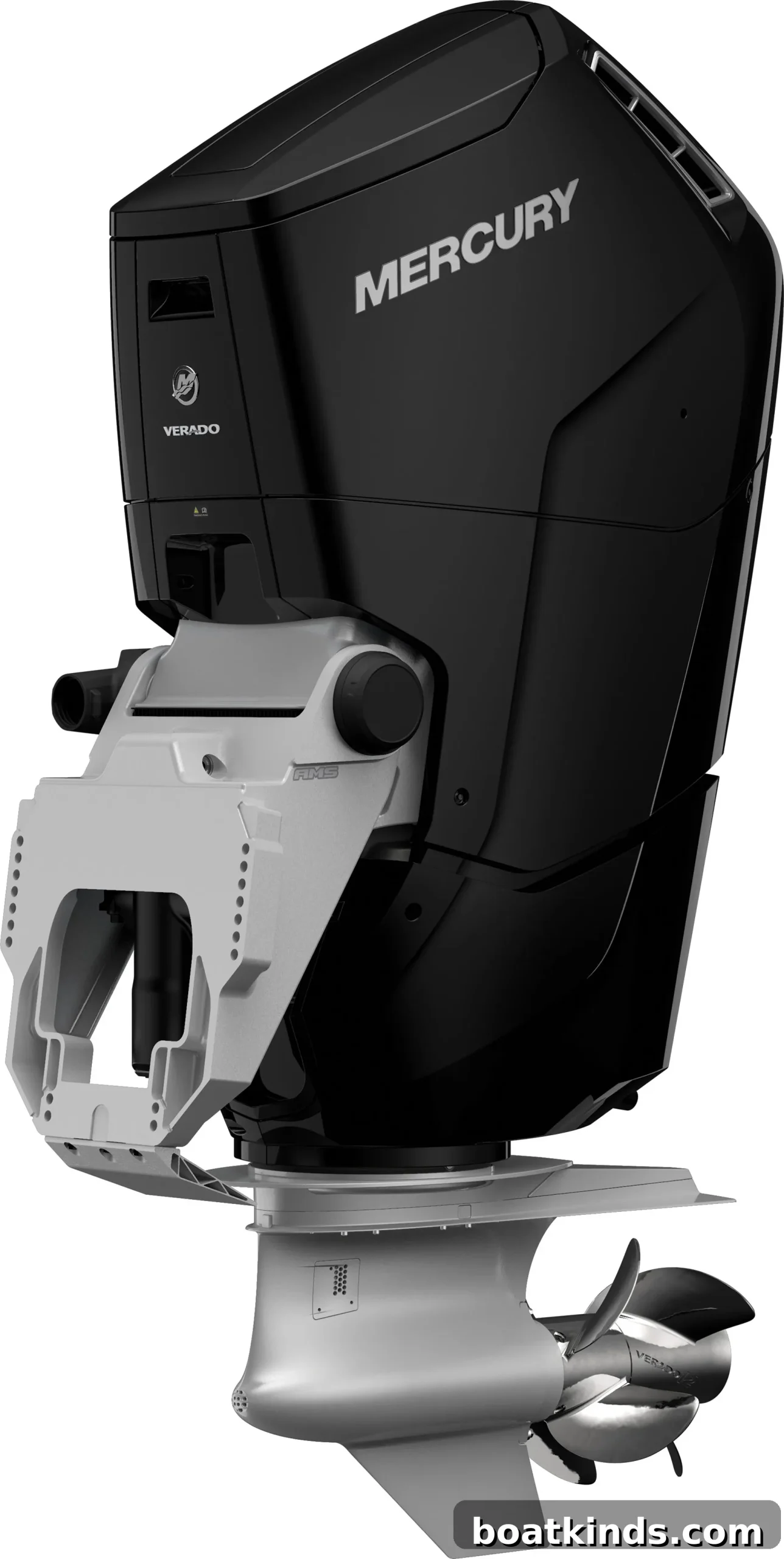
The Mercury Verado 600 is nominally an outboard—because it mounts to a boat’s transom—but in every other respect it represents a major leap forward in outboard motor design. Over the last century the basic outboard layout has changed little, yet the Verado 600 combines a host of modern engineering solutions that could reshape how large boats are powered.
On paper it’s striking: a 7.6-liter V12 producing 600 horsepower and driving contra-rotating propellers. But the Verado 600 is more than raw power. It integrates a two-speed automatic transmission for improved hole-shot and efficient cruising, a steerable gearcase that pivots independently of the powerhead, and a service-friendly cowl that opens like a luxury car hood. Quiet at idle and near-silent at speed, its performance, refinement and high level of engineering match the million-dollar center consoles and dayboats it will likely propel. The projected price—around $77,000—reflects that ambition.
“We’ve dedicated substantial investment and years of effort toward enhancing our ability to turn highly creative ideas into practical, functional and dependable solutions,” said Tim Reid, Mercury Marine vice president of development and engineering, referring to the roughly $1.5 billion Mercury has invested in R&D and manufacturing expansion since 2008. The Verado 600 is the result of that long-term effort.
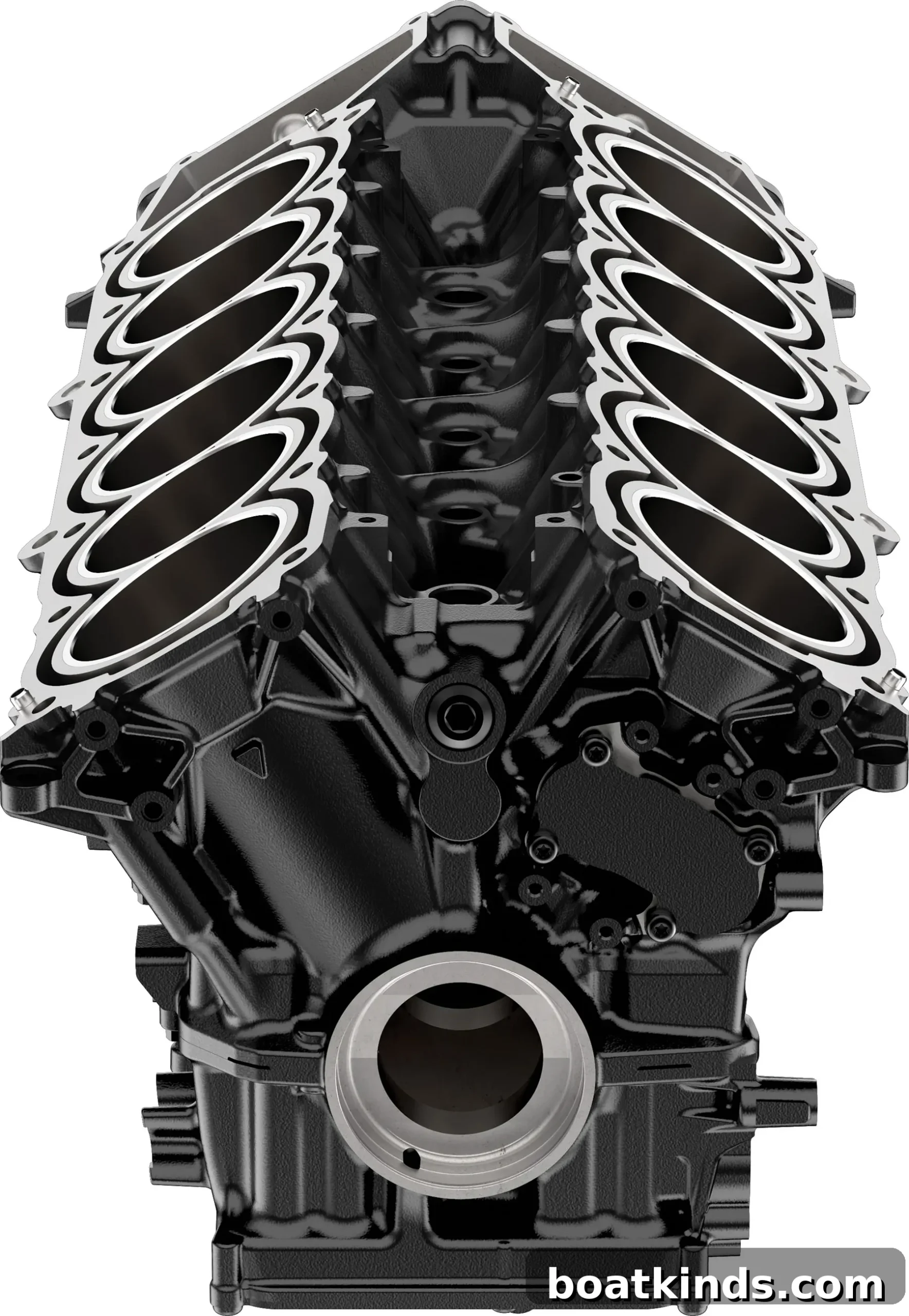
V12 Configuration
The Verado 600 shares architectural elements with Mercury’s 4.6-liter V8 introduced in 2018—features such as a 64-degree cylinder bank angle, double overhead camshafts and four valves per cylinder. The V12’s bore and stroke are larger than the V8’s, and while the V12 powerhead is slightly wider, Mercury maintained 27-inch center-to-center spacing to allow multiple engines to be mounted side-by-side on a transom, one of the team’s primary design goals.
A key benefit of the V12 layout is inherent balance: primary forces cancel out, producing exceptionally smooth operation. The powerhead is mounted to an Advanced MidSection (AMS), an aluminum halo with four elastic mounts similar to those used on Mercury’s inline six Verado models. These mounts isolate vibration from the boat. Mercury also repositioned the trim/tilt pivot farther aft so the Verado 600 can tilt fully within the same motor well designed for Mercury V8s—an advantage for boatbuilders. To meet the electrical demands of larger boats, the alternator produces 150 amps.
Two-Speed Transmission
Beneath the powerhead sits a multi-clutch, two-speed automatic powershift transmission designed by Mercury and built in Italy by ZF Friedrichshafen AG. First gear provides about 20 percent more torque than second gear, with prop-shaft ratios of 2.95:1 in first and 2.50:1 in second. Those gear ratios are significantly lower than those used in smaller Verado models and are designed to multiply torque for the contra-rotating propellers, making it easier to plane heavy boats and maintain low-speed control.
Shifting is managed automatically by the engine controller based on torque demand. In multi-engine installations each engine shifts independently; Mercury intentionally staggers shifts by fractions of a second so transitions feel seamless to passengers. The system can downshift automatically—much like an automobile—when additional torque is required for acceleration. Aside from selecting forward, neutral and reverse, there is no manual gearbox control.
Dual-Prop Gearcase
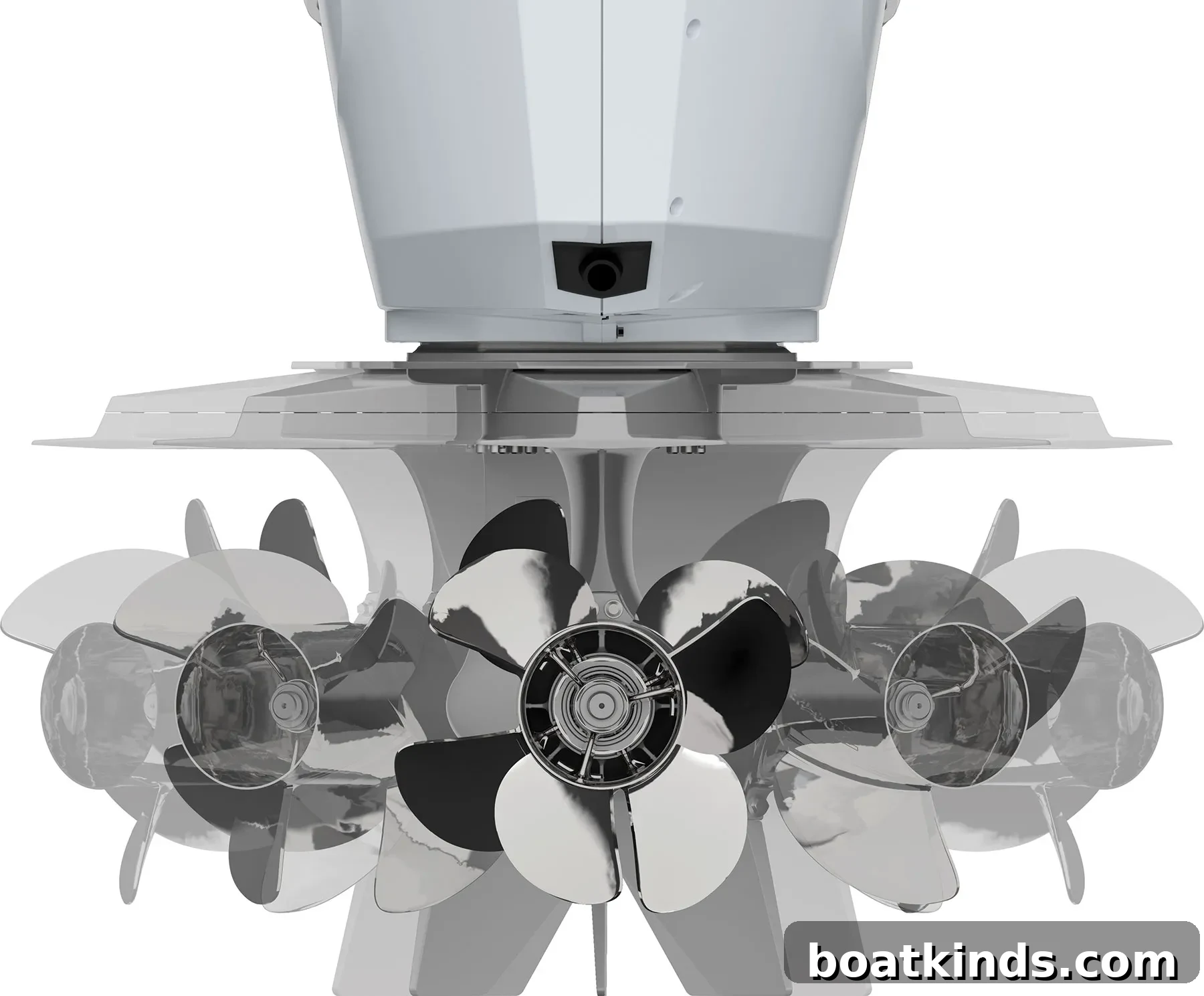
Mercury developed the Verado 600’s contra-rotating propellers to maximize blade area while keeping rotational speed and drag down. The forward prop has four blades and the aft prop three, a configuration chosen to capture and re-use the swirling energy generated by the front prop—known as “swirl recovery”—rather than letting that energy dissipate outward. Front and rear propellers have different shapes and diameters, and nine prop sets are available with pitches ranging from 23 to 37 inches.
The low gear ratios allow relatively large pitch values without excessively high prop rpm, improving propulsive efficiency and cruise speed. Front diameters range roughly from 18.25 inches (low-pitch props) down to 16.5 inches (high-pitch), while rear diameters range from about 16.75 to 15.0 inches. Because the transmission handles all shifting, the external gearcase is only about six inches in diameter—far smaller and more hydrodynamic than the large gearcase a single prop with equivalent blade area would require. Average propset cost for the Verado 600 is estimated at around $3,300.
Steerable Gearcase
The Verado 600 steers by pivoting the gearcase alone; the powerhead remains fixed. This design eliminates boat-mounted steering linkages, allows engines to be installed closer together, and provides greater steering range. In joystick mode the gearcase can swing up to 45 degrees to either side—compared with roughly 30 degrees for traditional outboards—granting more low-speed authority over heavy boats. At higher speeds the steering range is limited to about 30 degrees. The helm’s digital commands are converted to hydraulic action in a steering rack inside the engine, producing pod-drive–like responsiveness without moving the heavy powerhead.
Ease of Maintenance
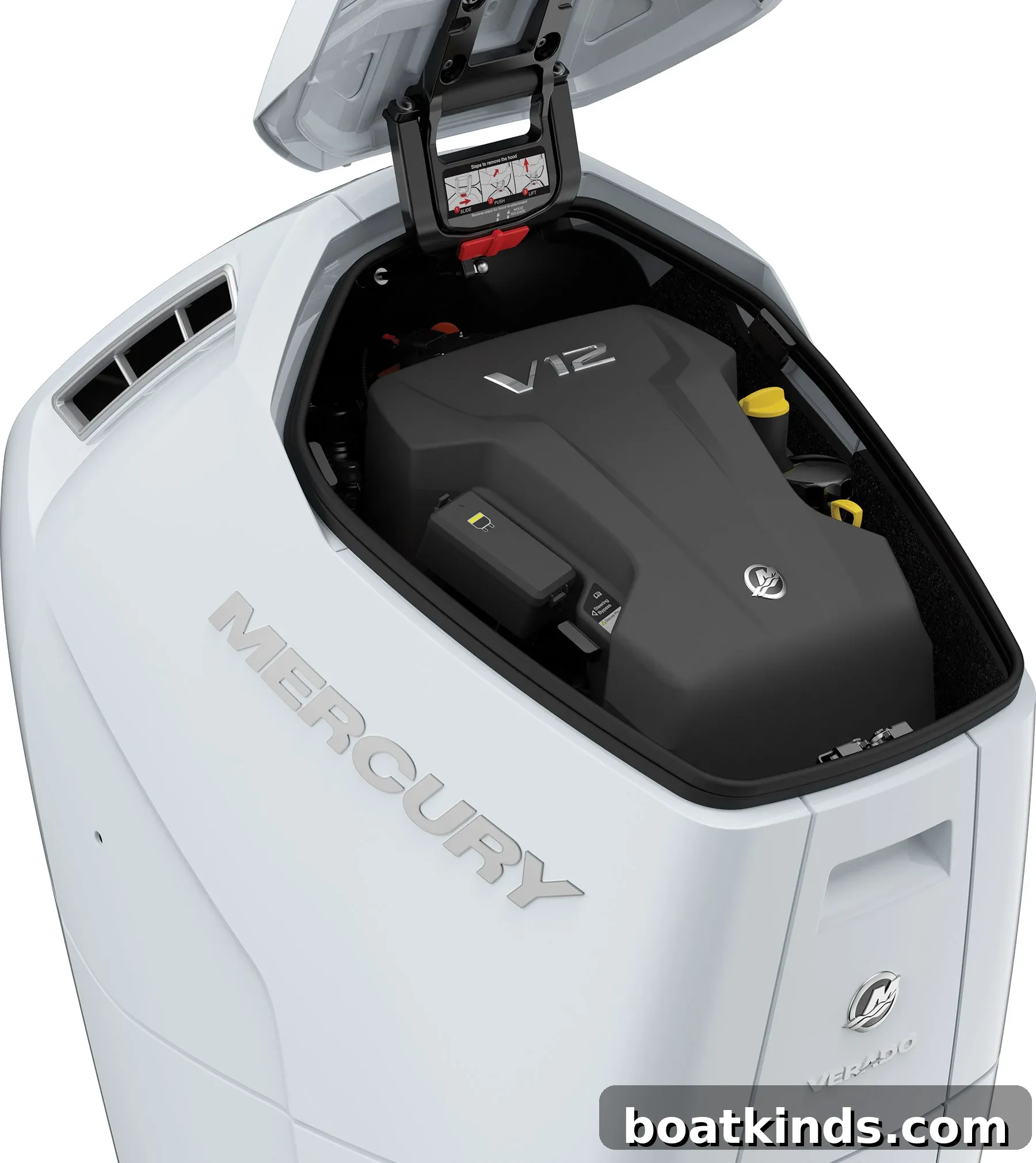
Understanding that a large outboard must still be serviceable, Mercury engineered a top hatch in the cowl that provides access to all items required for routine maintenance up to 200 hours: oil dipstick and fill, oil filter, and dipsticks for gearcase lube and transmission fluid. Each dipstick tube accepts a snap-fit extraction pump for fluid removal. Engine oil capacity is 14 quarts—one reason Mercury recommends 200-hour intervals when using fresh synthetic oil. The full cowl comes off for more extensive service at about 1,000 hours or five years to change spark plugs and service the water pump, which is intentionally oversized for durability.
Mercury also introduced Next Gen Digital Throttle & Shift (DTS) controls with the Verado range. The Premier DTS binnacle features improved ergonomics and an integrated display that reports system status and maintenance information.
Bigger and Bigger
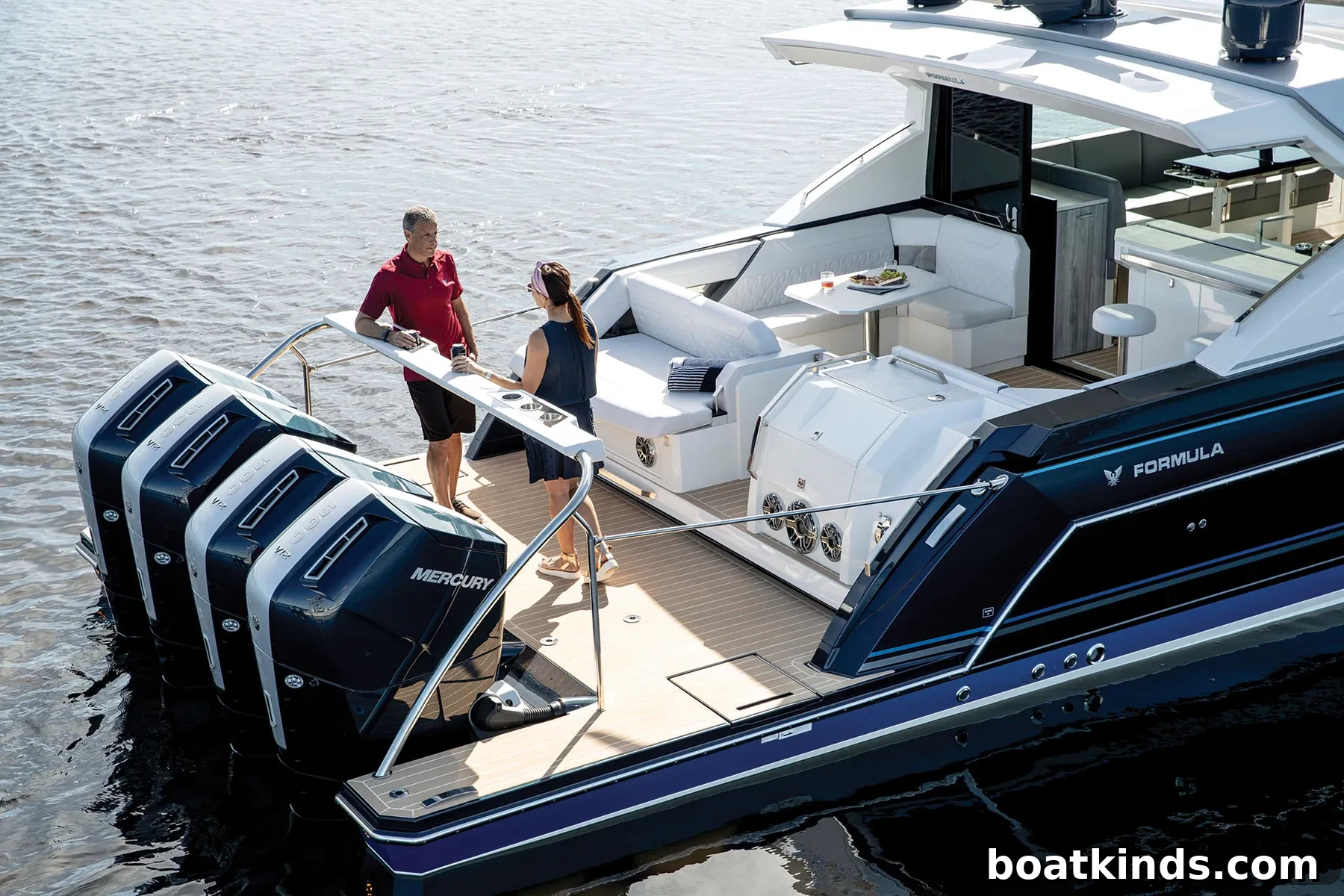
The Verado 600 is intended to reduce the number of outboards required on large boats: three Verado 600s could replace four Verado 400s while delivering greater total power, lower hydrodynamic drag and many advanced features. That concept mirrors earlier high-power outboard efforts but is backed by Mercury’s significant resources. A trade-off is weight: a Verado 600 is roughly twice as heavy as a Verado 400, so total engine weight increases—often by more than 1,000 pounds in that example—though that may be acceptable on larger vessels.
Mercury expects the Verado 600 to find a home on boats over 60 feet LOA, and it’s also available in a 20-inch shaft length for larger pontoons and other platforms that require a shorter installation. The Verado 600 delivers a combination of high horsepower, refinement, and modern outboard technology that many boat owners now demand.
Specifications:
Type: 64-degree V12 four-stroke
Displacement: 7.6 liters / 464 cubic inches
Bore x Stroke: 3.8” x 3.4”
WOT RPM Range: 5600 to 6400
Fuel Requirement: 87 octane
Final Drive Ratio: 2.97:1 / 2.5:1
Alternator Output: 150 Amp
Dry Weight: 1,260 pounds
Available Lengths: 20”, 25”, 30”, 35”
This article was originally published in the April 2021 issue.