
Jamie and Joe Lowell continue a family tradition of building Down East boats designed for work and pleasure.
At the Maine Boatbuilders Show in Portland this spring, I watched a video at an exhibitor’s booth of a classic 34-foot wooden lobster boat named Osprey running at about 30 knots, cutting through a 1-foot chop with virtually no vertical motion.
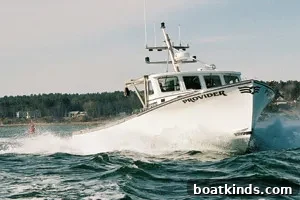
What struck me, besides the boat’s smooth ride, was how steady the footage looked. I assumed it had been shot with a stabilized camera from a car along a causeway. When I asked about the gear, the exhibitor said the camera was a basic hand-held with no stabilization. The secret, it turned out, wasn’t the camera — it was the boat. The photo boat was a Lowell Brothers 26, built by Jamie and Joe to their Uncle Royal’s design. The 34-footer in the video was a design by the brothers’ great-grandfather, Will Frost, from the 1940s. Frost also built famed rumrunners in the 1920s and ’30s — “brutal things with a tremendous amount of horsepower,” as one observer put it.
If you’re fed up with wide, flat, inefficient planing hulls that throw you around, there are more seakindly alternatives. Welcome to Maine: a place where classic design, modern materials and powerful engines combine to produce boats that handle the sea with grace.
The Lowell family’s boatbuilding roots run deep. Will Frost pioneered many designs through the first half of the 20th century, from lobster boats and draggers to rumrunners and commuter yachts. Riley Lowell became his right-hand man and son-in-law, eventually passing knowledge to Royal and Carroll Lowell. Royal and Carroll built reputations as designers and builders whose lines shaped dozens of production Down East boats still in service today.

Many recognizable Down East models trace back to the Lowells’ designs: Royal’s Bruno and Stillman range of 35-, 42- and 55-footers; J.C. Boatworks’ 31 and 35; Harris 35 and 38; the Sisu 22, 26 and 30; the Newman 46, 38 and 30; and the Holland 32 and 38. These boats earned reputations for comfort, steady motion in heavy weather, and dependable construction across sizes from small workboats to large yachts.
In 1997 Carroll’s sons Jamie and Joe formed Lowell Brothers, working from the family’s long-standing facility in Yarmouth, Maine. They began by making molds and handling repairs and maintenance; over time they grew into custom construction and production tooling. Today they operate with a small five-person crew, producing custom fiberglass and occasional plank-on-frame boats, while expanding their own production line.
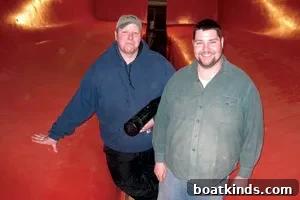
Their production models include 22- and 26-footers based on Uncle Royal’s designs, a 43-footer by their father Carroll, and a new 38-foot model designed by Jamie. Hull No. 1 of the 38 is currently being laid up; the brothers anticipate launching the first 38 in late summer, depending on fit-out choices.
Business has slowed recently due to a chain of market disruptions tied in part to reduced processing capacity in Canada and a decline in demand for Maine shellfish. That drop in demand has affected New England fishermen — the core customers for many Maine builders — and small shops like Lowell Brothers. The brothers report interest from West Coast fishermen and hope that will translate into more orders.
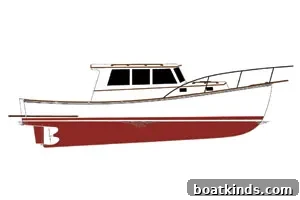
Despite a softer market, the first 38 is sold and the brothers hope it will spark new commissions. A few years earlier, between 2004 and 2006, Lowell Brothers produced eleven 43-foot boats in rapid succession, demonstrating their capacity when demand is high.
The new diesel power
Modern diesel engines have reshaped Lobster boat design. Decades ago I ran a 1975 Royal Lowell–designed 42-foot Bruno and Stillman powered by a 265-hp Detroit Diesel 6-71. It cruised comfortably at about 12 knots and consumed roughly 35 gallons on a day of back-to-back charters. Back then, faster boats required much heavier engines: a 350-hp Detroit 8-71 weighed around 3,300 pounds and delivered higher speeds.
Today’s lightweight, high-output diesels let builders achieve far greater performance without dramatically increasing engine weight. The first Lowell Brothers 38 is fitted with an 800-hp MAN that weighs roughly the same as a vintage 6-71 but produces nearly three times the horsepower. Coupled to a two-speed ZF transmission, a 2.5-inch shaft and a large four-blade prop, Jamie expects the 38 to top 30 knots and be highly efficient in the 20-knot range — demonstrating how bigger, modern engines can both increase speed and improve economy at common cruising speeds.
In these designs the engine sits as low in the hull as the transmission and oil pan permit, often down in a hollow keel. A low engine placement creates a low shaft angle — roughly 7 degrees on the Lowell 38 — which improves efficiency and reduces vibration. Keeping the engine and fuel low also lowers the center of gravity, improves stability, and keeps workboat decks closer to the waterline where practical.
More beam, less weight
Beam has increased on many Down East boats over the years. Wider hulls offer more payload and interior volume, which appealed to commercial fishermen and owners seeking more liveable space. But increased beam can reduce seakeeping and efficiency for a given hull volume. Modern high-horsepower engines make broader hulls practical because they can plane more easily when lightly loaded, offsetting some of the penalties of added beam.
Contemporary designs also carry more beam aft compared with earlier narrower-stern plans. At higher speeds a boat can better control its interaction with waves, reducing some of the motion problems that older, more buoyant sterns experienced at displacement speeds.
Weight-saving construction techniques are equally important. The 38’s one-piece deck and superstructure use a single carbon-fiber layer wet out in epoxy on both faces of Core-Cell coring (1-inch in the sides and trunk cabin, 1.5-inch in the house top). This approach replaces two conventional layers of 1808 fiberglass, dropping the deck weight from about 1,600 to 1,050 pounds while increasing stiffness. Reducing weight above the center of gravity decreases roll and improves both performance and payload capacity.
The hull uses Core-Cell foam-cored construction as well, resulting in a lighter, stiffer, stronger hull than earlier iterations. Laminate schedule begins with a Valspar BlushGuard gelcoat, followed by 1.5-ounce mat, multiple layers of non-woven fiberglass, the foam core, and additional fiberglass layers. Each hull side is laid up separately, then joined; the keel area is solid glassed up to three-quarters of an inch for strength where through-hull fittings attach. Vinylester resin is used throughout the layup for its blister resistance and durability.
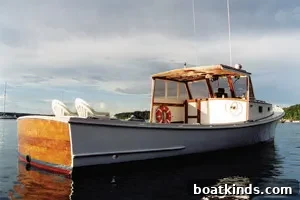
The Lowells pay close attention to noise and vibration control. Engines mount on a 7-foot aluminum channel bonded to the engine bed, which ties into the main hull stringers and is beefed up around the engine area. This creates a solid, vibration-attenuating foundation and simplifies future repowering by providing a consistent mounting structure. Each engine has one forward and two aft mounts per side to spread loads and reduce vibration. The pilothouse deck is cored with 1-inch Core-Cell foam and combined with sound-deadening materials in the engine room to contain noise.
Under way
Lowell boats are built to be used in real conditions: the rougher the better. These are not harbor cruisers or “floating gin palaces.” Jamie emphasizes that while looks matter at the dock, a boat’s true value is how it moves through waves and sheds water. The brothers take pride in clean wakes, quick plane times and comfortable seakeeping.
Owners and passengers often discover that they will use their boat more once they experience the comfort at speed in rough seas. Jamie enjoys taking people out and watching their reactions when running one of their boats at 20 knots in six- to eight-footers; many are surprised by how quiet and stable the ride feels.
Although Jamie and Joe value custom one-off builds for the creative freedom they allow, they are intent on reintroducing new Lowell production models that combine modern materials, higher horsepower and proven lines. The Lowell name still carries weight with owners who value offshore capability and resale value rooted in a long tradition of thoughtful design and rugged construction.
I saw this firsthand the morning after my visit, when I ran a 43-footer the Lowells had built with a 600-hp Deutz, capable of a 22-knot top end. It felt like a faster, quieter evolution of the 42-foot Bruno I knew, comfortable even running at 20 knots into three- to five-foot seas. In a market that values wider, roomier and faster boats, Jamie and Joe have shown they can deliver vessels that are truly made for the ocean.
Eric Sorensen was founding director of the J.D. Power and Associates marine practice and is the author of Sorensen’s Guide to Powerboats: How to Evaluate Design, Construction and Performance. A longtime licensed captain, he can be reached at [email protected].
This article originally appeared in the June 2009 issue.