
Power Ski and the Evolution of Personal Watercraft
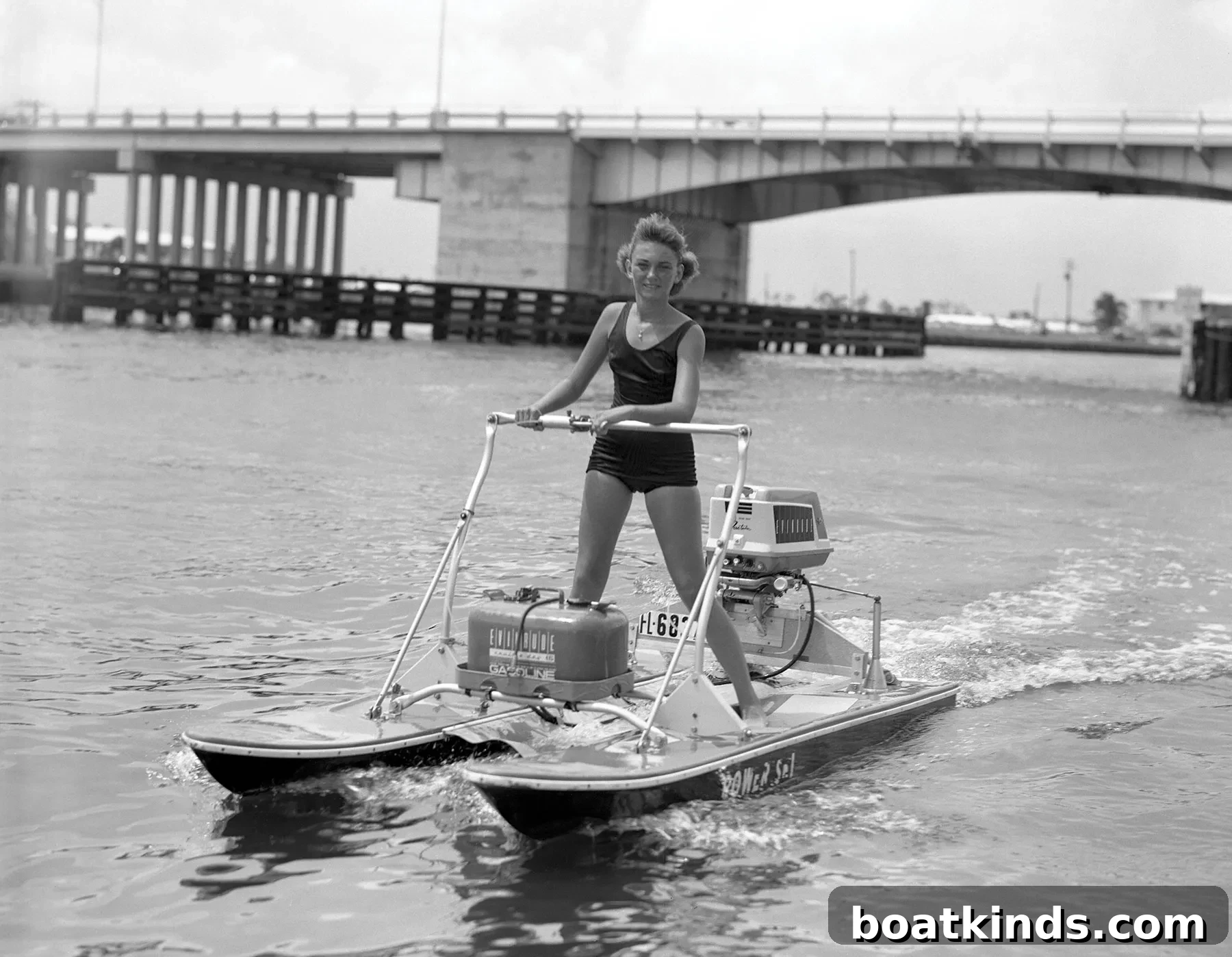
The Power Ski, shown above, occupies an important place in the evolution of personal watercraft. Though less well known than later machines such as the Kawasaki Jet Ski, the Power Ski represents a clear technological and cultural bridge between the early aquaplanes of the 20th century and the self-propelled recreational watercraft that followed.
Aquaplaning: the early excitement
Aquaplaning reached its greatest popularity during the 1920s and 1930s as a competitive and recreational pursuit. Riders stood or lay on relatively simple flat boards—often rectangular—and were towed behind motorboats at high speeds. One notable example from that era is a 1938 international competition off the coast of Southern California, where thirty participants raced from Catalina Island to Hermosa Beach along a 44-mile course. Riding rectangular aquaplanes towed by boats, competitors pushed speeds that made the sport both exciting and dangerous; Frank Roediger was declared the winner of that event with an average speed reported at about 26 knots.
The Power Ski: a self-propelled step forward
By 1960, inventors and enthusiasts began experimenting with ways to free the rider from the tow boat. The Power Ski, developed by Fort Lauderdale marina owner Fred Guiliano, was a notable result. Instead of a single flat board, Guiliano’s craft used a twin-pontoon layout that offered buoyancy and relative stability. The propulsion system was a conventional outboard mounted on the stern, and a fuel tank sat toward the bow, integrated into the craft’s layout. Steering was accomplished with a handlebar-style control, giving the rider a more intuitive and motorcycle-like interface than a traditional aquaplane setup.
Guiliano’s wife Anna is pictured in period photographs steering a Power Ski near the Oakland Park Boulevard Bridge. To manufacture and market the idea, Guiliano established the Oakland Marine Company. Despite the soundness of the concept, practical problems with available components and the challenges of mass production limited commercial success. Although the Power Ski did not become a mainstream product, it demonstrated several important ideas—self-propulsion, compact handling, and a rider-focused control scheme—that would reappear in later designs.
From Power Ski to Jet Ski: a design revolution
The next major leap came from a very different source. Clayton Jacobson II, an engineer from Southern California, set out to create a “motorcycle for the water.” After recovering from a motorcycle crash, Jacobson reimagined what a personal watercraft could be. His prototype, first developed in the mid-1960s, departed radically from both the aquaplane and the pontoons-of-the-Power-Ski. Jacobson’s design favored a stand-up riding position and motorcycle-style handlebars—one of which also operated the throttle—creating a single-operator, highly maneuverable craft.
Crucially, the Jacobson prototype employed a jet-drive system rather than an exposed propeller and outboard motor. This jet propulsion removed the bulky, vulnerable propeller and reduced some of the risks associated with exposed rotating parts. The fuel tank and other components were incorporated into the craft’s body to present a cleaner, more compact profile. In 1973 the model that became widely known as the Jet Ski arrived on the market and eventually found a large audience.
Legacy and modern personal watercraft
The Jet Ski’s commercial success helped create a new category—personal watercraft (PWC)—that has since grown substantially. The National Marine Manufacturers Association estimates there are roughly 1.1 million PWCs in the United States today, a sign of how the market expanded from simple towed boards and early experimental craft. Modern PWCs range from small, single-rider machines to powerful multi-passenger models. Current high-performance versions can be rated at 300 horsepower and carry four people at speeds approaching 60 knots, illustrating how far the technology has advanced from the modest Power Ski.
Although the Power Ski itself did not dominate the market, its contribution is meaningful: it demonstrated the viability of a compact, rider-centered, self-propelled craft and helped point the way toward designs that prioritized handling, safety, and autonomy. The progression from aquaplane to Power Ski to Jet Ski shows a steady evolution in thought and engineering that reshaped recreational boating and created a whole new leisure category.
This article was originally published in the February 2021 issue.